I. The Invisibility of the Trade
I ’m so glad I got out of the cab business. When I look back now, I realize everything happened in the exact order it had to. What felt like chaos was actually a well-structured line of dominoes, falling toward something good waiting for me at the end.
Seattle in 1985 was electric. A wave of people had just migrated from the neighboring states, and I could hear the drums of the coming tech boom loud and clear I couldn’t quite figure out how it connected to the last of the Yuppies yet, and though I had "parked" the idea of chasing success, the impulse was still there—even if the blueprint remained hidden. I felt like I still had time to just look around.
It had been two years since I walked away from my third year of law school. I still had my youth and my good looks. To the old-timers at the cab lot, I must have looked like an imposter—someone just looking to grab a few dollars before fleeing the trade. To be fair, that was the plan. I just hoped I’d get out before I turned into Alex Rieger from Taxi.
Still, while I was in it, I tried to make the best of it. I had fun—sometimes. I made it exciting. I had my share of accidents and "rough" shifts, feeling the specific physical ache of chasing a dollar and the mental strain of absorbing other people's perspectives. The list went on, but one fear loomed over it all: the terrifying thought of driving a taxi permanently.
At first, I tried everything. I worked every neighborhood, picked up anyone, and survived the night shifts. But little by little, a cloud of wisdom began to settle over me. No matter your outlook or your unspoken philosophy, you become a sharper observer—a bit of a street-corner philosopher—the moment you truly depend on the cab for your life. I began to celebrate my invisibility. I could tell if a couple walking down the steps of the Opera House were cousins or not just by the way they moved. I could spot the guy who was only doing a favor by the light, hesitant touch of the girl." Her boyfriend must be somewhere in this crowd," I’d tell myself. It didn't end there—at least not for me. I began to feel a strange sense of power. It was something I could somehow redirect, though I didn't quite understand it yet. I felt connected to everyone, even the ones who stood against me. I was magnetized. I searched for a reason for this shift until it finally hit me: I had silently stripped the "reason" away from everything. That was the realization that was lifting me. I started to view the whole of downtown like a cage—but I was viewing it from the outside. I felt like I could reach out and touch it. Displace it. It must have started after that trip to Tijuana.
II. The Blueprint and the Gambler
"Whose wedding is it?" I asked. "Wren and Tracey. And it’s an engagement celebration, not the wedding," Beatrice replied. It sounded odd. I wanted to ask "who was who," since both names were neutral, but I caught myself. I wouldn't know them anyway. Besides, I had always found engagement parties to be bigger and noisier than the weddings themselves. I was looking forward to a week of that brand of excitement in Anaheim; Beatrice's entire family was going to be there.
"Don’t forget your bible," Beatrice said, pointing at the book on the coffee table. It was Musical Thought by Carlos Chavez. I had covered it in plain brown paper so no one could "accidentally" read the title. "Don’t leave home without it," she continued teasingly, mimicking the American Express commercial.
The book was, in truth, a blueprint for rediscovering the world around me. It was a string of light flickering through Chavez’s theories on music. He touched on the symmetry and order of our world, linking our deepest passions to the very nature of sound. It had moved me. I’d had the book for months and still hadn't made it halfway through; I would read a few pages, stop, and then go back to read them again. I wasn't sure why, but as much as the book was becoming my lighthouse, I was afraid of the ending. I had a nagging feeling that Chavez might say something in the final chapters so demoralizing it would force me back inside the cage—the one I was finally starting to view from the outside.
I don’t know if Beatrice had warned them, but no one at the party asked about me quitting law school or driving a cab. I sensed they weren't avoiding the topic for their sake, but out of a misplaced consideration for mine. Small talk about failure and grit didn't suit a crowd like this.
For three days, I drowned myself in the frantic energy of Southern California, drifting between L.A. and Orange County.
I had lunch in Tustin, got lost near Sunset Boulevard trying to find my way back to Santa Monica, drank French coffee in L.A., and made a point of avoiding Long Beach. I knew that sooner or later, someone would suggest a trip to Vegas. I just didn't expect the suggestion to come from Sam, Beatrice’s brother-in-law.Sam was a successful recruiter. He charged companies $275 an hour and paid his programmers $40. I didn’t even want to do the math; I just took my hat off to him. But there was no way I was going to Vegas with them—not after what had happened in Reno a few months prior.
In Reno, I’d had to play the role of a rescue party for three other cab drivers. Two of them had lost their lives—metaphorically and miserably—at the roulette and blackjack tables. Only one came out a winner playing poker, and I’d practically dragged him to a Western Union to wire five grand of his winnings home to his wife before he could lose it back.
It was like a hit-and-run scene in a movie: you never knew who would stay to help and who would run.
I didn't want to imagine Beatrice’s brother-in-law dropping his son’s college tuition on a craps table, yet I felt guilty for accusing him of a sin he hadn't committed yet. I always felt like I could play a game of chess and win, but the mere scent of defeat terrified me. As much as I worried about Sam, there was no way I was following them to Nevada.III. The Sanctuary of the Border
I wasn't worried about Beatrice, and I didn't dare speak to her about Sam. I convinced myself it was only my own pronoia—that strange, creeping suspicion that the universe is actually looking out for you—which had settled over me after the Reno trip.
I had the rental car all to myself now, and I tried to let go of my anxieties. I finally found my way to Sunset Boulevard, trying to conjure up the ghosts of 77 Sunset Strip. I didn't want to go anywhere I wouldn't go without Beatrice, so I stuck to the margins: walking the beach at San Clemente and driving aimlessly. On my second night, the urge to explore took over, and I pushed further south. That’s when I saw it.Just past San Diego, a sea of calm, dancing lights stared back at me from a hillside. I kept driving until the big signs loomed over the highway. I took the last exit and tucked the car into a small, nondescript lot. After a short walk, I reached the iron revolving door—the kind you’d see in a New York subway station. There was no one there to check IDs or tickets. It felt as if I had already been invited.
It was only after I pushed through that I realized I was wearing my expensive Barcelino leather jacket. For a second, everything people said about Tijuana flashed through my mind. They said the city was looking "nicer" lately, likely a leftover effect of the L.A. Olympics, but I still had no idea where I was going. I didn't feel lost, though. As soon as I let go of the plan, a wave of warmth hit my face. The very air changed.
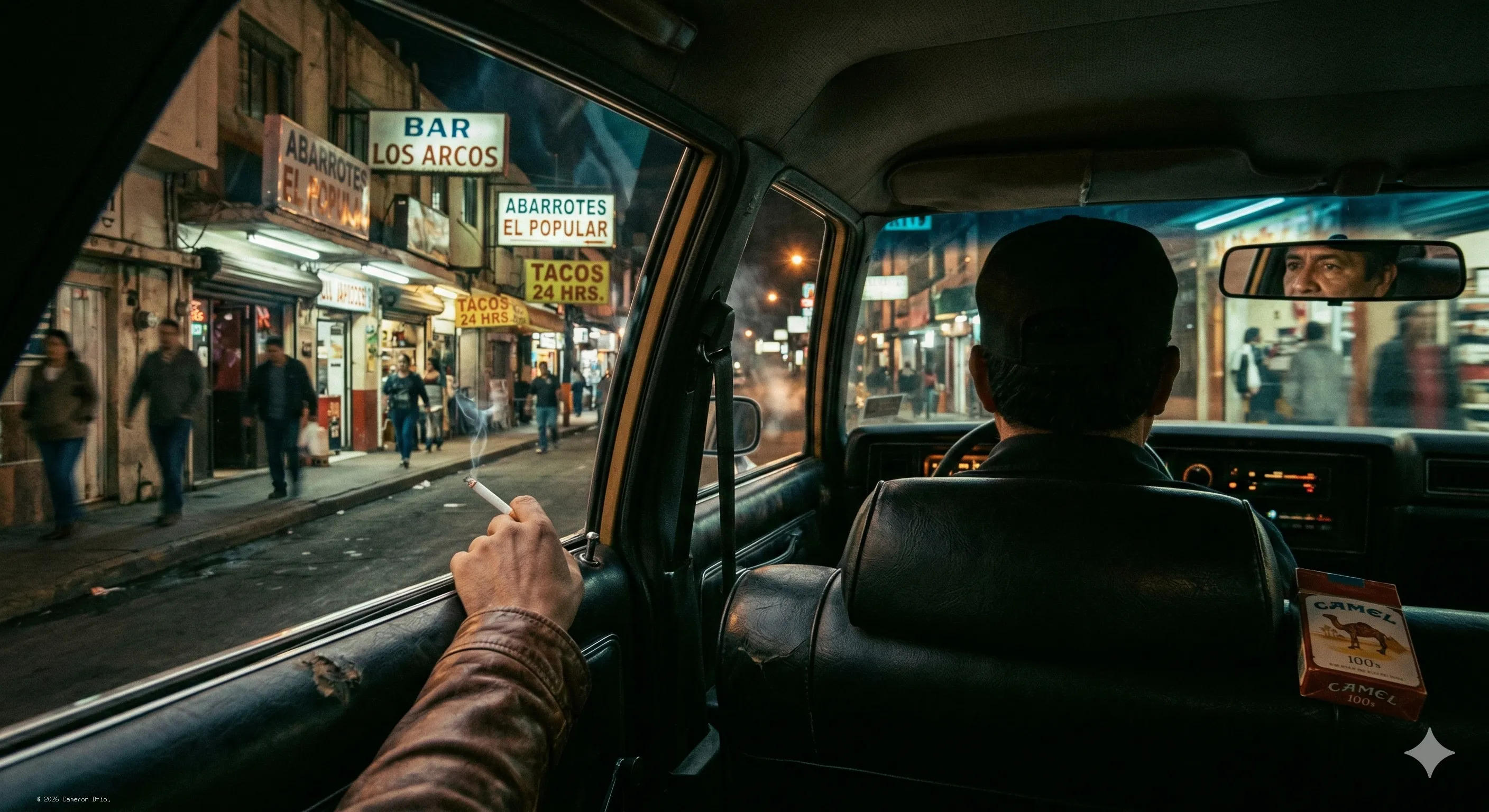
A few guys my age were loitering near the entrance. I bought a pack of Camel 100s from a street vendor—a habit I’d kicked years ago—and lit up. Before a nearby cab driver could even start his pitch, I climbed into his backseat.
"Take me to a place no one wants to go," I said.
I nodded with a smile, and he seemed to understand my shorthand: Take me where no tourist would dare to go. I handed him enough cash to drive around all night and eventually bring me back to the border. From the backseat, I watched the city roll by.
The streets were clean, the night was peaceful. I knew danger was lurking somewhere in the shadows, but I felt, with a strange certainty, that it wasn't looking for me tonight. We eventually turned into a lively, narrow street. Before the driver—Emiliano—could say a word, I knew he wouldn't go any further. The asphalt continued, but there was an unwritten sign posted in the air that only a local could read. I liked Emiliano’s vibe; I felt I could trust him. I stepped out of the cab as he pointed to the spot where he’d be waiting for me. As I closed the door, he gave me a look that was equal parts worried and curious, as if to say, You don't have to go down there. The street was teeming with people of all ages. No one seemed to be casing me or even cared that I existed, which put me at ease.
Lights were everywhere. It was a beautiful disarray: a small grocery store sat right beside a bar, across from a modern-looking theater. The layout of the buildings felt as free and unplanned as the people walking between them. I didn't see any of the "tough guys" from the movies, and I probably didn't need to. The air itself felt heavier here. I reached for a cigarette, only to realize I’d already given the pack of Camels to the guys back at the border. I bought another pack and started to walk deeper into the night. A few minutes passed, and I decided to simply live it. I bought a local beer from a small bodega and drank as I walked.
It couldn’t be helped; Chavez was calling to me. As I heard the passing voices and the bursts of laughter, I began to sense their rhythm—a pulse that covered the street, moving in waves, almost detached from the very people creating the sound. I could hear everything now: the sharp clink of a keychain, a dog’s yelp, the low hum of conversation. It all carried the same symmetry of nature. This was music I had never felt before.
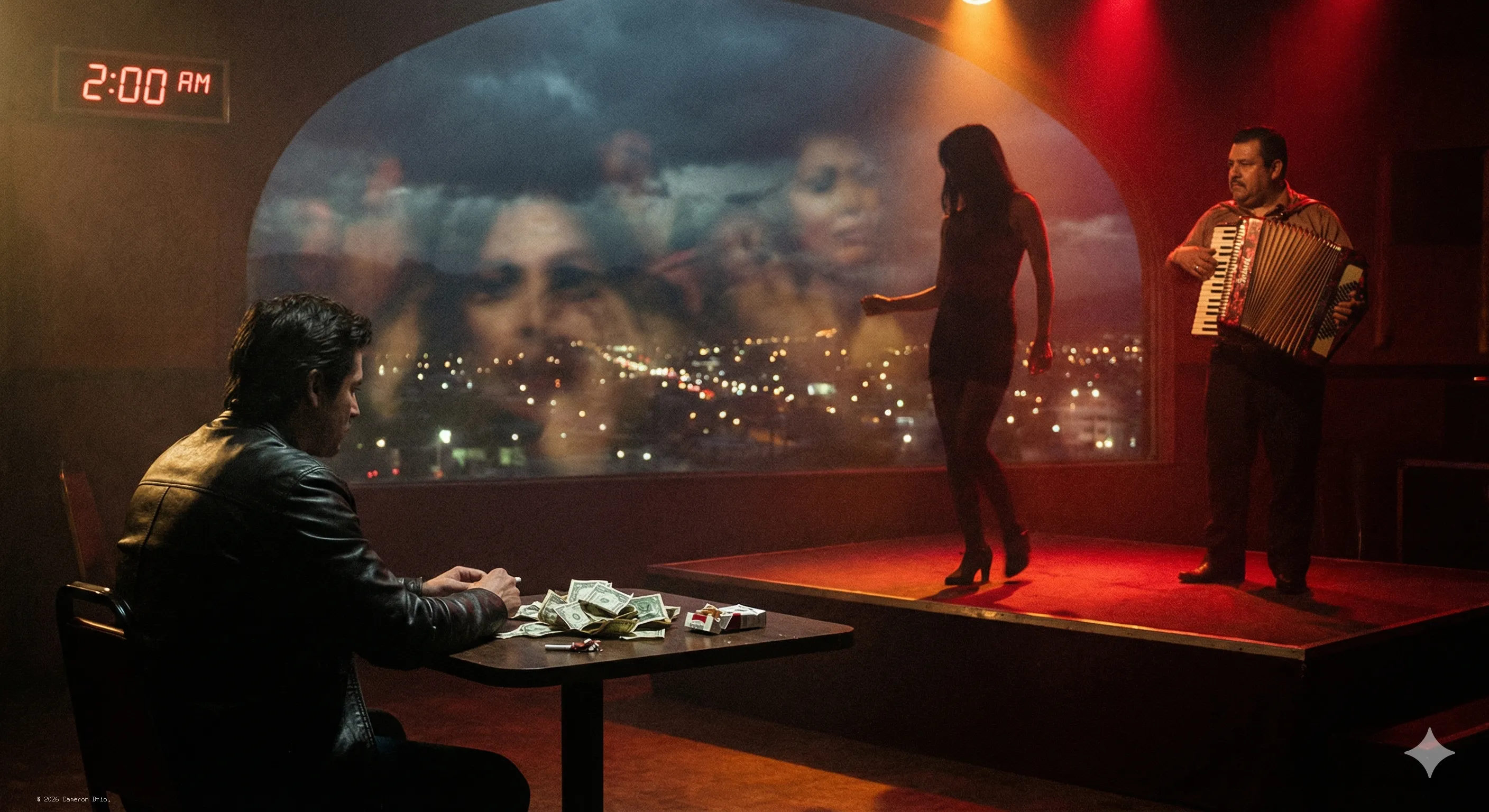
"Would you like another beer?" a waitress asked. Her voice was kind, inviting, and her English was nearly perfect. I had wandered into a small club. The stage was narrow, where a dancer moved against a pole in a slow, uneven rhythm. Beside her, a stocky man with a thick mustache squeezed a weathered accordion. This was the sound that had pulled me inside. The room was bathed in a dim, reddish light.
I finally saw a few of those "tough men" from the movies—they looked alert, aware of my presence, but they didn't stare. After a while, the room settled. At some point, it felt as if it were only me, the dancer, and the accordion player. I felt weightless, as if I had finally stumbled into a sanctuary. I didn’t know what I was escaping from, but I knew I didn’t have to go any further. Yet, despite my pronoia, a sliver of worry returned. The entrance was small; the door stood just ajar. I felt as if someone might shut it at any moment, and in that darkness, I would hand over everything I owned just for the asking.
Then I noticed the time. It was past 2:00 AM, and the accordion had been playing continuously since I’d arrived. The dancer hadn't left the stage. From the back, I could hear the tough-looking men; they had retreated to a rear office where the harsh, fluorescent light didn't match the amber glow of the bar. The realization hit me: I was their guest.
This wasn’t a tourist trap; it wasn't even a "local" spot. I had stepped into their territory, uninvited, and yet they were performing for me. They were holding the space open. I leaned back in my seat and made a single gesture—a nod filled with a thousand thanks to the dancer and the musician. I smoked a final cigarette, then reached for all the cash I had. I didn’t count it. I simply peeled a twenty-dollar bill off the top for myself and left the rest on the table. I smiled at them both and waved to the waitress as she disappeared into the back.
The street was quiet, though echoes still drifted in from the side alleys. After a couple of blocks, I saw Emiliano walking toward me, his silhouette recognizable in the distance. I tipped him the remaining twenty and walked toward the border station. The usual crowd had already filtered through.
As the agent behind the counter checked my license, I noticed a female agent—tall and athletic—staring at me. She looked at my hand, then back at my face, a ghost of a smile playing on her lips before she looked away. It was only after the agent handed back my license that I realized what she was looking at. I was still clutching a crushed cigarette butt in my fingers. I hadn’t been able to bring myself to drop it on the sidewalk before walking inside.
As I walked back to my car, I looked at those calm, dancing lights on the hill one last time. I knew I would never go back. A night like that couldn't be recreated; it could only be remembered.
IV. Alabaster and Ultimatums
This "order in the chaos" was nothing new—I had learned how to ride the current until it changed direction—but I found myself wishing those invisible thorns weren't pressing so hard into my shoulders.
I was floating. I had seen something in Tijuana that felt like a chance at redemption, yet I now felt a new cage closing in: the small stretch of downtown Seattle held in my palm, and the thousand strands of my thoughts trapped in a cage even larger than that. I still felt magnetized and powerful, but I couldn't shake the idea that something was watching me a little too closely.
It had been a couple of weeks since the engagement party I had no qualms about Tijuana or returning to the driver's seat. I hadn't shared my experience with anyone, yet I suspected Beatrice’s parents had figured it out. Maybe someone had simply spotted my car near San Diego; it wouldn't take much to assume I’d paid a visit to the other side of the border on a Saturday night. Still, I took comfort in knowing Beatrice would never ask. She was far above it.
By now, I had acquired a list of "personals." Practically all the regular dancers called me specifically for their rides home. In a short time, I had become the very thing I feared: I had earned an honorary position in the Alex Rieger world. I didn't have to hustle like the other drivers anymore. I had a clientele. Everywhere I went now, I moved with predetermination, expecting—and receiving—the desired outcome. Except for tonight. Something sinister was waiting for me; I only hoped the universe would oblige and grant me that final bit of symmetry.
As I walked across the lawn, I noticed a white statuette glowing under a yellow spotlight—a new addition I hadn't seen before. Inside, the usual crowd from Sam’s office was missing. The house was quiet, occupied only by Sam, his wife Maureen, and Beatrice.
"Can I bring you a Miller?"
Maureen asked, her smile tight and borderline scrupulous. Sam was a man of towering proportions. If he were a few inches shorter and grew a mustache, he’d be a dead ringer for William Howard Taft. He was the type of man you always found sitting in the corner or standing a few paces behind the group, fiddling with a drink, observing.Our conversations had always been indirect, built on suggestion rather than statement. Once, while watching Apocalypse Now, we reached the scene where Brando muses on the power he’d wield if he had ten men like himself. I had remarked,
"If I had ten men like that, there wouldn't be a need for bylaws."
A few months later, Sam dissolved his corporation and restructured as an LLC.
Tonight, he was already seated at the far end of the room, preoccupied with the VCR.
"Did you see the white Eros out front?" he asked without looking up. "It’s Alabaster," Maureen hollered from across the room as I nodded to Sam.
"Beatrice tells me you like James Caan," Sam said, his tone shifting into something directive. "I liked him in Rollerball" I said softly. "You ever seen him in The Gambler?" Sam asked. There was intent behind the question." Yeah. A long time ago," I replied. I felt a sudden, sharp urge to lie and say no.
"Funny thing about movies," Sam mused. "They capture things even better than the real thing."
I was convinced now: this wasn’t a party. Sam had something cynical to say. He started the VCR, the volume kept low. He had pre-set the tape to the scene where Caan’s character is winning, fueled by mathematical arrogance.
"Did you hear about that craps table in Vegas?" Sam asked, still playing with his wine glass, his eyes averted. "Not really," I replied reluctantly. "Oh, it was nothing, really. It didn't actually happen there," he began.
"We were cutting through the casino floor to catch the Pirate Show at Treasure Island. I doubled back to use the restroom, and when I came out, the group was gone. I guess Maureen hadn't heard me tell her to wait. Before I knew it, I was at the table. I don't know. Maybe I was just overdressed for a pirate show. Or maybe it was because the table was empty and the dealer was nice enough to help me polish my game." Before I could offer a polite response, he cut through the air.
"It was all right, though. I only dropped a couple grand." He finally turned to me, his gaze brisk and piercing. "It felt just like the Boondocks, you know?"
It was a threat. I wasn't sure how he’d found out about my trips to the local card rooms in the Boondocks, but he was bothered by something—something he thought I played a part in. He was validating a feeling I’d had but couldn't explain: that after you pass a certain threshold of wealth, you start re-defining the little things just to feel a pulse. This "refinement" he was exhibiting was a weapon.I wanted to play along, but I remained silent. After all, this was supposed to be a party. In the back of my mind, I wished he’d just come out and say it, but I wasn't angry. I didn't feel obligated to stay, yet I told myself I remained because I chose to. It had been a while since I’d stripped the "reason" away from a moment.
My time driving a cab had shed light on a specific human habit: most people navigate the world by slapping labels on things and connecting them like dots. In the back of my cab, I noticed that people always started or ended by talking about themselves. They would wait for a "label" to drop so they could spin the conversation back to their own lives. It made it easy to accuse or assume. >If the subject of music came up and I mentioned the magical sound of a flute, they’d immediately ask, "Do you play the flute?"
I’ve played classical guitar since I was nine and have never even held a flute. Ironically, I found salespeople to be the best listeners, but Sam wasn't a salesman; his partner was the one who actually brought in the accounts for their agency.
Curiosity pinned me to the spot. I decided to let Sam finish his practiced scene.
"You know," Sam continued, "it’s not what you think. I didn't even want to play. An empty craps table is no fun, so I headed toward the blackjack tables. I wish I’d stopped there, but I overheard some guy lecturing another about staying on a twelve and ruining the dealer's bust. I needed a table with some class. I looked to my right and saw a high-minimum spread. The dealer was standing there, arms spread neatly over the felt. As soon as I approached, she picked up a card and smiled at me with a gentle brush of the hand."
"Let me guess," I interrupted, my voice firm yet sympathetic. "A smile from Aphrodite herself." Sam shook his head and continued.
"Now you know how I feel about Beatrice," I replied. It was my response to his threatening intro—a way of securing myself while acknowledging his unspoken plea for help."You know, you could negotiate with them. They’re no different than a bank. They might settle for a third plus interest. You could probably clear the whole thing for thirty grand plus six percent."
Sam froze. He sat up straight, glancing at Maureen, who was deep in conversation with Beatrice at the other end of the room. He stared at me for several seconds.
"Really? I could do that?"
"Sure. Most people are too intimidated to approach the casino, but you should try it."
When the door finally closed behind me, I stopped to take a closer look at the statue on the lawn.
"It is Alabaster," I whispered to the night.I had entered that house as a gust of wind and left it as a gambler. There was no real difference between Sam and me. My overcautious limits were just a mask; I was gambling with my life every bit as much as he was with his chips. The Universe had simply sent Sam to remind me of the stakes.
V. The Weight of the Wing
I could feel the order within the chaos. I wanted to believe I was the only one who truly understood what Chavez meant—that every word held a specific meaning, and every meaning pointed toward something hidden in plain sight within our nature. Perhaps this was the price I had to pay for reaching toward the heavens; I didn't know who I was in any literal sense. I only knew I had to choose a single path before I simply exploded.
I had hit a bird while driving through Sand Point. It had been a few days, but I couldn't purge the image from my mind. In Seattle, a certain level of passion for nature is expected. Once, I stopped for an injured white egret at the waterfront. Before I knew it, several cars had pulled over. A couple gently wrapped its wing and ushered it into their car to drive it to the animal shelter on Elliott Bay.
But this time, it was different. I was burning inside, and I could tell no one. There was the blunt fact that the bird was gone, and then there was the guilt—the weight of the beautiful, terrible gift the universe had granted me in its place. Unlike the rare egrets at the waterfront, pigeons were everywhere. Back in school, I remember them wandering through the cafeteria, oblivious to the students. But pigeons are smart; they understand the rhythm of the streets.
It wasn’t strange to see them on the road from a distance—they always took flight before a car got too close. This time, one of them just wanted that last bite. I had seen the cluster and already slowed down, but for a split second, as I reached for the radio, my foot must have pressed a fraction too hard on the gas. That was when it happened.
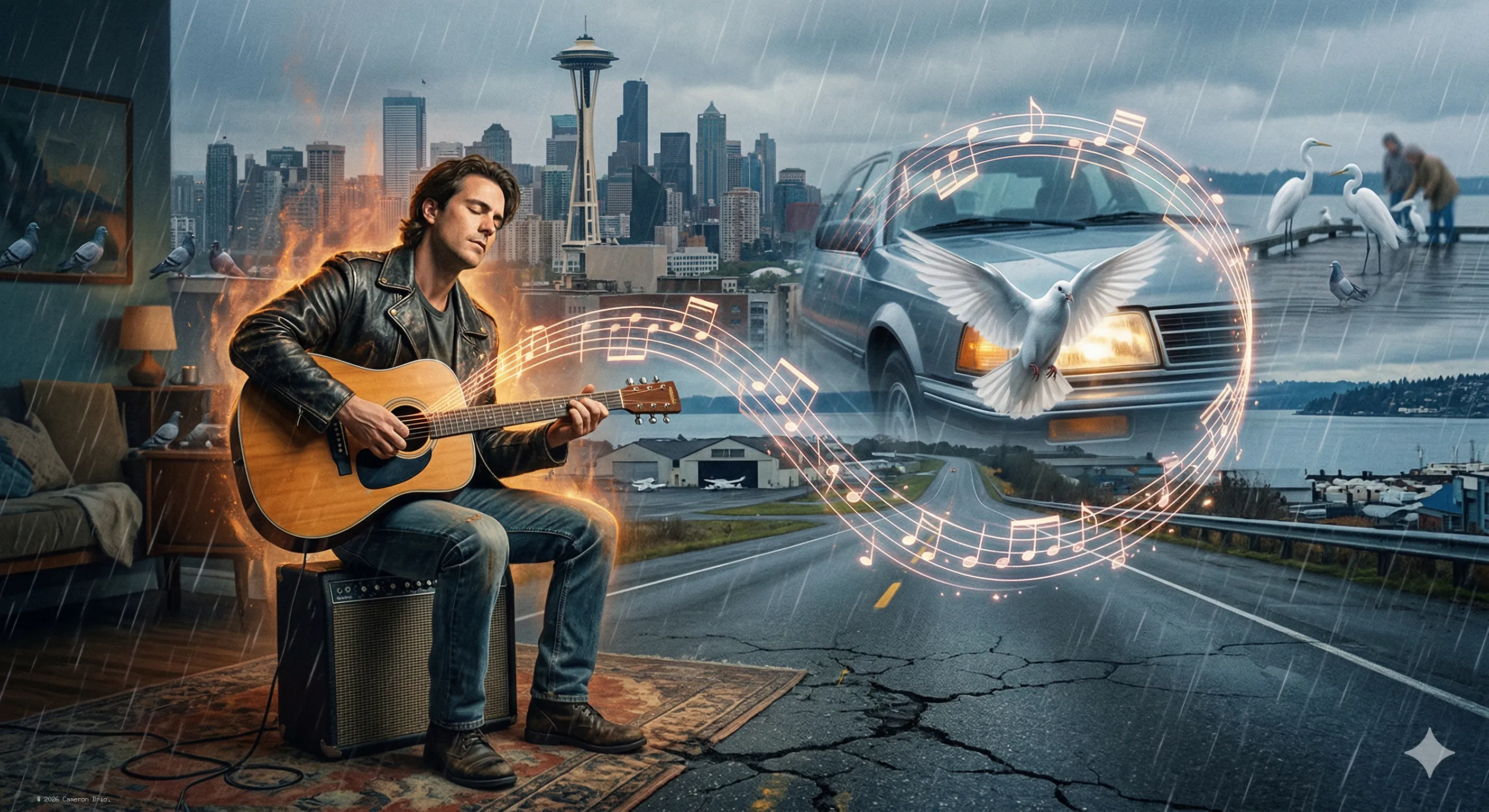
They scattered, but one caught my left headlight. I saw its wings span wide against the glass. I couldn't slam on the brakes with the traffic behind me; I had to drive several blocks just to find a median to turn around. When I finally looked across the road to the spot, I saw it. It lay there perfectly intact, but lifeless.
After that, I couldn't go anywhere. When I got home, I picked up my guitar. The moment looped in my head, swirling in slow motion. I wasn’t crying; I didn't even feel particularly passionate or remorseful. I felt connected. My entire being was still back on that road.
I began with a simple chord progression I’d written years ago. Gradually, the arpeggios kicked in—a rest stroke on the bottom of an A-minor chord, moving through a series of shifts from minor to major. Each arpeggio carried its own blend of expression until I landed on a loop back to the minor key. I leaned into a diminished chord and, from there, told a new story. I climbed into the higher register, keeping the harmonious arpeggios flowing, before ending with a soft, firefly-like expression of lament. Then I stopped.
The entire piece had come to me in a single, smooth stream—no trial and error, no backtracking. It was "Musical Thought" made manifest. A gift from the universe.
As I left my apartment, I felt a brush of hot air on my face, despite the Seattle drizzle. It had started again. I was burning inside, and strangely, I didn't want it to stop. I wanted to go back to Sand Point just to feel its dimensions, to stand where it happened. Instead, I went back into the cage. I went back to work downtown.
VI. The Invisible Culture
Seattle’s beauty was easy to catalog: the vibrant colors, the scent of damp brick as you passed historic facades, and the sunlight flickering through the canopy of the Washington Park Arboretum. But few ever saw the invisible culture of the city. I was still burning inside, yet the magnetism remained. As I drove down Seneca, I slowed to admire the small trees lining the sidewalk. I was seeing beauty everywhere, in everything.
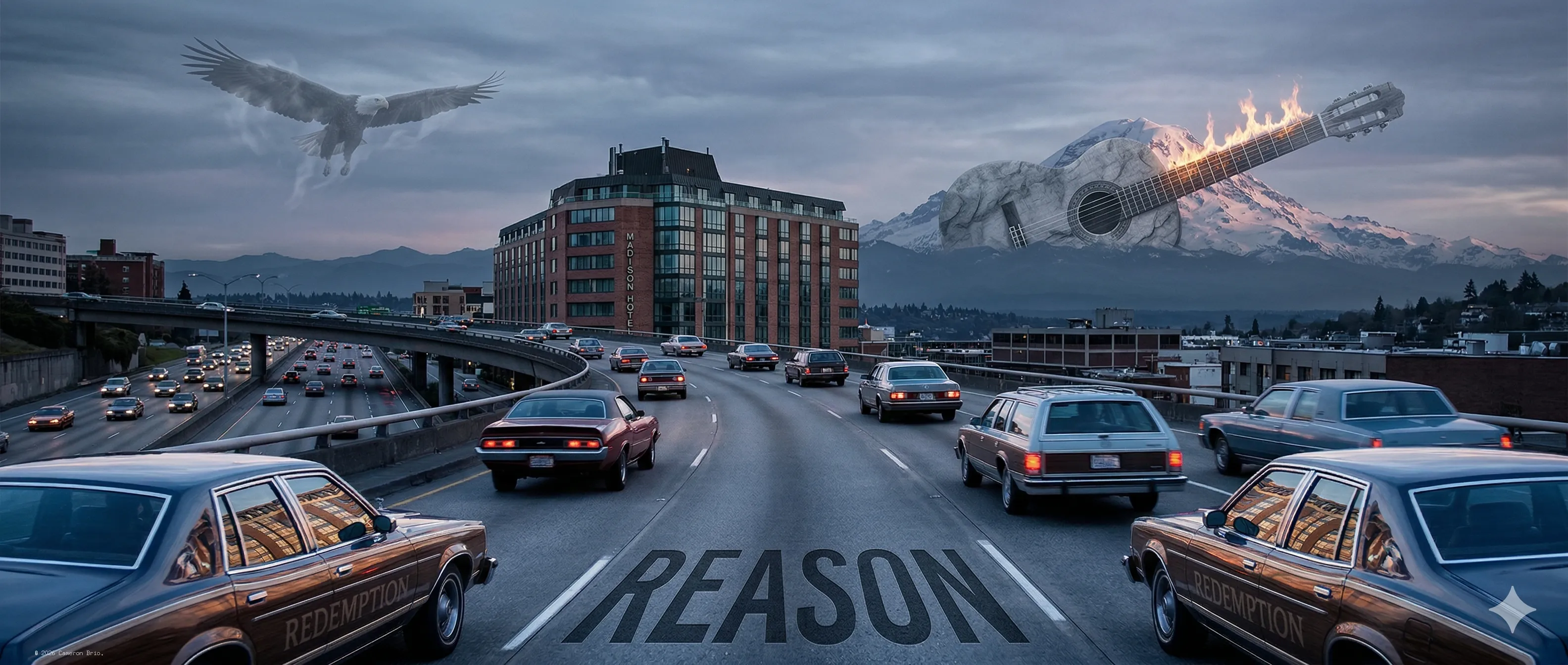
I had a couple of hours to kill before my "personals" began calling for their rides to work. Even on a Saturday night, the streets would fall into a hollow desert for a few hours before the real action started. This was the time when cabs would cluster at hotel taxi stands, the drivers smoking and trading stories. I headed for the Madison Hotel, but the stand was full. I tucked my cab into a nearby alley and walked up to the hotel on foot. The freeway offramp there exited in a sharp, elevated curve right in front of the building—a sight I must have seen a thousand times. Tonight, however, it looked artistic, mesmerized by the way it mirrored the curvy line paintings of Willem de Kooning. And then, the universe offered me a chance at redemption.
I spotted a pigeon limping in distress, unable to fly. It had emerged from a small, sunken walkway that connected to the hotel’s ground floor. Through the glass, you could see people in the large room below, but the exterior door was always locked. The pigeon seemed to know this was a safe place to hide, but it had grown restless and climbed up to the street to try its luck. I walked over and scooped it up gently, intending to put it in my car for a trip to Elliott Bay. But it didn't work. Its heart began to pound so violently I thought it might explode in my palms. I had to let go.
It looked up, traced a frantic half-circle, and retreated back into the safety of the walkway. I turned back, weighing my next move. One of the old-timers offered me a cigarette. "Let it be," he said simply. "It’ll come around when it wants to."
I realized then that I’d left my heavy brick of a cellphone under the seat of my cab. I stepped into the hotel lobby to use the house phone, calling the shift manager at the club to see if any of the girls had left a message for me. As I walked back out, I noticed a young couple—definitely not cousins. They were walking too closely, too cuddly for a pair just leaving a hotel. Usually, people looked like that on the way in. I watched them climb into a car parked just ahead of the blue strip marking the taxi stand. The spring night was cool, the air refreshing against my face. I stood there, split between watching the offramp and checking the walkway for the injured bird. The other drivers noticed me standing there without my cab; being old-timers who had seen it all, they gave me that classic "I don’t want to know" look. I stepped around the lead cab to get a better view of the freeway when I saw a shadow moving in the couple's car.
They were at it—heads and hands moving up and down in a rhythmic silhouette, right there in front of the hotel. It felt like a scene from a Woody Allen movie.The old-timers had noticed it before I did and were pointedly looking away. But as I watched, I realized the traffic exiting the offramp could see right into the car. People were shaking their heads—some with grins, others with looks of pure disgust. It was an unwritten rule of the invisible culture. Without a word of consultation, we all stepped toward the car. We formed a line, our backs to their windows, acting as a human screen. It worked out for me; with my back to their theater, I had an unobstructed view of the freeway and the "offramp blues." A few minutes later, a door slammed. The Woody Allen movie was over.
I was still burning inside, but I couldn't bring myself to go back to the injured bird. I was too afraid to try a second time. I returned to my cab and headed for my usual spot at the Spring Hotel to wait out the remaining quiet of the night.
VII. The Exoneration Box
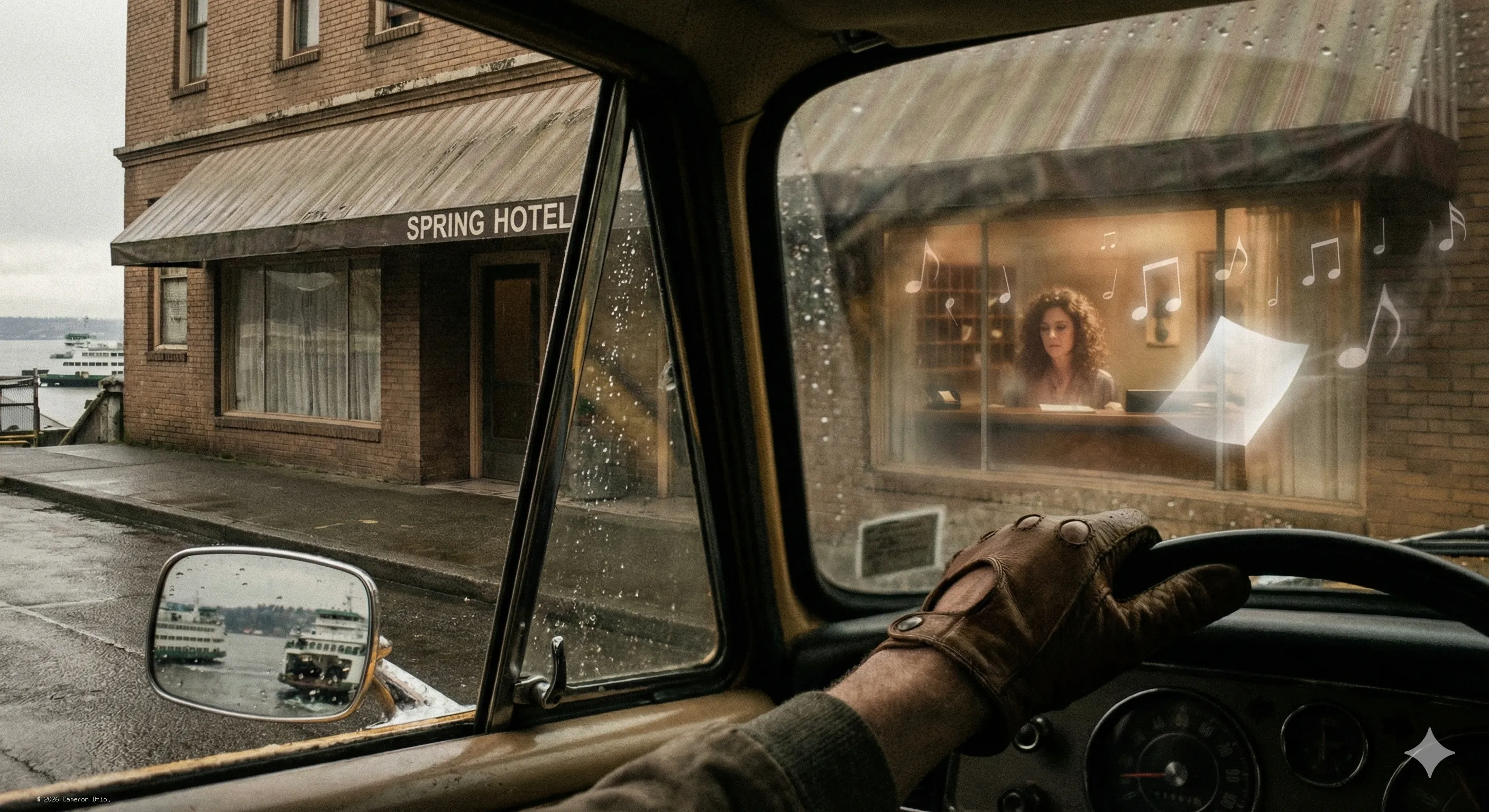
I found the Spring Hotel poetic. It was small and unassuming, yet it possessed a hidden prestige—a sanctuary for old money. I once picked up a woman and her elderly mother there and drove them to Boeing Field, where a private jet sat waiting; they were the kind of clientele who usually only surfaced at the Olympic Four Seasons. I loved that spot.
Spring Street was hilly, allowing me to watch the waterfront through my sideview mirror while simultaneously catching glimpses of Vanessa at the reception desk through the large lobby window. I didn't want to admit it, but she was the reason I lingered there. She was the harmony of the street, the note that held all the disparate pieces together. We weren't friends, exactly, but there was a connection I couldn’t define.
Beatrice knew about her. If I ever took a call that didn't fit my usual schedule, she’d give me a look that said, This better be Vanessa. I remembered one Sunday morning when Vanessa called early. I had already finished a grueling night shift and didn't want to pick her up in my personal car. I stopped by the cab lot and grabbed a "sitting car"—one that hadn't been leased for the day. The owner was happy to let me take it for a few hours. When I arrived in Renton, she stepped out of the house barefoot, wrapped in a white sheet.
She knew I’d come for her anywhere, anytime. And yet, we kept our distance. Usually, while waiting at the Spring Hotel for the dancers to call, I did nothing but read my book—unless a "flag-down" wandered off the street. But that night, I made the mistake of listening to the radio.
A call came in for a hotel on First Avenue. The fares had apparently missed the first two cabs and were getting anxious. I’m not sure why I took it—maybe I felt the dispatch office needed a favor, or maybe I was hungry for the kind of insider business talk I’d heard earlier. Regardless, I keyed the mic and accepted. Immediately, it felt wrong. The wavelength of the night had shifted.
Three men were waiting, standing in the shadows of the lobby before stepping toward the curb as if they had just arrived from the outside. The man in the middle was short and wiry, wearing a new sport jacket that clashed miserably with his wrinkled pants and tennis shoes. To his left was a tall, fit man who moved with the quiet confidence of a bouncer—steady in a bar, but apprehensive out here in the open. On the right was an average-looking man, heavy-set with small, calculating eyes. As they reached the door, the short man pointed at me and whispered something to the heavy-set one.
"We’re going to White Center," the short man said. "It’ll be a round trip."
There it was. The red flag. I’d learned from the old-timers that a "round trip" was rarely just a ride. It was usually a "no-pay" waiting to happen, a precursor to a disappearing act, or a gateway to a never-ending circle of stops that inevitably ended in screaming, yelling, or a fight on the sidewalk. To top it off, White Center was a territory I wanted no part of. Technically, I had the legal right to refuse service. It wasn't uncommon for a driver to decline a long, risky haul if it meant losing a steady local customer.
But I sensed this wasn't about the ride—it was about getting me to their destination. I felt like they wanted me on their turf to answer for something I might have seen or heard on a previous night. The night shift has its own unwritten rules. We weren't supposed to make assumptions, but that didn't stop people from making assumptions about us. I used to joke that for some people, a taxi was an "exoneration box." I’d seen it during my time as a gopher at the courthouse; attorneys used cabs to create doubt. One lawyer once asked me, "If a guy walks in wearing a wet raincoat, is it raining outside?" I’d nodded. "Well," he said, "think of the raincoat as the cab, and the rain as what they’re carrying.""We're in a hurry," the short man snapped, noticing my hesitation. "White Center, you said." I muttered, turning my head slightly.
By now, they had crowded into the back, their bodies huddled so tightly there wasn't an inch of air between them. "You have to take us," the short man said angrily, as if he’d been expecting a fight. "Well, technically I could—" Before I could finish, he slapped several twenties onto the front seat. I felt a menacing roar of tension vibrating behind my neck. I tried to speak, but the short man ignored me, turning to yell frantically at the heavy man. I couldn't catch every word, but he was babbling about being out of options, as if he were trying to prove to his companions that he’d exhausted every possibility.
For a moment, I thought of Sam. I felt a sudden, irrational impulse—the gambler’s mind taking over. I wanted to take them just to prove a point. I even caught myself calculating moves against the bouncer—the headbutts my cousin had taught me. I wanted to prove that an invisible hand was protecting me, that nothing bad could touch me tonight. But the "burning" inside had sharpened my senses. This wasn't a game. This simple cab ride was a doorway to a world of trouble.
The short man’s agitation spiked. He began shaking the back of my seat with his tiny, trembling hands. He looked more terrified than I was. I searched for a way to defuse the bomb, reaching for the mic to call the police, but I hesitated. Then, a piece of old-timer wisdom flashed through my mind: Don't keep valuables in the cab. If things go south, just turn off the engine and walk away. They see the driver and the car as one entity; if you remove yourself, you break the circuit.
I did exactly that. I killed the engine, yanked the keys from the ignition, and grabbed my "Bible"—Chavez’s Musical Thought. I stepped out of the cab, leaving the three of them sitting in the sudden, heavy silence of a dead car. I forgot to take the radio mic, but it didn't matter. I left the cab sitting on First Avenue and walked up the hill toward the Spring Hotel. I didn't look back until I reached Vanessa’s desk to call the superintendent.
VIII. The Silent Dance
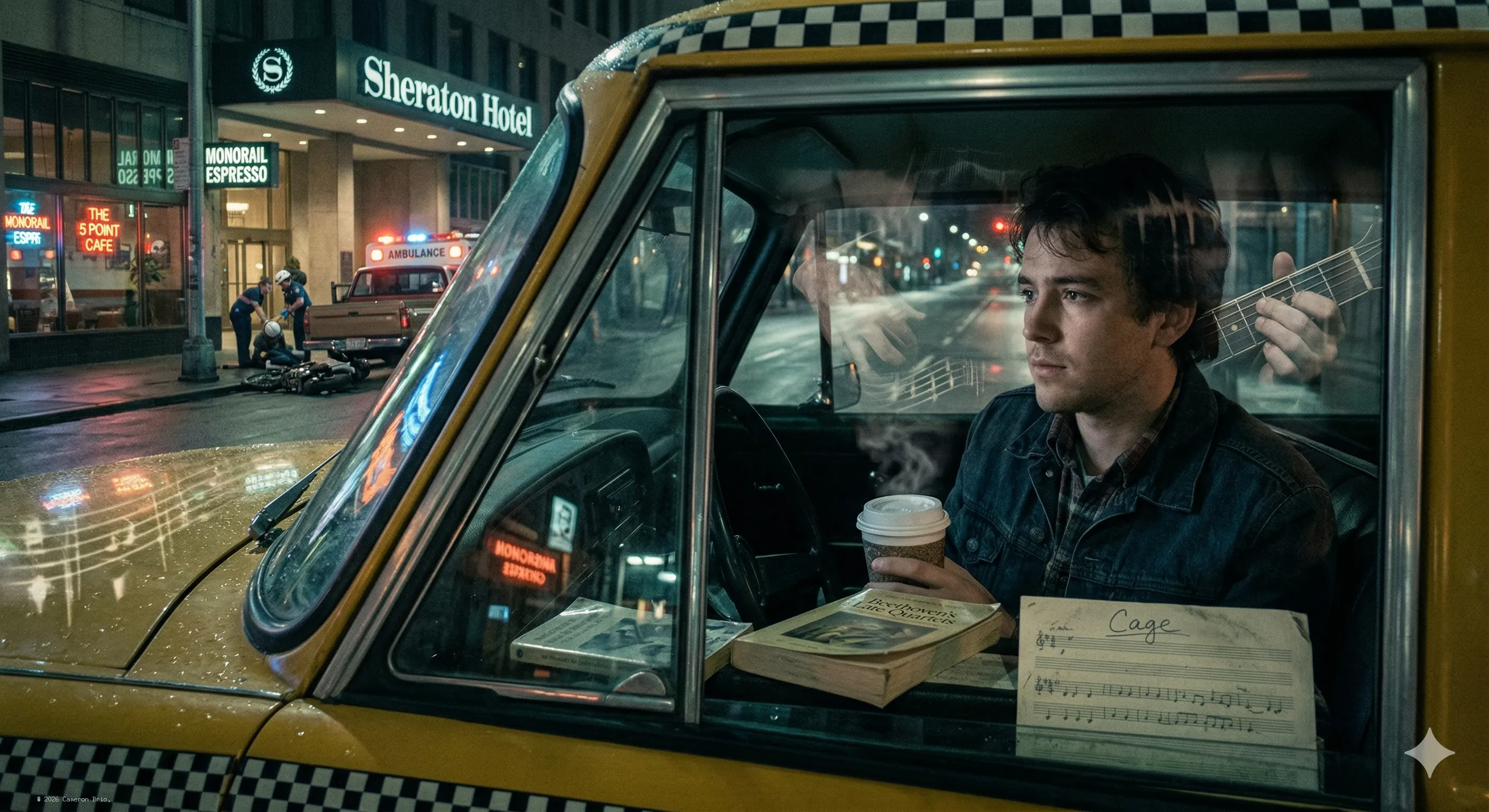
It has been almost a year since Vanessa left the state. I’ve found a new spot now; I park at the Sheraton. It’s much quieter here, with a clear, unobstructed view of the street stretching out alongside the hotel. I leave my "Bible" at home these days. I still haven't finished it. I stopped reading shortly after the passage where Chavez describes listening to Beethoven in his later years. He noted how the music began to sound mechanical to him, even though he knew it was the same score that had ignited a burning passion in his youth.
Passion or not, I still try to play the piece I composed. I named it Cage.
No one else has heard it. Sometimes, I sit on the couch in my living room and play it so softly that even I can't truly hear the notes. I simply watch my fingers dance across the chords, moving up and down the fingerboard in a silent rhythm. I can still feel the music, though it isn't as vivid as it was when Vanessa was around. The magnetism has faded, but I remember every fragment of my trip to Tijuana. I suppose it was a journey I was required to take.It’s a quiet summer night. The Sheraton is still; there are no conventions in town this month. I was sitting in the cab, sipping my coffee, when I saw a motorcycle clip the back bumper of a small truck. It didn’t look like a violent collision, but the rider flipped off his bike and landed hard on his neck. He was wearing his helmet.
The ambulance arrived quickly. It has been an hour now, and the man on the ground hasn’t moved.