The Gopher’s Mandate
I could never come up with a good reason for why I’d quit law school. I wasn’t sure which was worse: quitting in my third year, or driving a cab immediately after. Most people saw it as a trade-off—exchanging one life for another—but Beatrice didn’t see it that way. And that was all I needed.
When I look back, I feel like I learned more during those few months as an apprentice at the courthouse. I had a fancy title, but to the regular staff, I was just a "gopher." I didn’t mind. The funny thing was that I’d had to pass countless hurdles and spend a fortune on tuition, books, and board just to get a license to work at that courthouse as a gopher. The regular staff would never understand it, but to me, it wasn’t just a job. It was a License to Observe. In those few months, I had molded my soul into the walls of the courthouse; from simple traffic infractions to King County Superior Court cases, I had seen it all. Seattle was vibrant, but it was still a fairly small city back in 1985. Yet, while I was working at the courthouse, it felt like the biggest city there was.
It was difficult to hide that history from people, especially with my young, collegiate look. No matter how many hours I put into cab driving, I still had the "look." It’s like seeing a soldier in a bar without his uniform; it would take years to shake that off. Those three years of law school made me a magnet for "free clients." Passengers and cabbies alike would always drop a question or two. It didn’t take long for me to earn a reputation. I didn’t think I was saying anything particularly special—most of it was just common sense—but people either didn't know or didn't want to know. They didn’t have the License to Observe.
My first encounter was with Charles. He was a tall, quiet guy who only drove day shifts. Days were difficult and risky for most drivers; there were too many twists and turns you could miss. On my very first day, I found myself driving in a bus lane. The motorcycle cop explained that between 4:00 and 6:00 PM, one specific lane was reserved for buses between Spring and Columbia. Go figure. Who would remember that? That was the Emerald City’s specialty. I saw Charles once at the small office in front of the lot. He asked for advice about a case he was sure he could beat, but he didn't want to hire a lawyer and spend a fortune. His court date was looming.
"What does the police report say?" I asked.
"I have no idea," he said, sounding surprised. "Don't you have to be a lawyer to see that?"
"No. Just go to the fourth floor, show them your ID, and ask for the report. It’s your right to see what the police reported to the court."
He later told me his case was dropped at the arraignment. Something was totally off in the report, and with the help of a public defender, he pointed it out to the prosecutor and got the charges dropped.
But the tip that made me famous in the cab lot was this: "Never allow your case to go to the magistrate." People just didn’t know. The misdemeanor courts were so busy, and hearing every case through a full cycle was so costly, that they would appoint an agent—a Magistrate—to handle the volume. People liked it because they got to sit in a small room, one-on-one, and talk to a seemingly regular guy. In most cases, the magistrate would let them off or reduce the fine. But what they didn't know was that, for most cases, the magistrate would officially enter a "guilty" verdict on their file, even if they were exonerated or the fine was waived. The paperwork would be filed and buried in the archives. It was a shrewd way for the city to keep their conviction stats up while keeping the citizens happy. The trick was to go all the way—even if you had to go to a jury trial. The court would never allow the system to spend that kind of money on a traffic violation. They would almost always give in and drop the charges or offer a massive compromise. It was certainly better than a "buried" guilty verdict. The story of that advice tumbled and rolled through the lot until people thought I had a thousand more secrets like it. I realized then that my License to Observe was quite valuable indeed.
The Refund Rule
All of that made me uncomfortable, shadowed by a persistent sense of irony. Back in law school, I’d had to hide my trips to the boondocks for the obvious reasons; now that I was driving a cab, I had to do the same for entirely different ones. Beatrice knew about it, but she was less worried than I was. I wasn’t even sure why I went there myself. Maybe it was the chaos of the tribal casino, or the subtle lawlessness of sovereign land. A few years ago, it was just a trip to the sticks; now, it was a vice to counterbalance the "wise guy" image I had inadvertently created. Or maybe it was none of that. Maybe it was just the way I was raised. I was playing French Poker for pennies when I was nine years old. That was the real irony: gambling in a "normal" family. What made us normal was a rule my uncles had established: at the end of the night, nobody left the party until all their money had been returned to them. We never gambled with much anyway, but the elders wouldn't have it any other way. Nobody kept their winnings. You couldn't truly understand the feeling unless you saw the pot of money sitting right in front of you. Once the night started, it felt like a real game: the stress, the anticipation, the stinging defeat, and the disappointment. When I played, I never let myself think about the refund only a few hours away. All I knew was that, in the moment, it was for real. I don't have anything tangible to show for those years. The experiences I encountered can’t easily be put into words, but this comes close: it all gave me a sense of control. Most people live with a pseudo-sense of control, a feeling that oscillates between audacity and denial. For me, it was like a spiral vision. I would fan my invisible wings around me, observe and absorb, and then push forward so that turning back became difficult. It was like taking out insurance for two steps forward, while paying a smaller premium for the step back. Maybe that was why Beatrice wasn't worried about me. And maybe that was why Charles and a couple of his friends wanted me to go down to Reno with them this weekend.
Preparing for the Gauntlet
Beatrice trusted me. She knew I had a sense for boundaries and that I would never get too close to the abyss. This wasn't my first time dealing with the house; I knew a thing or two about surviving a casino. In fact, I’d grown so savvy that I’d once coached George, Beatrice’s brother-in-law, through a negotiation with a casino—a move most people are too intimidated to even attempt. He’d managed to whittle his gambling debt down from eighty grand to fifty-five. He considered it a win, even if it didn't make much of a dent in his fortune; the man charged his clients $275 an hour, after all. Beatrice trusted my judgment, sure, but a weekend trip to Reno with the guys from the lot was going to take some serious convincing.
"Are you going to see Jeneen while you're down there?" Beatrice asked, her focus on the onions she was chopping.
"Sure," I said, perhaps a bit too quickly.
She let out a short laugh. "A little hesitation might have helped your case."
"All right," I said, biting the corner of my lip. "I won't go if you don't want me to."
"Don't be silly. I understand you wanting to see Jeneen," she said, pausing mid-chop. She looked straight at me with a half-smile that didn't quite mask her serious intent. "But why go with those guys from the cab lot? And in that beat-up car of theirs? You know it won't survive the 'Desert Stretch.'"
Beatrice was way ahead of me. We’d taken enough trips to Reno together to know it wasn't just a gambling town; we loved the festivals, the crisp air, and the dry mountain bike trails. But she also knew the geography of the risk. The "Desert Stretch" was a notorious sixty-mile gauntlet of I-80 passing through Lovelock. In the peak of the heat, the road becomes a graveyard for engines. The air gets so hot that cars malfunction and tires swell to the bursting point. There are signs warning drivers to kill their AC just to keep the engines from seizing. Driving an old car with bad tires through that stretch wasn't just a gamble; it was asking for disaster. The car in question was a "retiring" cab the guys were borrowing from the owner. They did this every now and then when a vehicle was being cycled out but still had a few days of insurance left. It was a way to share the ride and save airfare—money they’d rather spend on a motel or whatever vice was waiting for them in Nevada. Plus, it saved the wear and tear on their personal cars. But Beatrice was right: those cabs were always held together by spit and prayers.
"Besides, it’s written all over them," she continued, resting her hands on the counter. "They just want you along to chaperone. I don't think they’re heading to Reno for the weather or the 'cultural activities.' You’ll be the one bailing them out or carrying them home."
I took a long pause, looking away for a moment before meeting her eyes again. "Whatever you say."
She went back to her chopping, the rhythm of the knife filling the silence. After a few moments, she stopped again. "Should I be worried?"
"Not at all," I said, though my expression remained uncertain. "Any sign of trouble, I’ll just fly back home."
She finally offered a smile of genuine relief. "Maybe Jeneen can drive you all the way back here," she joked.
"She just might," I replied, matching her tone.
Mob Mentality
Beatrice had no issue with me spending time with Jeneen; I’d gone down to Reno alone plenty of times. I’d stay for a day or two, helping her boyfriend restore old cars while she tended to her mother. It was a clean, predictable arrangement. But overall, Beatrice was right on every count. I trusted myself; I knew there was no spark in me that would ignite into a disaster. However, I also knew that traveling with a group changed the physics of a man's character. It’s a "mob mentality" in motion—we all do things with a crowd that we’d never dream of doing alone. Most of the time, the shift is subtle, but it's always dangerous. That’s how a herd of businessmen ends up dropping twenty-five grand in a strip joint for a few lap dances. I’d seen it escalate on the streets, at parties, and even in the courthouse. A client makes a very different go/no-go decision when a gallery full of family and friends is watching from the benches.
There was something else, too: I didn't really know these guys, but they knew each other intimately. Two of them were childhood friends. If there was trouble waiting for me out there, these guys were the ones who would mix and stir the drink before serving it to me. As the trip began, I knew I had to quietly take the lead. But I wasn’t ready to burn my energy yet. I claimed the back seat, leaning my head against the passenger-side window and pretending to doze off. I let Ben, Charles’s childhood friend, take the first shift behind the wheel. In a way, we were all professionals. We knew how to handle a car like a horse; you know exactly when to push and when to pull back by the feel of the sweat and the sight of the swollen jugular veins in its neck.
"Take it easy for a bit... I’ve still got a hangover from last night," I muttered as Ben turned the ignition. It was a half-truth, but I wanted to set a slow pace. I could use a smooth ride.
It already felt strange. Usually, guys are upbeat at the start of a trip. It’s like going to a bar: everyone is electric on the way in, and it’s only at closing time that they look like their dog just died. There’s probably a song about that somewhere—and if there isn't, there should be. I had already taken out my insurance. Before we left, I set a non-negotiable condition: everyone had to deposit a few hundred dollars with me. It was enough to cover emergencies or gas money home if they lost their shirts in Reno. I made it clear that I wouldn't release a dime of it while we were in Nevada. They’d get the balance back in Seattle, minus expenses. It wasn't an original idea—I’d seen people do it for hiking trips or drinking benders on the islands—but what worried me was how quickly they agreed. It was Ben, the roulette player, who handed over the cash for the group. I didn’t care where it came from; I just wanted the leverage. We started out rough, but I hoped they’d loosen up once the city was in the rearview mirror.
Eventually, Peter, the poker player sitting next to me in the back, started talking. He led with the usual lament: his "old lady" was against his habit, but he couldn't pass up one last run at the Reno card rooms. He described himself as an average player who scratched out a living in the local rooms around town. But Seattle had too many restrictions; the hourly rate didn't justify the grind. There were always the underground games in the boondocks, but we all knew how those ended. Despite my suspicions about the two in the front, I felt I could trust Peter. Or maybe I just wanted to. Regardless, I knew I had a "checkmate" move waiting for them if things went sideways. I just had to wing it long enough to reach Reno in one piece. And I knew one thing for certain: I wasn't letting a single one of them drive through the Desert Stretch.
Dreams of Hazel Eyes
Ben had driven five hours straight; we had just passed Eugene, Oregon. Despite my need for control, I’d drifted off for a couple of hours. The old Chevy Impala still had something to offer, and that was its suspension. I’d checked it myself before the trip. It was a trick I’d learned from the old-timers: before starting a shift, you give the rear tire on the passenger side a sharp, full-impact kick right below the fender. It was a primitive way to check pressure and integrity. If the tire was healthy, it would absorb the impact and stay still. If the interior layers were inflamed or failing, the shock would jerk right back at you, even if the treads looked brand new. There was no gauge for it; you just had to feel the difference. It was like the difference between a conductor banging his baton on the podium, yelling at the entire orchestra that someone was out of tune, and a quiet music teacher who stops a small ensemble to calmly tell the third trombone he’s a hair flat. Either way, you could tell. When I’d kicked that tire a few hours ago, the shock had bounced all the way up to my knees, but I hadn’t heard any of the subtle, hollow sounds from under the fender that signaled real trouble.
I was starting to enjoy the trip now—not because of any tangible comfort, but for the small things only I could value. Like dreaming about Jeneen. Watching the Oregon landscape blur past the window brought back the memory of how we met. Jeneen had been a blackjack dealer at a small, family-owned casino in Vegas—the last of a dying breed. I’d noticed her from across the floor as I was passing through. She had an elegance that felt like it belonged to something higher. Every movement of her body seemed to have a story to tell. She was thin, average height, but possessed a dominating presence. Her hair was pulled back into a mid-height ponytail, and she stood firm, offering an inviting smile over the green felt. I didn't hesitate. I couldn't pass up the chance to be near that kind of grace.
"You think I have a chance tonight?" I asked with a dubious smile.
"There’s only one way to find out," she replied, her smile mirroring mine. She made a light gesture toward the edge of the table and began shuf0fling a fresh single deck.
I didn't really have a blackjack strategy. Usually, I just stayed—never drawing extra cards, putting the weight on the dealer to bust. Most players try to "win" by calculating risk, doubling down, or agonized over the dealer's insurance call. For me, it was simpler: just stay. But for a moment, I found myself unable to refuse her eyes. My simple plan was no match for those big hazel eyes. I kept drawing cards, card after card, until my hand looked like a game of Rummy. Two Aces, a few small numbers... I finally stopped when I felt the weight of the total. Predictably, Jeneen slapped a twenty-one over my twenty.
I’m not sure why, but I felt an impulse to spread my cards face-up on the table, as if I wanted the pit boss and the ceiling cameras to see exactly how I’d played it. "Interesting hand," Jeneen said, her smile genuine, with a hint of admiration. "Played so interestingly." In that moment, I knew the count, even if I wasn't counting. The small cards were gone. A winning spree had just been handed to me. I went back to my old plan, betting high and letting Jeneen bust with the face cards left in the deck. Unlike me, she had no choice but to draw. By the end of the shoe, I hadn't won a fortune—a couple of grand is nothing to a casino—but I felt like I’d won the lottery and was splitting the ticket with the cashier.
Then, a tangent cut through the cord. The waitress had returned with my drink. Even though the drinks were free, any sane customer tips. As I raised my arm to reach for a chip, I saw the overhead lights bounce off the three digits of my winnings. I was halfway there—my hand was reaching back toward the waitress—and I realized it was too late to pull back. I dropped a heavy chip into her hand. Jeneen gave me a look that suggested I’d made her day. Her eyes were brighter; she was clearly entertained. There was only one thing left to do. I let go of the last chip on the table. "Oh well," I said, getting up gently. I walked toward the exit still ahead, but deep down, I knew I would have paid twice those winnings just for the experience.
Crossing the Black Hole
Another couple of hours passed. My brief moment of joy began to fade as the reality of the road returned; Charles had started hinting that he’d take the next shift. We would soon be approaching the outskirts of the Nevada line, and I was already mentally rehearsing how to distract the two of them into stopping at a rest area so I could seize the wheel. But as it turned out, I didn't need a ruse. To my surprise, Charles calmly steered the Impala toward an exit. It was as if he knew exactly what was coming. When we piled back into the car, the hierarchy had shifted without a word. Charles climbed into the back, and Ben took the front passenger seat. They were so calm, so oblivious to my internal calculations, that it almost unnerved me. Oh well, I thought. It didn't matter how it had been orchestrated; I was behind the wheel. That was all that mattered. We just had to get through the Desert Stretch in one piece.
Just like the blackjack game in Vegas, the key to survival was simple: stay. In this case, that meant slowing down and refusing to be baited into a race with the heat. The "border" of the stretch hits you suddenly. It reminded me of a similar drop in Simi Valley, just north of Los Angeles. As the elevation falls, the temperature spikes twenty degrees in a matter of minutes. But this was something else. After a brief, Simi-like introduction, the desert let out a silent, gripping roar.
The air thickened. It remained clear to the eye, but it felt foggy, heavy with the metallic scent of rusty cans. There were hardly any other cars on that long, straight ribbon of asphalt. When the heat first hit the cabin, it felt fresh, almost welcoming for a fleeting second—but then it took hold. It felt as if every pocket of air had its own weight, flowing through the car with a hollow, rhythmic sound. Rolling the windows up or down offered no relief; there was nowhere to turn.
I wasn't truly worried until we were halfway through. Every few miles, I eased off the gas, slowing down more and more to save the tires. I could almost hear them—the heavy, slushy sound of rubber softening against the scorching road. But there was another danger haunting me—something even these professional drivers in the lot likely hadn't considered. On a long, shimmering straightaway in the dead of day, heat distortion creates a lethal optical illusion. A car approaching from behind at high speed can’t easily distinguish a slow-moving vehicle from a stationary one. Given the shimmering mirage on the horizon, a driver might not realize how quickly he’s closing the gap until it’s too late to react. He could slam into our trunk with a devastating, high-speed impact before he even sees our brake lights. I didn't want to turn on the hazard lights; I didn't want to alarm my passengers or attract the attention of the State Patrol station we’d passed a few miles back. Besides, there was no guarantee that blinking lights would be visible enough in the blinding glare of the noon sun to trigger a reaction from a distracted driver. And yet, the world moved on. No incidents. No sirens. No screeching tires.
We had about fifteen miles left, and I was crawling along at thirty or forty miles per hour. Any slower and we would have been better off getting out and pushing the car ourselves. When the stretch finally ended, it felt as if we had emerged from a black hole—startled and grateful to find ourselves whole on the other side.
The Harrah’s Gambit
My checkmate move was simple. I intended to drop the crew downtown at Harrah’s and be done with them. I knew the type: they’d start playing the moment they hit the floor. Ben was a roulette devotee, Charles would inevitably drift toward the slots, and Peter—well, I knew Peter could pull his own weight. Harrah’s was the perfect place for them to drown; no gambler could resist its siren call. I wasn't sure about the quality of their roulette, but I knew they had hundreds of machines and a dozen poker rooms. Local gamblers have a different rhythm. They play a bit, win or lose a little, and then go home to try again another day. But for those from out of state, time is a depleting resource. Their pace is frantic. Most dive in without a plan; others try to execute a strategy they saw in a video or discussed over drinks, only to find themselves caught in the casino's claws. Somehow, though, a flicker of sympathy awoke in me. I found myself wishing they wouldn’t just dive in and lose their shirts. So, I decided to go in—to watch over them.
The main hall was cavernous and spotlessly clean. The air smelled fresh, despite the sea of old men nursing cigars at the tables. Slot machines were everywhere. A few minutes passed, and I imagined the scene: Ben gunning for the roulette wheel, Peter inhaling secondhand smoke at a poker table, and Charles... well, he wouldn't have to go far. The machines were inescapable. But they were all frozen. They stood clumped together, staring at the floor in amazement. They hadn’t seen anything like this before; no movie or secondhand story had prepared them for the reality. Aside from the staff, you could hardly see a soul under the age of forty. This place was the last of its kind. They seemed to sense it, too—that they were standing in the presence of the casino’s fading soul, trying to catch what was left before it vanished. Peter finally broke the silence. "Not here... man." "Why not?" I asked quickly. "I don't know... I can't put my finger on it," Peter said with a trace of hesitation. "I just feel like I'm outnumbered here."
I didn’t expect a reference to being "outnumbered" from a poker player; it felt out of character. Nonetheless, I seized the opportunity and guided them back to the car. I suggested finding a motel first, before scouting more casinos, but they insisted on seeing the MGM Grand. It was only a couple of miles east of downtown. By then, the crew had calmed; their reckless rush had evaporated. Perhaps the modern splendor of the MGM, with its polished restaurants, would be a better "tourist" introduction for their first day. The MGM Grand felt like a lavishly decorated shopping mall with gaming tables tacked on. Everything looked brand new. The roulette wheels were so shiny they looked as if they had been unboxed that morning. You could hardly find a smoker; instead of the usual travel crowd, the floor was filled with men in sports jackets and women in dresses. I felt underdressed, a stark contrast to the grit of the cab lot.
Hardly a word was spoken as we drifted apart, separating into the maze of endless hallways to absorb the scenery. I took the moment to call Jeneen. It was a brief conversation; she was at work, now settled into her role as a paralegal for an attorney. Hearing her voice put me at ease. I felt relaxed enough to leave the guys to their own devices for a while. With a couple of hours to kill before Jeneen finished her shift, I decided to rejoin the crew. Finding Peter was easy. He wasn't interested in the table games here; he was at the bar, eyeing the waitresses. "So, where’s the wrecking crew?" I asked jokingly. "Over there... around the corner," Peter said, gesturing toward the end of the hall before taking a slow sip of his beer. He didn't say anything else. He just picked up his drink, and we began walking with a curious sense of purpose toward the far end of the main hall.
The Charting of the Kill
The weight of the long journey suddenly caught up with me. I felt a desperate urge to retreat to the bar and order a drink, but a persistent, bad feeling kept me anchored. We reached the end of the hall, where three or four roulette tables were clustered together. Beyond them, the room tapered into a narrow walkway leading toward the south entrance. We saw Ben first. He was standing in the center of the cluster, clutching a fancy, leather-bound notebook and jotting something down with an even fancier pen.
"What is he doing?" I asked Peter. "He’s charting the tables," Peter responded, his voice cool and detached.
I had a vague idea of what that meant, but I pressed him anyway. "What does that entail?"
"He’s got a system to evaluate the odds," Peter explained. "He’s trying to establish a hot-cold ratio so he can move in for the kill."
I finally understood Peter’s earlier unease. I had seen this before. I didn't know the logic behind it, but in the few instances I’d witnessed it, the move had been unsettlingly successful. I once watched a blue-collar guy staring at a roulette wheel with an intensity that made everyone at the table uncomfortable. Suddenly, he leaped forward and slapped a hundred-dollar bill onto red—no chips, just the raw cash—barely a second before the dealer’s final call. Red hit. Whatever the logic was, I didn't want to know.
"So... he’s just about ready now?" I asked, half-hoping for a "no." "This is likely his second or third run," Peter replied. "He doesn’t start charting unless he’s already losing."
Before I could voice an opinion on the strategy, we watched Ben take a few steps back toward the table in front of him. He sat down, credit cards already gripped in his hand. No further explanation was necessary. The damage was already in motion. The combination of my exhaustion and a crushing sense of false responsibility brought a cold sweat to my forehead. A wave of nausea hit me so hard I couldn't remain standing. I sank onto the edge of an adjacent roulette table—one that wasn't currently open for play. I looked at Peter, expecting some kind of reaction, but he just sipped his beer. He was oblivious—or perhaps just indifferent—to the unfolding disaster. He had seen this play out before. He knew Ben couldn't be stopped, and he was simply content to watch until Ben had nothing left to play with.
The Magnifying Gift
With his drink still in hand, Peter drifted toward the direction of an excited roar erupting from a craps table. I headed the opposite way, retreating toward the bar. Jeneen was originally supposed to pick me up at the entrance, but I called her back and asked if she could meet me inside. When she arrived, she scanned my face with a concerned expression.
"Are you sure you don't want to eat anything with that beer?" she asked. "No," I replied with a weary, half-smile. "Right now, this is all I need."
Nothing had gone according to my plan since we arrived in Reno, except for seeing her. In her presence, I felt the tension uncoil; I felt secure. She looked even happier than the last time I’d seen her, and I found I liked seeing her in formal dress. Her subtle, elegant movements restored my sense of balance. Suddenly, I was in a different place—elevated above the noise and the desperation of the floor. I even liked myself more when I was with her.
I felt like the only person who truly understood her—that magnifying gift of nature she possessed. It wasn’t just her looks or the way she moved. Everything she said carried weight; her words were spoken at the exact right moment, with the perfect rhythm and purpose. They never floated or wavered. It was as if she had already lived a full life long ago and had only come back to experience it once more, armed with her own brand of delicate patience. I wanted nothing more than to get up and leave with her, to forget those three and their downward spirals, but she must have read the truth in my eyes: I couldn't. I gave her a brief summary of the trip and told her I needed to stick around a little longer.
"Are you coming over tonight?" Jeneen asked. "How about I stay at your mother's?" She looked surprised. "She would love that. But are you sure? On your first night here?"
I had stayed at her mother's house before. Jeneen and Dave took care of her basic needs, and a neighbor helped with the shopping, but the house was often quiet. Usually, I would end up falling asleep on the couch while she watched wrestling or the TV evangelists. I hoped that staying there might ease Jeneen’s mind for the night—a small trade for the peace she gave me."I’m sure. I’m looking forward to seeing Jimmy Swaggart again," I said with a genuine smile.
I remembered one of Swaggart's sermons where he had invited a violinist to play a Fugue from Bach’s Sonata No. 2. It was a strange, beautiful memory. I held onto a glimmer of hope that I might witness something like that again—a moment of unexpected grace in front of her mother’s television. "I should be there before 10:30," I added. "I’ll take a cab."
"Don't be silly," Jeneen said, her smile reassuring. "Dave can give you a ride. Just call when you’re ready."
The Donner Solution
I wasn't entirely sure of my next move or the order of operations, but I started with the basics. I walked into one of the MGM’s twelve restaurants and ordered a Denver omelet along with my fourth cup of coffee. The caffeine and protein did their work; things began to clarify. I realized I didn't need to prevent a disaster or play the hero. I just had to do what made sense for the hour. What made sense was a place to sleep. I made the short drive to the Donner Inn on 4th Street and spent two hundred dollars of their emergency fund: two rooms for two nights, free parking included. I stocked one room with snacks and drinks and then headed back to the MGM. I wasn't in a hurry to find them.
I found a quiet spot on the east side of the hotel and treated myself to a slice of New York cheesecake and a peach schnapps. As I sat there, I reflected on the state of the crew. Several hours had passed since Ben had laid down his credit card; I figured he was deep in the hole by now. Peter clearly hadn't started with much capital; he was likely hoping Ben would stake him a couple of grand to get him into a card room. As for Charles, it didn’t matter which corner of the floor he was prowling—he had either lost his own stake or handed it to Ben to lose for him. I felt a sense of relief knowing the rooms were waiting at the Donner. They could walk around downtown with empty pockets all day tomorrow for all I cared. My only remaining task was to hand over the keys and keep my distance for the rest of the night.
I decided to reward my efficiency with another shot of peach schnapps and a beer chaser. It felt good. My time was running short, so I called Jeneen’s house. Dave picked up, and we arranged to meet at the main entrance. I found Peter at a low-stakes blackjack table, maintaining his usual calm demeanor. I didn’t want to analyze his play; I was just glad he hadn't drifted far from the main hall. I walked over, handed him the room keys, and gave him brief directions to the motel. With a few minutes to spare before Dave’s arrival, I let him tell his story.
The picture was exactly as I’d deduced: a single-deck, one-dollar-minimum table. He had a small pile of chips in front of him and had just tipped the waitress a five-dollar chip for a free drink. I wasn't worried about Peter. But Peter didn't want to talk about himself. He seemed to be trying to warn me about something—or someone. He mumbled something about the cards he was holding, swallowed half of his words, and gestured vaguely toward my three o’clock. I looked over, and there they were: the wrecking crew.
Charles had his eyes glued on me with a strange, unrecognizable look that felt distinctly sinister. He was too far away to reach me quickly, but it didn't seem like he intended to. He and Ben were standing together at the edge of a section where the slot machines were banked side-by-side, forming a jagged wall—a hallway built of chrome and flashing lights. I didn't know what that look meant, and I had no desire to find out. I turned and walked briskly toward the entrance. Dave was early; he was already there, waiting for me.
The Spanish Omelet and the Reflective Shield
I thanked Dave for the ride as he handed me the house key. I entered the hallway as quietly as possible, half-expecting to find Martha asleep in her chair. The old hardwood floors looked like they would groan under my weight, but they remained surprisingly silent. I saw her immediately—to my right, sitting at the far end of the living room near the window. The air felt fresh, buoyed by the high ceilings, and the television hummed at a low, respectful volume. An infomercial was playing. After our usual greetings, I went to the kitchen to fetch her water, making sure she drank a good portion of it. It was my only real assignment other than keeping her company. Exhaustion finally claimed me on the large couch. I tried to follow the infomercial, but my eyes gave out.
When I drifted back to consciousness, it was well past midnight. Pat Robertson was on the screen now. I didn’t mind him, though I still preferred Jimmy Swaggart—even without a violinist, there was usually some soulful singing to get lost in. The 700 Club felt more like a political briefing than an evangelistic show. Robertson spoke of current events, asylum seekers, and the geopolitics of Colonel Saad Haddad, all before closing his eyes to foresee miracles of healing. I remembered the last time I was here; Martha had tuned in to a cable channel featuring a young man named Joel Osteen. He was a different breed—packing his message into a tight thirty minutes, rooted in a single New Testament quote mixed with an empowering, contemporary message of hope.
Martha believed he would eventually outshine the others. I liked them all, mostly because I liked the way she watched them: wholeheartedly, yet with a strange sense of detachment. Still, I had to admit Osteen was easier to follow; he sounded more like a psychologist than a pastor. Perhaps that was the secret to his appeal. The morning sun woke me at seven, warming my face. I’d spent the entire night on the couch. The TV was finally dark, and I could hear Martha moving about the kitchen. I jumped up and stepped inside just as she began contemplating breakfast.
I took over immediately, taking my time to distract myself from that lingering, sinister look Charles had given me. The only way to convince myself I wasn't preoccupied was to stay busy. I asked Martha if she’d prefer an omelet over her usual eggs. To my surprise, she sat up with a spark of excitement and said, "Spanish omelet." "Coming right up," I said, smiling back.
I didn’t have a formal recipe, but I knew it needed sliced potatoes, and that was enough to start. As I poured the mixture into the pan, I searched for a way to clear my head before seeing Jeneen later that day. I recalled a conversation I’d had with an administrator from a cancer research center on a recent trip to the airport. He’d mentioned a man named David Kolb who had published a journal on a "reflective model." It was designed for learning, but it struck me as a perfect framework for problem-solving. It was exactly what I needed: a scientific solution rather than an emotional one. The model moved in stages: Concrete Experience, Reflection, Conceptualization, and Experimentation. It felt like the armor I’d been looking for. I decided to apply it tonight—reflecting on how I’d managed to get myself into this mess, and more importantly, how to navigate my way out of it.
The Symmetry of Motion
Although I’d hinted at the situation to Jeneen, I was determined not to let my problems leak into our visit. I had left no trail for the "wrecking crew" to follow—no address, no phone number. This was my chance to detach from their ordeal, even if I knew that eventually, I’d have to head back downtown to check on them. I wasn't worried about them running around with empty pockets; I only hoped the situation wouldn't escalate into something darker before we returned to Seattle. Jeneen had taken the afternoon off to be with me. After a quick shower and some tidying around the house, I sat with Martha on the front steps, soaking in the sunshine while we waited. When Jeneen pulled up, time seemed to decelerate. She was wearing a navy blue T-shirt with a Wolf Pack logo and jeans. Even with my back turned, I could feel Martha’s smile. I hadn't realized I was already standing, stepping toward the car before Jeneen had even cleared the door. I usually tried to hide how much I idealized her, but I must have let my guard down around Martha. She was clearly enjoying the spectacle.
No one truly understood the bond between Jeneen and me. For my part, I didn't feel the need to analyze it; I simply knew what I felt, and that was enough. She had unlocked something in me. Since meeting her, my outlook on the world had shifted toward a clarity I’d never known. Every conversation with her opened a new window. She looked at everything with an admiration that suggested she was seeing it for the first time, yet I felt she had discovered the secrets of nature long ago. Every pause and every inflection in her voice felt like a hint toward the very mysteries I spent my life trying to solve. I would talk to her about Carlos Chavez—how reading Musical Thought had changed the way I perceived the world’s symmetry of motion. I’d talk about Adam Smith’s "Invisible Hand" or Marcus Aurelius’s belief in our universal connection. She never offered a flat opinion. Instead, she responded with a gesture—a look in her eyes, a movement of her hand, or even a deliberate silence. Talking to her always led me toward something grander. She embodied the idea that our possessions and titles are irrelevant; what matters is how we are connected to one another—not just in a neighborhood or a country, but as a species.
I had tried to expand my horizons through the classics and contemporary philosophers, but Jeneen taught me that there is no single, absolute light that guides us. No person or ideology can construct a prism capable of breaking that light into a definitive truth. Ironically, Marcus Aurelius himself touched on this. He noted that Aristotle and Seneca were merely men who lived as we do and left the world just the same. It’s said Aurelius hired a servant to whisper in his ear before he addressed the masses: "You are only a man." Just as Chavez pointed out the symmetry of day and night, we are all riding waves of divinity, mystery, grit, and emotion. We begin our decay the moment we are born, yet we refuse to accept our inevitable exit. We spend our lives trying to explain, change, and redefine our existence, only to return to the same point of origin as the philosophers before us. We fail to see that the only obstacle to our connection is our own vanity—a hollow ego that springs from within us, not from the nature that hosts us. Jeneen listens to me speak like this without adding a word. I always get the feeling she has felt the same splinter in her mind, yet she lives with an unmatched elegance and an acceptance that only nature itself could define.
The MGM Proposition
I considered asking Jeneen to join me at the MGM for a quick drink, but I kept the thought to myself. It would be my last time seeing her for a couple of weeks before returning for a longer visit with Beatrice. I confirmed that I still intended to spend the night at her mother’s, and though I preferred to take a cab back later, she insisted that Dave would give me a ride. As soon as I walked into the lobby, I saw them. The whole bunch was sitting there, waiting for me. They appeared remarkably calm, maintaining a proper demeanor; even Charles seemed to have abandoned his sinister posturing. It didn't matter to me. My only goals were to inform them of our departure tomorrow morning and to see if they needed funds for food or essentials. However, they had a different agenda. They had a proposition.
I loosened up slightly, thinking, Why not? Let’s treat them to dinner. We headed to the nearest buffet just off the lobby. It took them a while to get to the point, but they finally spit it out. Ben and Charles admitted they were deep in a hole. They weren't trying to hit me up for cash to chase their own losses; instead, they were offering me an "investment opportunity." As it turned out, Peter had managed to grow his two-hundred-dollar stake into five hundred. He was ready to play the high-stakes poker he had come to Reno for, but there was a hurdle: while the winning margins at the MGM could be legendary, the cost of entry was steep. Peter needed ten dollars per hand just to sit at the table.
The math didn't require much explanation. I understood immediately that he would need at least two thousand dollars to stand any chance against the professionals prowling the MGM rooms. Even then, he would have to maintain a massive win ratio just to grow his stack to a viable "X" amount—a number I guessed would have to be nearly unlimited to satisfy them. The casino would likely enforce rules on raising ratios, but the pot’s growth was a different beast; it could shift from a steady wave to a parabolic spike in an instant. Furthermore, there was the "Gentleman’s Agreement"—that unprovable conspiracy where the regulars at a table sense a "low-ball" newcomer with a five-hundred-dollar buy-in and collude for a few hands. They’d keep raising until they spun the newcomer out of the game, only then returning to their real play. In this room, a two-thousand-dollar budget was a joke.
Yet, they wanted me to bridge the gap. They wanted me to put fifteen hundred dollars of my own cash into their hands so Peter could play as their representative. They hinted at a "big" win—something in the neighborhood of fifty thousand dollars. The split was already decided: twenty-five percent for me, fifty for Peter, and twenty-five for Ben and Charles—presumably for their "masterminding" of the plan. My eyes widened. I felt a fiery barrage of sarcasm rising in my throat. I wanted to give them a piece of my mind, to dismantle their arrogance word by word. Suddenly, a line from Harry Callahan in the 1973 movie Magnum Force flashed through my mind: "A man's got to know his limitations." My version was slightly different:
A man has to know his limitations when it comes to insulting another man’s intelligence.But I realized it would be no use. I gathered my thoughts, forced a smile, and turned to Peter. "What do you think?" "Just put me at the table," Peter said, his voice as neutral and calm as a stone.
The Poker Room Maneuver
Peter had to be aware of the math. He had to know that even with two thousand dollars, the "Gentleman’s Agreement" could squeeze him out in an hour. Did he know something I didn't? Or was he simply driven by a need to test his own skill? There was, of course, a third possibility: he didn't care about the money at all—he just wanted to satisfy Ben. I’d already noticed a strange rapport between them; perhaps Ben had something on him. It didn’t have to be sinister—maybe Ben had co-signed a loan or helped with a family crisis—but Peter acted as though he were under a debt of honor. Despite the shaky logic, I couldn’t shake Peter’s calm, Sun Tzu-like confidence. He carried himself as if the money had already been won. My instinct was to say "not interested" and walk away. But I realized it wouldn't matter what I said. Any direct engagement with Ben or Charles would be signaled as an acceptance of the deal. All they needed was a spark of confirmation—a nod, a pause—and their collective denial would do the rest, transforming my silence into a contract.
I was beginning to believe in Peter, but I needed to get him to the table away from the other two. There was no room for elaborate distractions; Ben and Charles were sticking to Peter like glue. We walked toward the west side of the building where the poker rooms were tucked away. Though public, the rooms were shielded from the main foot traffic, accessible only through a series of L-shaped hallways. A casino manager monitored the area, discreetly escorting newcomers to their seats once their buy-in was declared.
I sensed that Ben and Charles were waiting for me to take the lead, as if my presence gave them a legitimacy they didn't possess. I seized the moment. I asked the two of them to stay back for a minute so Peter and I could speak with the manager to get him situated. They were hesitant, but they had no choice. I still hadn't breathed a word about their "investment" proposal. If they chose to interpret our walk toward the room as an agreement, that was their prerogative. The manager was obligated to let a player sit with any budget, but entering a high-stakes room with a low buy-in made everyone—the manager, the players, and certainly Peter and me—uncomfortable. It was an embarrassment we simply had to endure.
When the manager asked about the buy-in, I said, "Five hundred." Peter immediately corrected me. "Actually, four-fifty." Go figure, I thought, unsurprised. They were going to stiff me for the extra fifty. Peter’s expression told me everything I needed to know: he knew I wasn't going to spring a dime for this "investment." In that moment, Peter and I formed our own brand of "Gentleman’s Agreement." I let him know I’d be staying in the hotel and would leave word with the concierge regarding my location. I told him I’d be back at seven in the morning to check on him.
My plan was settled. If he won, I’d take him straight to Western Union to wire the winnings to his wife in Seattle. If he lost, I’d treat him to a fine breakfast at one of the hotel’s restaurants. The only thing I hadn't devised a plan for was how to shake off Ben and Charles, but I decided to leave that to Peter. They could haunt the halls, checking on him and trying to gauge his bankroll all they wanted. I didn’t feel like drinking, but I needed somewhere quiet—somewhere with low lighting but enough glow to write by. I tipped the concierge at the main entrance, explained my requirements, and left instructions to fetch me if Peter appeared. The concierge provided a legal pad and a few pencils. I ordered a gourmet French coffee and a slice of New York cheesecake. I had a couple of hours to work on my reflections before Dave arrived at the front entrance.
The Pansy and the Blue-Print
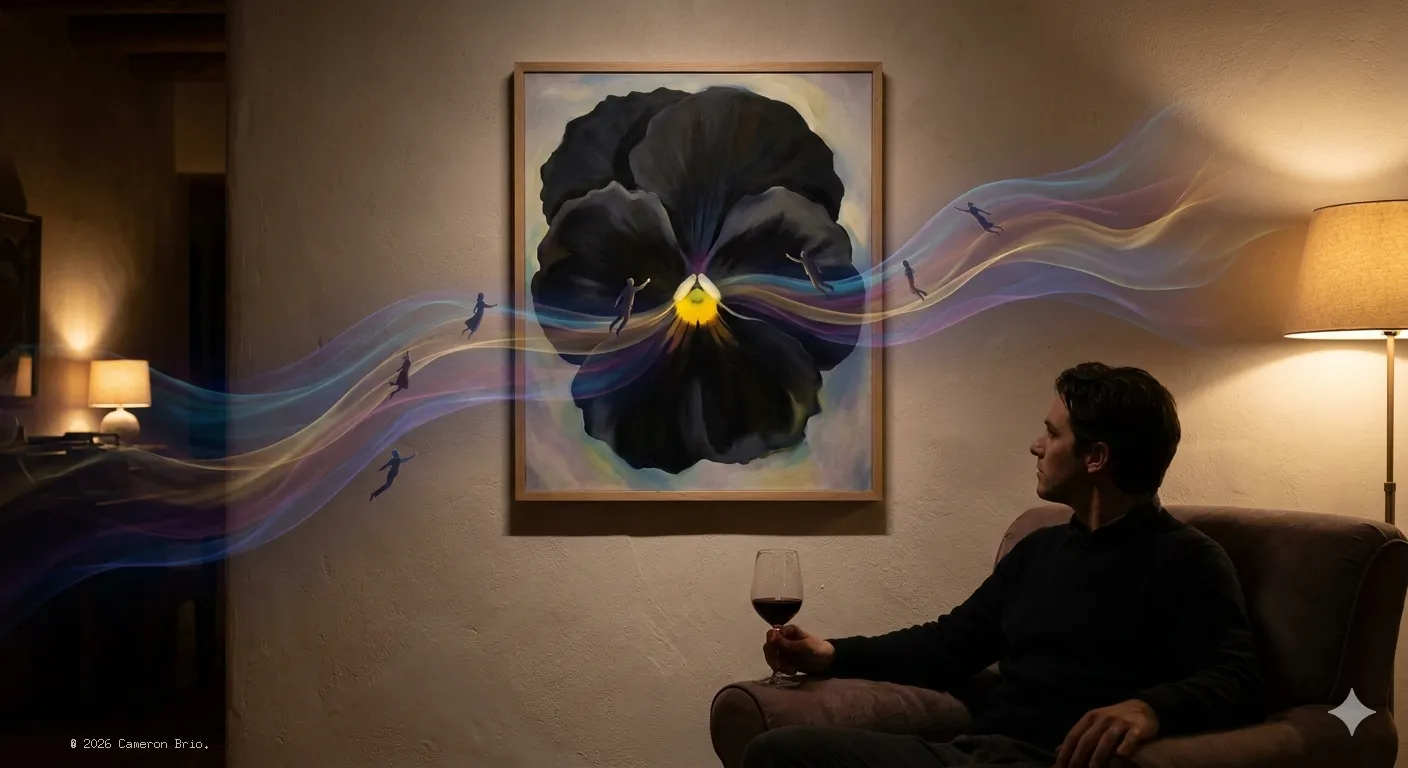
I sat in my quiet corner, enjoying my cheesecake and coffee. I made a mental note of this spot; it would be a perfect place to bring Beatrice. These small, tranquil pockets of the MGM aren't advertised, but I found myself admiring the decor. The painting on the wall beside my table, though in harmony with the room, stood out with a life of its own. It seemed like an original, though the lighting was too dim to seek a signature on the canvas. I felt I owed it to the artist to make the effort. I leaned in. It was a copy of Georgia O’Keeffe’s Pansy, 1926. I hadn't noticed a mix of colors quite like that before: the yellow stigma of the flower glowing with its own light, contrasting sharply against black petals on a light blue background. It was nearly surreal. The different elements of the flower, paired with the subtle background, created a dimension of their own. The density of the contrast seemed to shift with every slight movement of my head—likely an optical illusion created by the tiny spotlights glowing above the frame.
I found myself enthralled. I was beginning to understand why people can stare at a single painting for hours. It was ironic that I had to stumble upon this romantic corner because of a bad encounter I had ultimately helped develop—in a bar, in a casino-hotel. I couldn't help but ponder the artistic value of the piece. Had it been hanging in a museum, I might have walked right past it. Why don't museums present paintings with this kind of directed optical artwork? If they did, would the painting and the lighting become a single, unified piece of art? Despite the digression, the painting felt like a bonus for the trip. I decided then that I would look up Georgia O’Keeffe later to see if she had painted more of these flowers. At the same time, I was still trying to focus on the Kolb model. I realized I had to adjust a few things before I could truly utilize it; I had to define an overall direction. Why am I doing this? Was it just because I wanted to play with a fresh idea using a practical example? Did I genuinely believe that reflecting on my thoughts would help me see things more clearly—or better yet, help me avoid making the same mistakes again?
I knew I had to remain neutral and objective. I had to view myself from the outside and filter out my own biases. That wouldn't be easy; no one likes to admit their own bias, and I didn't yet know how mine had contributed to my easy agreement to this trip. I also needed to write down an assessment of the characters involved, but I found that difficult. I had spent years cultivating a "second nature" of not talking about other people—even in the privacy of my own mind. To me, talking about others was like hosting a guest who would never leave. You have to be careful whom you invite in. They must have an invitation and a valid reason to be there; curiosity or "shooting the breeze" isn't enough. It’s a tempting vice, one that many justify as "social analysis." It isn't just gossip in homes or coffee shops anymore; entire industries now cash in on this temptation.
As Joel Osteen might say: "Run from temptation." If you let it in, you can’t always stop it where you want to. This very casino was a testament to that lack of a "stop" button. For me, talking about others felt like it devalued my curiosity about nature, its rules, and its hidden beauty. I was convinced that gossip poisons the mind. I had kept up the habit of looking past "personality" to the point where no person stimulated my interest based on their character alone—not artists, not athletes. I was interested in the work, not the person, even if one complemented the other. I seemed to be on my own with that philosophy. Gossip even bleeds into professional settings. I’ve read plenty about Jackson Pollock’s drinking and his abusive relationships; reviewers often mix his personal life into his work to find some "angle of redemption." But when I first watched a clip of him pouring paint onto a canvas, I didn't see a "troubled man." I saw an artist with a unique curiosity and the ability to transform his thoughts into motion. This was exactly what Chavez had explained: something is awakened inside us—the symmetry and rules of nature combined with the instruments man creates—to help an idea take form. I hadn't written much down yet, but I didn't feel bad. I now had the blueprint for how I would finish my reflection. It was going to be a long night. It was almost time to meet Dave.
The Scholarly Mirror
Martha seemed content. I tried to offer a word every now and then while she watched her programs, but I suspect it didn't matter what I was doing, as long as I was there and awake. But now, I have to dive in. I have to get started.Primary Goals:
- Why did I agree to this trip, knowing the odds were stacked against it?
- What steps must I take—and what must I watch for—until we reach Seattle?
Tools for Discovery:
- An account of the characters involved.
- An identification of my own bias.
An Account of the Characters
Ben I’ve heard whispers around the lot that Ben might have a Master’s degree in Art or History. His fancy car, his clothes, and his array of credit cards suggest he has the backing of a family with resources. His routine is a familiar one: a family that provides the basics plus enough "play money" to keep him afloat, holding onto the flickering hope that he’ll eventually find his path. He pays no attention to his surroundings unless they serve his immediate desires. For the most part, he seems more destructive toward himself than others. However, being connected to a family with resources is a unique kind of danger; people like that often have proxies—volunteers who pave their way just to ingratiate themselves with the source of the money. Ben has likely been in a hole many times before. With every mistake, his family grows more weary, but he knows that if he’s truly cornered, he can make one appealing phone call and help will arrive. For now, he prefers to settle his debts with the hand he has: the manipulation of Charles. He seems to recognize that I’ve looked out for the group, but he likely views my help as his entitlement—just another person falling in line to assist him.
Charles He has a business degree from a local university. I remember a driver once trying to downplay Charles's education because he didn't go to a prestigious state school like the UW. Charles’s problem isn't gambling per se; it’s a false sense of entitlement. He needs an anchor, and as long as he’s attached to Ben, he feels invincible. He carries a deep-seated resentment and jealousy toward those around him. At the lot, he is demure and humble—a perfect mask to draw people in. But Charles needs an enemy. If one doesn't exist, he’ll create one. Like Peter, he has a sense of Sun Tzu about him, but it’s rooted in callousness rather than courage. He practices the art of harassing the enemy at the gates not as a means to a goal, but for the sheer joy of the insult. He only picks a fight when he is certain the opponent is significantly weaker.
A sinister look from a stranger in a strange city is a tell-tale sign. It’s the low-level soldier letting the opponent know the line has been drawn. The interpretation of Charles’s look was clear: Bring the money we left with you, and bring it now. It’s a delusional, almost comical demand, but it depicts his reality.
Peter The easiest to read, as his story is well-known at the lot. He used to teach Political Science at the University of Montana. There’s a gap in his history that he evades, but after draining his severance and savings, he found himself overqualified for anything in Missoula. He moved to the Emerald City and took up cab driving to supplement his card-room visits. He appears content with the status quo, but he is quietly, passively calculating his next move. He is dangerously unafraid of consequences. You can’t scare a man like that into submission; if he submits, it’s because he has reached a logical conclusion to do so—like a male elephant in Kerala that allows itself to be chained because it knows there is nowhere left to run. Peter poses no immediate danger to me, but his cold, calculated nature and his ties to Ben mean he would not hesitate to join a "collective vice" if pushed.
Finding the Bias
What is the common denominator? Higher Education. I realize now I have a deep bias toward the educated. Did I agree to this trip because I subconsciously found common ground with these men? I look at my life: Jeneen has a social science degree. Beatrice has a degree in Chemistry. Her brother-in-law, George, is in Computer Science. Even I needed a degree just to get into Law School—mine was a B.S. in Sociology. Does that make me a hypocrite? I claim to avoid the "Yuppies," preferring the blue-collar taverns of Northgate, yet I don't have a single friend who doesn't have a college degree. I drive a cab, but I live in a world of credentials.
The Strategy How does this help me for the rest of the trip? I have two tasks: I must be the one to drive through the Desert Stretch, and I must avoid conversation until we reach Seattle. Or, perhaps, the best solution is to not join them at all. I have no set schedule. I could stay here another day, then take a bus or a plane back. But the trip has brought some good. I’ve reaffirmed my ability to handle a crisis, and I now know the work of Georgia O’Keeffe. Kolb’s Reflective Model Summary:
- Concrete Experience: I took a potentially dangerous trip with no plan for unpredictable consequences. The full impact is still unknown.
- Reflective Observation: I am now aware of my own inner psychology and my intellectual bias.
- Abstract Conceptualization: The "wrecking crew" moved out of my control initially. I have regained it, but I must keep my guard up, maintain distance, and avoid confrontation.
- Active Experimentation: Should I end the trip here? If I go back with them, I must drive the Desert Stretch and ensure I don't sleep in that car.
I’ll hold these questions for now. There is no right or wrong answer yet. It’s 4:30 AM. Martha is asleep, but the TV is still humming. I’ll know more after I see Peter in a couple of hours.
The Five-Dime Exchange
I finally called a cab, refusing to bother Dave for another ride. I knew better than to show up at the poker room. Instead, I stopped at the concierge desk in the main lobby. I asked them to recommend a proper restaurant—not a buffet—and left instructions for them to let Peter know where to find me. It was around 7:15 AM when Peter walked in. Given the sheer scale of the MGM, it must have taken him several minutes to navigate the halls; I took his punctual arrival as a good omen. His hands were empty. If he had won anything, he’d already cashed out his chips. He sat down, looking utterly spent. As he flagged down a waiter, he handed me an envelope.
"Five dimes," he said. "Exactly."I opened the envelope and did a quick count to verify: five thousand dollars. I had dropped a hint to Dave about this possibility the night before. He couldn't handle the transfer himself, but he offered to send his cousin—the one who had helped us haul an engine during one of Dave's restoration projects. I didn't waste a second. I walked to the host station near the entrance and asked the waitress for the phone to call him. On my way back to the table, a surprising thought struck me. It wasn't just that Peter had survived the game with such a low buy-in; it was the modest size of the winnings. After clearing the initial hurdle, he should have surged much higher—unless I had caught him at the bottom of a wave, interrupting his momentum with my 7:00 AM deadline. He didn't seem to mind, though. I quickly regained my detached demeanor. My priority was to get this transaction over with and then decide whether to join them for the trip back.
Dave’s cousin arrived shortly after. To my relief, he didn't approach the table. I had no desire to introduce him to Peter. I simply handed the envelope, along with a note, to our waiter. I offered a silent nod of thanks to the cousin as he retrieved the package from the waiter and slipped away. That was it. My part was done. Peter could call home later to verify the arrival of the money if he chose, but I had a feeling he wouldn't bother. We sat in silence. We didn't discuss the game or the night’s events. Judging by the way he attacked his breakfast and the strawberry cake, it had been a grueling session. Only after his third coffee did he begin to look relaxed. I decided to test the waters.
"Is the car gassed up?"
It was an out-of-bounds question. Peter had been at the table all night, and it was highly unlikely the other two would have the foresight to fuel the vehicle. I hadn't planned on asking, and I didn't want to sound sarcastic, but the words were out. "Probably not," Peter said, oblivious to my tone. "The car isn't here. Those guys drove it back last night." He sensed my curiosity and continued.
"They came and went a few times. The other players were getting annoyed. I gave them a few chips around 2:00 AM, and they didn't come back after that."
I gestured to the waiter for more coffee, desperate to break the rhythm of the conversation. Peter’s account was odd, but I truly didn’t want to know more. My only interests were that the money was en route to Seattle and that their car had vanished. But then, Peter abandoned his detached pose. Perhaps because he saw that I had fulfilled my end of our secret bargain, he moved closer to the heart of the matter.
"I guess you're not coming back with us?" he asked. His voice carried a subtle weight, suggesting he actually wanted me there.
I didn't want to offer a long explanation. I only asked, "Will it make a difference?" Peter took a long time stirring extra sugar into his coffee. Finally, he posed a question that was also an answer—one I already knew.
"With those two?"
The Mustard Yellow Impala
Up to that point, I’d been pleased with myself. I was spinning the trip as a positive experience, proud of my imperfect attempt to apply Kolb’s model and admit my own biases. Overnight, I had felt like a new man. But then, a cold sweat broke across my forehead, and my shoulders felt heavy with a sudden weight. I already knew what I was going to do the moment Peter finished his sentence. Why can't I just stick to the logic of the model? I wondered. Why do human emotions always interfere? For a second, I tried to force my thoughts back toward pure logic, but it was no use. My only comfort was the thought that I could still go back and look up more of Georgia O’Keeffe’s work. I dropped my detached facade abruptly.
I looked Peter in the eye and said, "Let's go."
We took a short cab ride to the Donner Inn. There it was: the mustard-yellow Impala, parked at a slight angle at the foot of the stairs. We headed up. I saw Charles already pacing in front of the room. Something was wrong. Peter walked ahead of me and went inside, casually gathered a few things, and was back out by the time I reached the door. It was odd that he didn't go to his own room two doors down, but I didn't ask for an explanation. As I approached, Charles offered me a humble smile that only made me more uneasy. He presented it with the same audacity as his earlier sinister look. I tried to ignore his masked, demure demeanor as I slowed my pace. It was close to checkout time. The motel didn't have a formal process, but the cleaning crew would be arriving soon to clear the rooms. Things weren't adding up. I thought of Kolb’s model again, but my mind refused to operate on cold logic; I settled for simply appearing cold. I nodded to Charles and looked inside. Ben was half-asleep, moaning and mumbling, making no effort to get up. I was furious inside, but I kept my composure. Seizing the opportunity, I said to Peter,
"Let's go gas up the car."
As expected, the tank was bone-dry; we barely made it to the nearest station. After I pumped the gas, I realized I needed a few minutes to think. I pulled over to the air hose, checking the tires and adjusting the pressure on the driver's side—a necessary distraction. Then, I simply leaned against the car and watched the traffic across the street. Peter didn't join me; he paced in a rhythmic, horizontal pendulum under the station sign, waiting for my decision. I was fed up with the two of them. They weren't outsmarting me—or Peter, for that matter—they were just unpredictable, fueled by an unlimited sense of audacity and denial. I had a feeling they wouldn't have acted this way if they were alone; I suspected Peter felt the same. I couldn't back out now. I made a quick plan and promised myself I wouldn't deviate:
- Go back to the motel.
- If Ben was in a state I didn't even want to contemplate, call the medics and make sure someone notified his family. Then, leave them all.
- But if Ben could talk and walk straight, put him in the car and prepare for an unpleasant trip back to Seattle.
I felt like Peter would have been relieved to hear the summary of my plan, but I didn't feel like talking. The fact that I was behind the wheel as he got in said enough. As we drove, a massive wave of exhaustion hit me. I felt a light dizziness as the lack of sleep from the last few days finally caught up. I could have taken time to rest and take the group to a proper breakfast, but instead, we hit a McDonald’s for coffee and food to go—fuel for the "medicine" the others would need. I got my answer the moment we pulled back into the motel lot. I could see Ben hovering over the wooden railing in front of the room. His swollen face and the tangled sheet still draped over his shoulder were tell-tale signs of the places they had been all night—places I had no desire to know. But they were ahead of us. Ben was already holding a coffee, and Charles stood beside him, almost motionless. They looked so calm and casual that, if I hadn't been part of this ordeal, it would have looked like the lazy start to a pleasant road trip.
The Kick of the Horse
Finally, Ben was settled into the front seat. Charles had even managed to find a cup holder for his coffee—a trivial detail, perhaps, but one that revealed the depth of their codependency. I didn't realize the danger until it was too late: Charles was behind the wheel. We still had a good ninety miles before we reached the Desert Stretch, and I figured I could use that time to calm my nerves. I planned to seize control of the car at the first rest stop once we cleared the city limits.
For a while, Charles drove with surprising grace, likely out of respect for Ben’s splitting headache. He came to smooth, polished stops at every intersection, playing the pedals against each other to eliminate any kickback. It was a trick we used to impress passengers in Seattle, especially on the steep, punishing inclines of Columbia Street between Second and Fifth Avenue.
As the rhythm of the road lulled me, I drifted back to Georgia O’Keeffe’s Pansy. I wondered where the original was now—a museum, a private collection, or lost to time with only copies left to witness? I imagined myself sitting before it, staring into the canvas with a glass of red wine. I could see the waves of colored light passing by, carrying people shrunken to the size of my palm. Some pointed toward the yellow stigma; others tried to leap and grab the black petals as they began to rotate in slow, uneven circles.
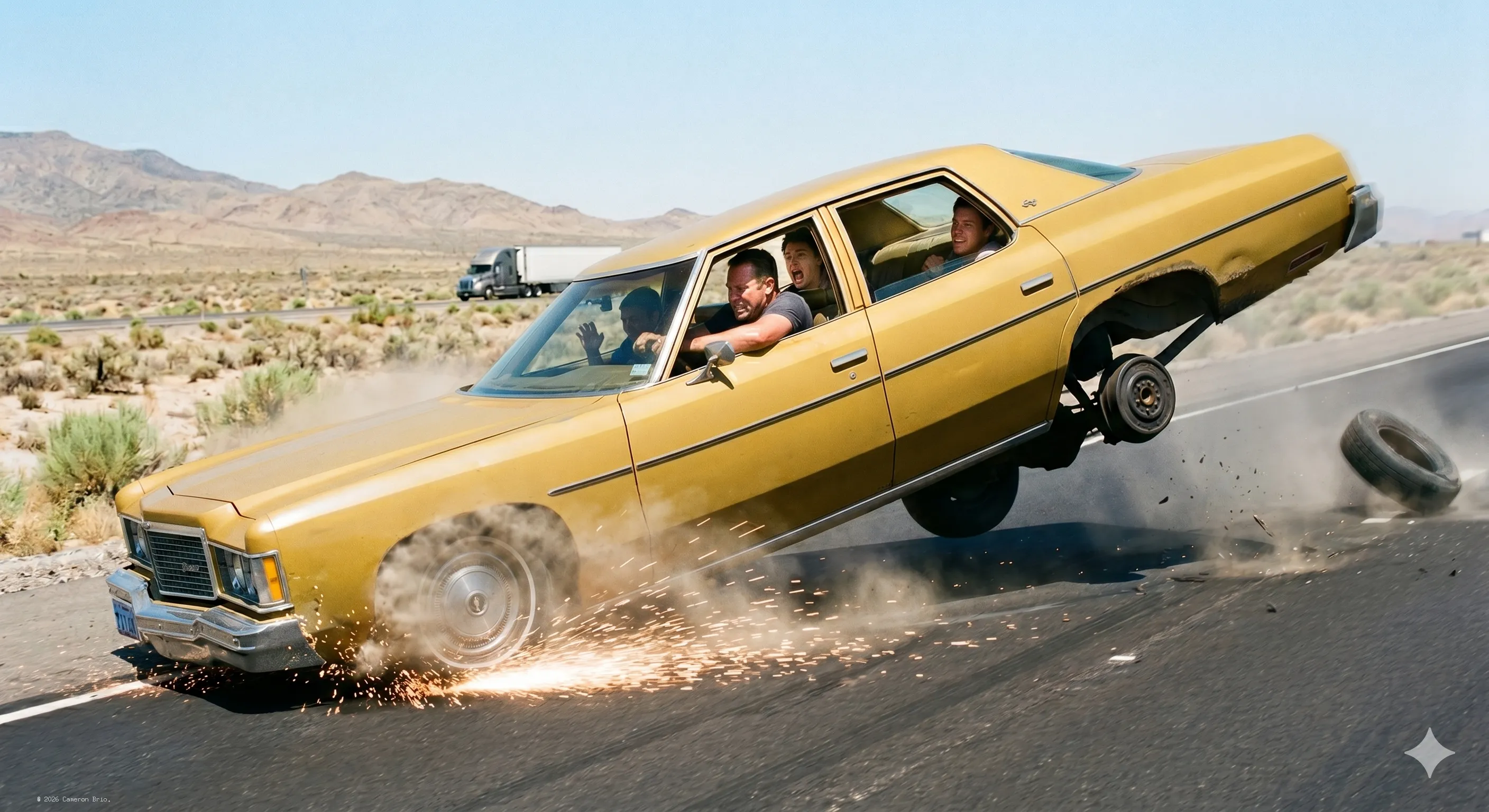
Suddenly, I was ripped from the dream. I couldn't breathe. My eyes snapped open, glued to the odometer: it read seventy-five. In the rearview mirror, I saw Charles’s face—a jagged, terrifying grin fixed on his features. Before I could utter a word, a muffled explosion tore through the cabin, sounding like ten shotguns firing in unison. I was thrown forward. I reached out, desperate to grab onto anything, but I felt weightless. I was in the air. As the world tilted, I saw Peter just beginning to wake up. Through the rear window, the horizon disappeared as the car began to flip. The entire back end was launched upward, like the hind legs of a horse that had just kicked off its rider. I heard the sickening screech of the front bumper grinding against the road. Everything began to spin with the violence of a high-magnitude earthquake. Then came another muffled thud, much weaker than the first. The rear of the car slammed back down onto the asphalt. The Impala continued to shake, skidding at a sharp angle across the width of the road before finally shuddering to a halt. The engine was still running, but it was accompanied by a frantic clicking and a relentless, multi-directional hissing, as if the entire machine were preparing to burst.
The Desert Stillness
After a few seconds, the world stopped spinning. The sounds of the wreckage began to thin out, and my internal auto-pilot kicked in. It had happened to me before, though never to this extent—a mechanical focus that rises to the surface after an accident, pulling helpful details from the back of my mind to control the scene. It’s a survival instinct I can’t quite explain, but it arrived naturally. With my vision still blurry, I reached over and twisted the key to kill the engine. I looked around the cabin; all three men appeared beaten and confused. We were a few miles into the Desert Stretch, and the heat was already intense. I knew that a post-roll explosion usually occurs when fuel travels to opposite ends of the system and collides, and while we hadn't made a full flip, I wasn't taking chances.
"Get out! Get out now!" I yelled.
For the first few seconds, they didn't move. Finally, Peter scrambled out and helped Ben. I went for Charles. He was dazed but didn't look injured. I expected to see blood, but the windshield was intact. His tall stature and long arms had actually saved him; by hunching over the wheel, he had locked himself into position and absorbed the impact. He seemed to be in shock. He was too heavy for me to pull, so I resorted to screaming directly into his ear. That broke the spell. He tried to drag himself out, nearly tumbling backward onto the asphalt until Peter joined me to catch him. We managed to get the two of them away from the car and sat them down by the roadside. They sat there, slowly processing the reality of the wreck. They weren't bleeding—just hollowed out by the shock. Then came the new worry: another car. At high noon, the shimmering heat of the Desert Stretch could easily disguise the mustard-yellow silhouette of our car until a driver was right on top of it.
Ben began to shake slightly. "Is there any water in the car?" I asked Peter calmly. Ben tried to move toward the wreck, but I cut him off. "Sit down. Don’t move," I ordered Ben kindly. He obeyed instantly. I stripped off my shirt and ordered Peter to do the same. I told the other two to stay put so they wouldn't interfere. Peter and I took up positions on either side of the road, eyes glued to the shimmering horizons, ready to wave our shirts like signal flags. A few minutes passed without a single vehicle in sight. To my surprise, the Impala actually started back up. I drove it just far enough to clear the roadway. The evidence of the disaster was strewn across the asphalt: the deep grooves of the screeching bumper, jagged skid marks, and the shredded remains of the tire. The smell of "rusty cans" returned, and my mind kept replaying the explosive sound of the tire blowing apart.
Once the wrecking crew seemed stable, a small truck appeared, roared past us, and vanished. It offered no comfort. I couldn't stop thinking about how much worse it would have been if a front tire had been the one to go. Charles finally found his composure. He started pacing, carefully avoiding my gaze, though he would frequently circle back to Ben to mumble something in his ear. I inspected the car and had Peter do the same. The engine was running, but the spare was a "donut" designed only for short distances, and a persistent, ominous hissing was coming from the axle. Peter confirmed my suspicion: the car was totaled. Even if it weren't, I was done with it. In the back of my mind, I felt a strange sense of admiration for the Impala’s suspension. I was thankful it had held up long enough to keep us alive. I took a deep breath and started walking away from the group, seeking a moment of distance. Peter took the signal and moved toward the others. As I’d stood there waving my shirt, I had spotted the corner of a building at the far end of the road, just before the terrain dipped. I allowed myself a few moments of silence.
Then, without regret, I told myself: "Let’s do some business."
The Road to the Patrol Office
The building was a State Patrol station. It was exactly what I needed. My split-second glimpse of that corner had been nothing short of a miracle; seeing that sliver of architecture had mapped out my entire plan, step by step. I started pacing toward Ben. Before I could speak, he had a question ready for me.
"What do we do?" he asked, his voice genuine, a literal cry for help. He had surrendered completely, humbly placing his fate in my hands. I had sensed this shift minutes earlier, shortly after the "staged" accident—as I’d come to think of it—had occurred.
I offered a smile as kind and genuine as I could muster. "Who did you borrow the car from?" I asked, meaning which owner at the lot.
There were only three possibilities. It didn't matter if he answered, or even if he answered correctly; I just knew that, for once, I was going to get the truth. I still didn't trust any of them fully, so I ordered them to stay put until I returned. Charles was still pacing, though I knew his stamina wouldn't last long in this heat. He was ranting to himself now, keeping a wide berth from Ben. Despite everything—the hunger, the shock, the thirst—Peter’s face remained as inscrutable as it had been at the Grand Café in the MGM. Even in the professional poker world, he would be considered the coolest head in the room. He was a good soldier, too. Since the accident, he had obeyed every order, not out of confusion or fear, but because he had made a conscious choice to follow the best lead available.
Judging the distance, I had a good fifteen minutes of walking ahead of me. I moved slowly, wary of the heat. I tried to distract myself with my favorite philosophical subjects, but my thoughts kept circling back to Charles. I recalled passages from Marcus Aurelius’s Meditations about how we are all connected, but I struggled to see how I could be linked to someone like him.
I was tired, thirsty, and feeling a dangerous sense of righteousness. For this one time, I allowed my thoughts to drift and finally "talk" about him in the theater of my mind. I was walking through the Desert Stretch, exhausted, and he was still lurking in the margins of my life. He was the true definition of a "class act"—the one-of-a-kind, all-around leech. He had sold his soul, not to a divine power, but to an empty promise locked in the abyss. He had stripped himself of every shred of decency, blinding himself to the beauty of the world. In simple, unpoetic terms: he would likely never earn more than nineteen thousand a year and would end up marrying the ex-wife of Ben’s older brother.
But as soon as the thought formed, I took it back. That wasn't who I was. Where did he go wrong? I wondered. Why was it that a human like me was blessed with two of the greatest women in the world—women to die for—while the universe strengthened my ability to see its beauty and its wrath in everything? Why was I allowed that, while another man was robbed of even a glimpse of it, left to drown in a diluted world that shrank day after day? We are meant to be different, but
why are we created and raised to be worlds apart? So far apart that some of us miss the taste of the very humanity we belong to, forced to live in the same prism of grit, greed, and denial we spend our lives trying to escape.I decided right then: I was going to fix this. I was going to fix it for each of the three of them. That was the connection Marcus Aurelius spoke of. Today, while dragging my thirsty, exhausted body through the hundred-degree heat, I realized that these three—while not my friends—deserved to return to Seattle with their dignity intact.
The Art of the Trade
The air-conditioned lobby felt unreal—a gift in and of itself. Through a large window to my left, an officer caught my eye. He wore a faint, knowing smile, the look of a man who had seen this exact scene a hundred times before. He quickly looked away, granting me the professional courtesy of letting me compose myself before I approached the desk. The lobby was small but functional. I went for the water fountain first, the cold stream a miracle against the desert parching. I washed my face in the clean restroom, the shock of the water making me forget, for one blissful minute, exactly where I was.
Before addressing the officers, I called Beatrice. I told her I’d be a day late. I wasn't worried about an "I told you so," so I brought it up myself for a laugh. Hearing her voice restored my equilibrium. I couldn't help mentioning Georgia O’Keeffe; Beatrice knew of her work and even mentioned a gallery in Bellevue that sold prints. That small tether to my "real" life gave me the final bit of balance I needed.
The reporting was the easiest part. I provided a concise summary of the accident, omitting only my specific memory of the speedometer, though I’m certain they deduced our speed from the physics of the skid marks. They kindly offered to send a cruiser to pick up the others, but I refused. The tow truck was only fifteen minutes away; the wrecking crew could survive the heat for a few more minutes. I used the time to call the car’s owner back in Seattle.
He was strangely helpful—sympathetic, even apologetic. I wondered if our "cargo," Ben, had something to do with his sudden change of heart. According to the owner, he had offered to have the lot mechanic check the car and rotate the tires before we left.
I did the math in my head: they rotate tires diagonally. Had they simply moved the rubber without replacing it, that failing tire would have ended up on the front driver’s side. At seventy-five miles per hour, we wouldn’t have just skidded; we would have performed a somersault or two before shattering against the asphalt.
The owner didn't care about the car. He’d already squeezed enough profit out of that Impala over the years; he considered it a favor just to have it discarded. He accepted the ultimate responsibility, admitting he never should have let the vehicle leave the lot unchecked. I took his words at face value and told him I intended to dispose of the car right there.
When the tow truck driver arrived, I saw my opening. I knew that even as scrap, the Impala was a gold mine for a junk yard. Between the intact engine and various parts, he could easily net five or six hundred dollars over the long haul. He offered me a measly hundred and twenty-five dollars for the title.
"I'll take it," I said, "if you throw one thing into the deal: You arrange a private car to take the four of us back to Reno."
He agreed. Before we left, the driver headed down to the wreck site to retrieve the crew. Meanwhile, I put the owner on the phone with the driver to arrange the transfer of the title—a document that would likely sit in a dusty junk yard office and never see a registration desk again.
The wrecking crew looked utterly defeated when they finally shuffled into the lobby. They took turns at the water fountain before slouching onto the plastic chairs, half-asleep and drained of their earlier audacity. Shortly after, the tow truck driver’s wife arrived in a personal car to ferry us back to Reno.
The King Street Station Solution
I wasn't done yet. I didn't want any of them cashing in their final chips or making a desperate, last-resort appeal for help. Besides, in the chaos of the crash, they had completely lost sight of the emergency funds I was still holding for them. The crew was dead on their feet, still drained by the brutal heat of the Desert Stretch. I asked the driver to pull over at Daniel’s. I paid her extra to wait and continue as my driver for a while longer. After securing a fresh motel room, buying them new T-shirts, and picking up some fast food, I finally felt the crew was stable enough to be left alone.
I laid five hundred dollars on the motel desk. I suggested they take the Amtrak back to Seattle’s King Street Station; it would cost about two hundred dollars for the three of them, and there was a dining car where they could eat while watching the scenery roll by.
Charles remained quiet, though I caught the lingering resentment in his eyes. I didn't mind. If only he knew the depths of the thoughts I’d had about him while walking toward that State Patrol office, he might have looked at me differently. Or perhaps not.
I felt a sharp pull to see Jeneen one last time before I left, but I resisted the urge to call. Beatrice was already one step ahead of me; she had contacted a travel agency in downtown Reno just in case I decided to take the expensive flight back home. I looked at the ticket. After the long night, the desert wreck, and the mental weight of the "wrecking crew," I decided I deserved the airfare.