I love movies; all kinds of them. But I’ve always had a particular thing for James Caan. He was a force in Rollerball, and I used to mumble to myself that he should have been the one in the epic roles—the ones they gave to Charlton Heston or Jack Nicholson. I remember watching an interview with Kirk Douglas where he said he would have paid the producers just to play McMurphy in One Flew Over the Cuckoo's Nest. I just shook my head. No, if it wasn’t Nicholson, it had to be Caan.
That was the case until I saw him in The Gambler.
I was at a family gathering—one of those mild parties where the smooth jazz plays softly and someone is always bound to ask, "What’s that supposed to mean?" about a topic better left alone. I was at the far end of the L-shaped room when someone hollered, "James Caan is on!"
I grabbed my drink and rushed over, hoping for a scene from Rollerball. But it wasn't. It was The Gambler. Within seconds, I felt the blood rushing to my face. Caan was playing a professor who just liked the rush—a man who wins on mathematical wisdom only to throw it all away on a compulsive bet the moment he gets home.
Watching him was like looking into a mirror I had spent years trying to break. I saw myself in the character; I felt like I could teach the actor how to act it. Terrified that my face would reveal my secret to the room, I bolted for the upstairs bathroom.
"I got a bit dizzy," I lied badly to my cousin through the door. "New pills."
When I finally came back downstairs, the air felt different. I felt like a stranger to my own family. I didn't have the same mask I had walked in with, and I knew I couldn't fix this one.
The interior of my cab usually felt like a sanctuary. I had been driving for twelve-hour shifts ever since I walked away from my third year of law school. I still had the "college look" on me—a trait my business fares loved. They liked my silence, my polite greetings, and the way I never pried.
It was raining, a typical Seattle drizzle, when I picked her up. She was going to West Seattle, a long trip that made the drive across town worth it. When she opened the door, she froze for a second, looking at me, then the cab.
"Do you know…" she started, then paused. I caught her eye in the rearview mirror and smiled—an "at your service" look. She finished with a meaningful smile and a "never mind."
"Her presence affected me more than I expected. Her grace was like an upward violin blow playing a slur of connected notes from Vitali’s Chaconne."
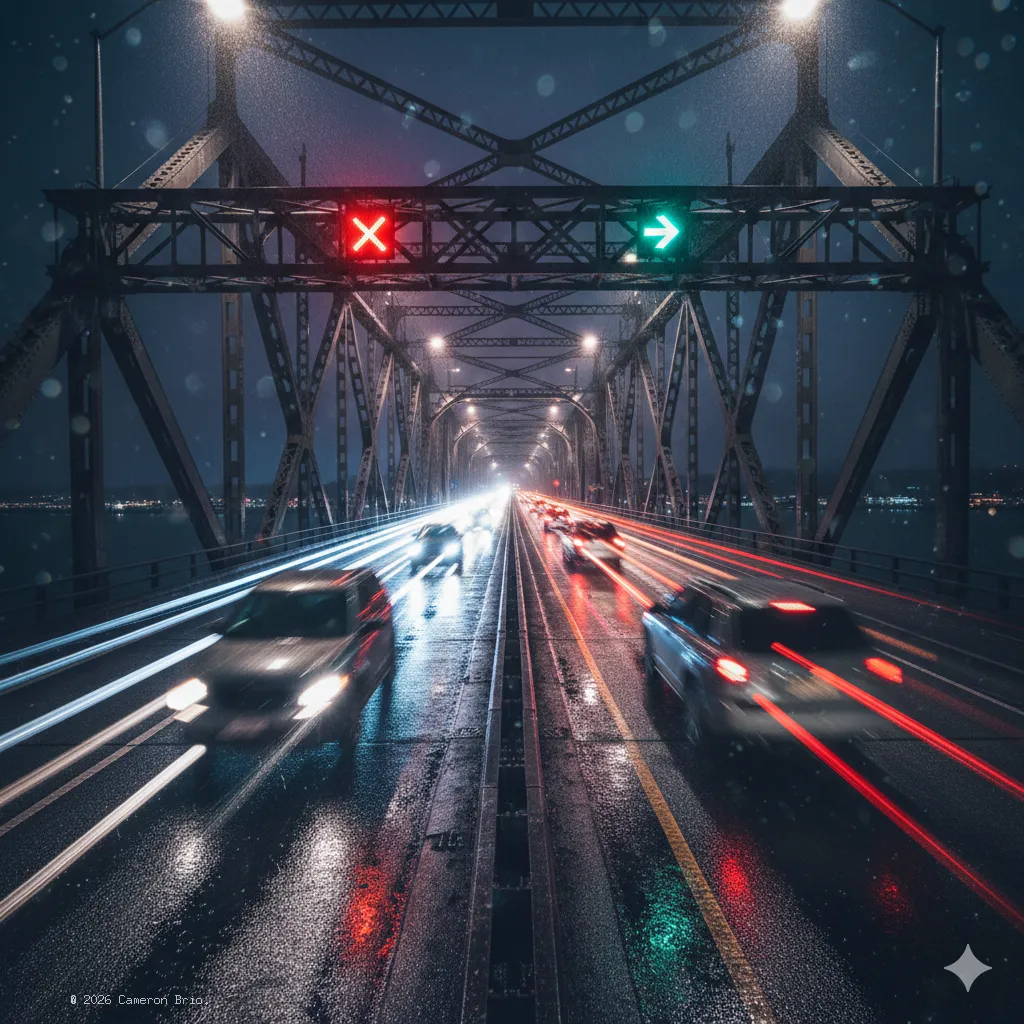
But the James Caan feeling was trailing me. As we approached the Lake Union bridge, my sense of appreciation got the better of my focus. We were traveling south in the fourth lane, and the Red X was fast approaching.
The bridge was a steel-grate surface, slick with rain. Beneath our tires, the pavement surrendered to a honeycomb of wet metal. I was doing fifty. The lane was ending. To my right, a river of steel surged in the green lanes.
My brain shifted into that feverish gambling math. I could slam the brakes and risk a pirouette into a logging truck, or I could hunt for the miracle. I chose the miracle. I always did. "Brace," I wanted to whisper, but I couldn't break the spell.
A flash of headlights appeared in my peripheral—a gap, or the illusion of one. I didn't check the blind spot; I felt it. I dumped the car into the right lane. The cab groaned. I felt the rear driver-side tire catch a groove—pop—a violent jolt that sent a shudder through the frame.
The car behind me blared its horn, but we were in. The traffic around us slowed, a collective intake of breath from a dozen strangers who had just witnessed a man go "all in" and win. I rolled down the window. The cold, salt-tinged air hit my face like a slap. I felt like Superman. I felt like a winner. I didn't realize then that the "miracle" was a lie.
I drove straight to the Dog House, the after-hours sanctuary for drivers and night-shifters. I sat at the counter, the "invisible thorns" of my secret life pressing into my shoulder blades. My order was a ritual: two slices of apple pie, vanilla ice cream, and my fourth coffee.
As I watched the steam rise, my mind drifted back to James Caan. Not the professor from The Gambler this time, but Frank from Thief. I thought about the collage he carries in his wallet—the "picture" of a life he wants but doesn't know how to inhabit. I realized then that I was carrying the same thing, only my "picture" was the law degree I never finished. Like Frank, I was a professional. I knew the technical precision of a "save." But I was a thief of my own time, stealing hours from a future I was too afraid to claim.
Millie moved through the diner like a ghost in a uniform. She had a seventy-year-old face and a brisk, youthful body. She slid the pie onto the counter with a heavy clack.
"You’re vibrating, dear," she said, her back to me.
"I saved a woman today," I muttered. "On the bridge. I pulled a move that... well, most couldn't have made it."
Millie didn't applaud. She turned around and locked her eyes onto mine.
"How was your trip?" she asked. "You’re going home soon. Right? To your own bed. Not the one in Reno. And not he one in Tulalip."
I froze. She reached out and rested her warm, steady hand on mine, nodding toward the window. Outside, a rare flare of Seattle sunset was bleeding across the sky.
The Superman cape finally fell off my shoulders. I stood up, left a handful of bills on the counter, and walked out into the fresh summer breeze. I stood on the sidewalk and looked at my cab. The cinematic filter was gone. I saw the truth of that fourth lane. There had been no car behind me. I had manufactured the danger just so I could be the one to solve it.
I wasn't James Caan. I was just a driver, finally learning how to navigate the road without needing to crash.
The Quiet Lane
The rain wasn't a dramatic "wash-the-sins-away" downpour any more. It was just a persistent, gray mist that clung to the windshield of my cab like a film of oil. For the first time in years, I was driving with my headlights on "low," staying exactly two miles under the limit in the middle lane. There were no miracles tonight. No "all-in" bets on the Lake Union bridge. Just the steady, rhythmic thwack-thwack of the wipers.
The silence in the cab was deafening. Without the internal roar of a manufactured crisis, I could hear every rattle in the door frame. I felt like James Caan at the end of Thief—not the part where he’s blowing up the house, but the moment right after. The moment he realizes that when you burn everything down, you’re the only one left standing in the dark.
I had been living other people’s lives for years, the rhythm of their conversations, the put-downs, the cheating business partners. I hadn't just read about the “Comedy of Errors,” I had seen it in my backseat. I always felt like I’d be better at it; I could read the deep desires of the women riding in the back, yet I felt invisible.
Sometimes, I played the part. I’d drop a fare, drive around the block, and knock on the door with my own keychain. "I think you left your keys in my cab..." A slick move that worked every time—until the night a husband answered the door.
I pulled the cab into the neon glow of the Dog House. I parked perfectly parallel to the curb. Millie was at the far end of the counter.
"Just one slice tonight, Millie," I said. "And maybe skip the caffeine. Make it a herbal tea."
The rag stopped moving. Millie looked up. "No 'save' tonight? No Superman cape caught in the door?"
"The bridge was just a bridge," I said. "I stayed in the middle lane. You ever take the 520 back from Bellevue late at night, Millie? On the left, Lake Washington is throwing a fit—white caps catching the moonlight like shattered glass. It looks like the inside of my head. But on the right, under the shadow of the bridge, it’s dead calm. Black as ink."
I described the breeze coming from both directions, the humming of different worlds. "It’s a gift, Millie. Seattle looks like a heavenly place trapped in a skid row of wealth that’s slipping away. But then the bridge ends, and I’m back."
Millie leaned on her elbows. "The high is a lie, honey. The boring part? That’s the only part that’s actually yours. Go to the back booth. Stop looking at the moon and start looking at the ink on the page."
I walked to the back booth and pulled out Prosser on Torts. I opened it to Res Ipsa Loquitur—"The thing speaks for itself." I had spent so long trying to be the narrator that I’d forgotten how to just be the evidence. I forced myself to read. One sentence. Then the second. It was the hardest thing I’d done in a decade.
When I finally left, I didn't reach for a "lost" key chain. I turned the key in my ignition and drove. I passed the exit for the casino, the neon lights a blur in my peripheral. Tonight, the magnet was broken. I stayed in the middle lane.
I wasn't a character in a movie. I was just a man heading home to a quiet apartment. I rolled down the window, letting the cool breeze hit my face. It didn't feel like a cinematic moment. It just felt like air.
Last Call at the Terminal
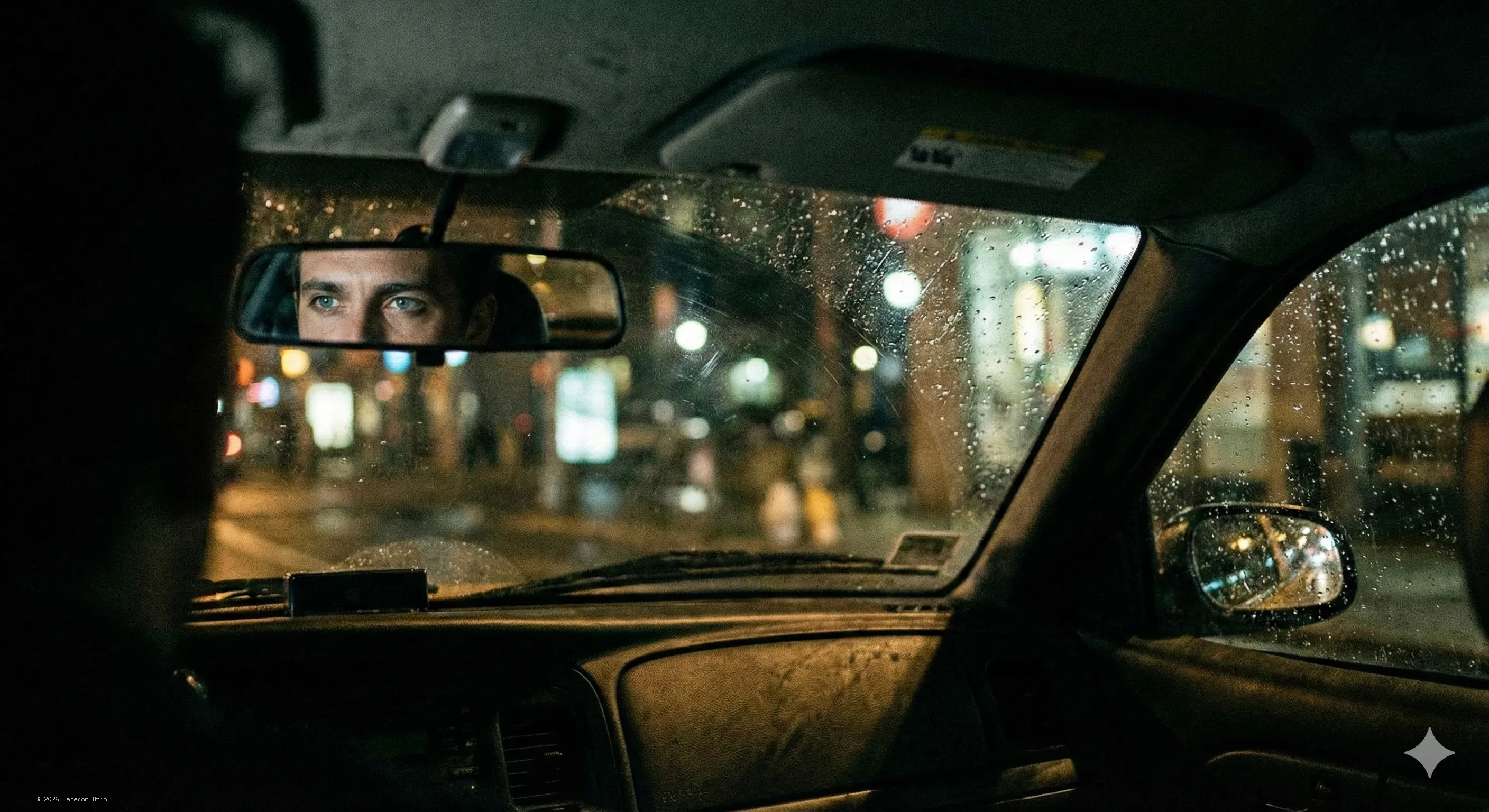
The side mirror of a taxi is a secret admiration tunnel. I discovered this months ago, sitting at the Spring Hotel stand, bored out of my skull. In that small, convex glass, the world appears smaller, condensed into a frame that’s handed to you for interpretation. No matter how hectic the Seattle streets are, the mirror grants you a version that is calm, possessing a beauty that only music could describe. I remember a woman once—tall, with dark-short hair, athletic yet fragile. She walked as if every step had a meaning. As she approached, her eyes caught mine in that glass. She gave me a deep, knowing smile right before she slipped out of the mirror’s peripheral. When she reached the front of the cab, she turned half around and finished the smile, as if she had read my mind and was thrilled by my silent admiration. She laughed a young, light laugh and kept walking."Go figure," I’d muttered to myself. "The first time I look at my mirror, I get caught."
Tonight, the mirror showed me something else. Through half-opened eyelids, I saw a tall, brown-haired man approaching. He wore a long raincoat that matched his hair, so clean-cut I couldn't tell if he was a quarterback, a real estate agent, or a junior lawyer running errands for a partner. I straightened my posture from the lazy slouch of a twelve-hour shift. Stop it, I told myself. Listen to you. You’re starting to sound like a ‘real’ cab driver.
Then he opened the door. The ocean-blue eyes gave it away instantly. It was Brad. My stomach turned, and I felt myself going pale, my body suddenly light as if I might float out of the seat. For a heartbeat, I wanted to bolt—to run down to the ferry terminal and never come back.
"...just up to Queen Anne, please," he said.
His voice brought my nerves back, but only just. I kept my face in the shadows, praying for green lights, desperate to get the trip over. I was a ghost in my own car. I didn't dare look in the rear-view mirror; I didn't want to see the ghost of the man I used to be reflected in his eyes.
"Hopefully this is not it, right?" The question hit the back of my head like a stone.I finally looked in the rearview, knowing the top of my face was masked by the cabin’s dark molding. I gave him a "what do you mean?" look as I signaled the turn.
"You don't look like a cab driver," Brad continued, his voice smooth, professional, yet holding a vibration I couldn't place.
"Looks like you’ve got something else going for yourself."
Relief washed over me, cold and sweet. Maybe he didn’t recognize me. I forced a smile into the mirror. "Sure," I said. "I've got something. I'll soon pay off."
As we climbed the long drag of the hill, the tension began to leak out of my shoulders. It didn't matter if he knew. We were just two men in a car, moving through the rain.
"Right here is fine," he said, pointing to a dark spot in front of a closed pizza shop.
I felt the old gambler’s worry prickle my skin. No one asks for the pizza shop unless they don’t want you to know where they live. I wondered if he had a "key chain" move of his own. I rolled down the automatic window as he stepped out. He didn't walk away. He leaned toward the window, pulled out a couple of neatly folded large bills, and gently placed them on my dash. He didn't look at the meter. He looked me straight in the eye, the blue of his pupils cutting through the Seattle dark."Hang in there," he said.
Before I could find my voice, before I could say his name or ask him how he knew, he disappeared around the corner. I sat there in the idling cab, the engine humming a low, lonely note, looking at the money on the dash. He had known the whole time. He hadn't just paid for the ride; he had paid for the silence.
The Alex Rieger Trap
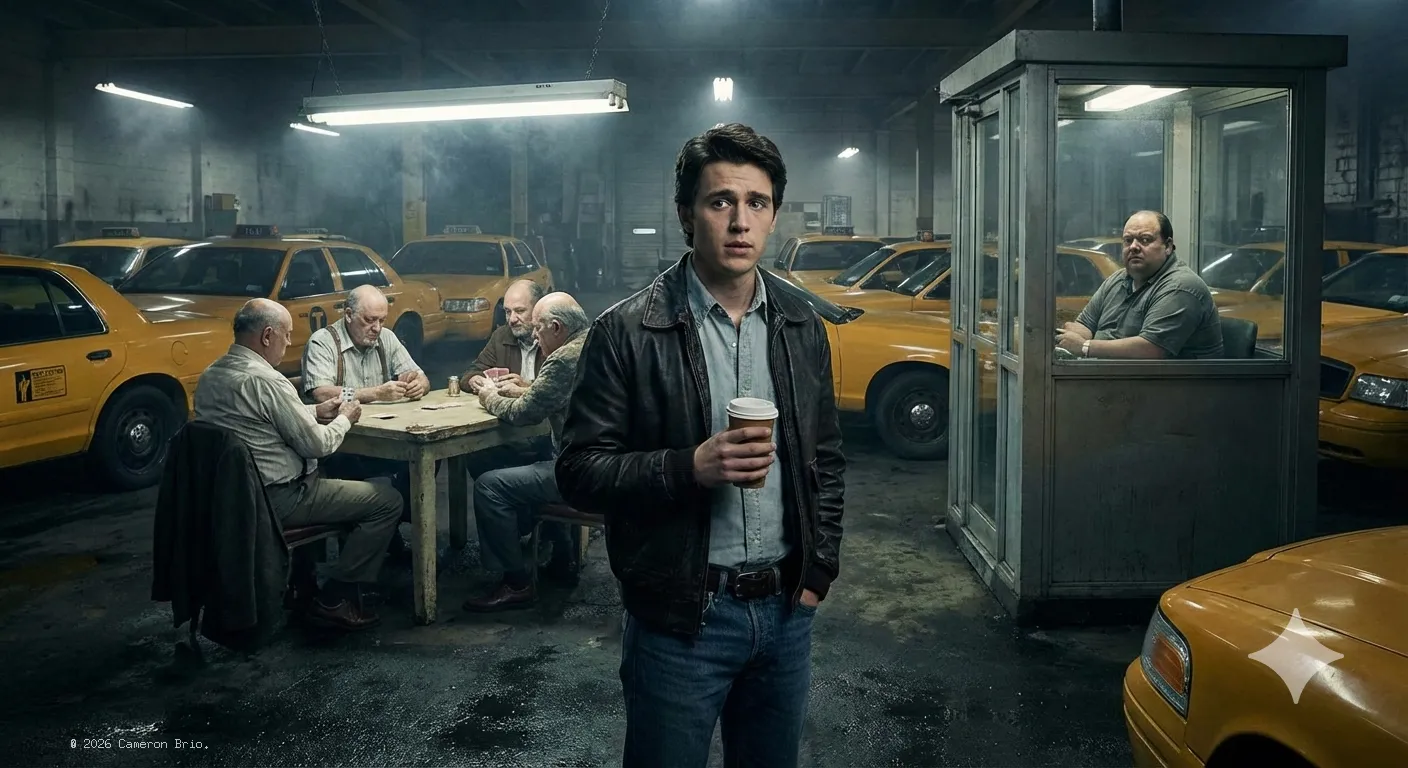
A lot of times, when I walked into the fleet lot, I felt like I was walking onto the set of Taxi. It was the exact same mise-en-scène, only smaller, smellier, and populated by a few more zombies. We had the whole cast: the scurfy, bald men playing purposeless card games in the corner; our own version of Louie De Palma, only taller, heavier, with small, fox-like eyes that suited his predatory nature.
And then there was me. I was trying so hard not to be Alex Rieger.I never went looking for movies or TV shows to mirror my life, but sometimes the screen is too damn honest. Producers take reality, tailor it, strip away the ugly hopelessness, and dress it up in pseudo-confidence and humor. But my world was numbingly more "real" than anything they ever dared to depict. It was the kind of realism that gets out of hand—like when The Sopranos writers accidentally scripted an actual insurance scam the New York mob was running because they’d researched the "truth" a little too well.
Secretly, at home, I never missed an episode of Taxi. It was my sanity check. I had made myself a promise: Don’t become the Alex Rieger.
I remember the episode where they introduced Elaine Nardo. She’s standing in that grimy lot with a naive smile, telling Alex that the cab is just a temporary gig while she works at the art gallery. She isn’t a "driver," she says.
And then Alex does it. He points around the room like a grim reaper with a clipboard. He points to Tony: "He’s not a cab driver; he’s a boxer." He points to Bobby: "He’s an actor." Finally, Elaine, her confidence bleeding out, asks him, "Who are you then?"
Alex just looks at her. "Oh, me? I’m a cab driver."
The first time I heard that line, I spun in my chair. A cold sweat broke across my neck. I rushed to the kitchen for a drink, but judging by the empty cans on the coffee table, there was nothing left. I settled for milk and a handful of brownies, forcing them down until my heart stopped hammering.
The writers had hit the nerve. They’d found the "miracle" I was hunting for and revealed it for what it was: a holding pattern.
I eventually came to terms with it. That episode became my favorite, a private haunting I revisited. I even felt a strange, protective pride for it. When the DGA Awards came around, I was mumbling at the TV like a lunatic: "No, no... it shouldn't be 'Jim's Inheritance' winning... it’s 'Elaine Nardo.' It has to be 'Elaine Nardo.'"
Because if Elaine could keep her gallery, maybe I could keep my law degree. But I looked at the scurfy men playing cards in the lot, and I knew I didn't have much time left. I was standing on the edge of the Rieger Trap, and the meter was still running.