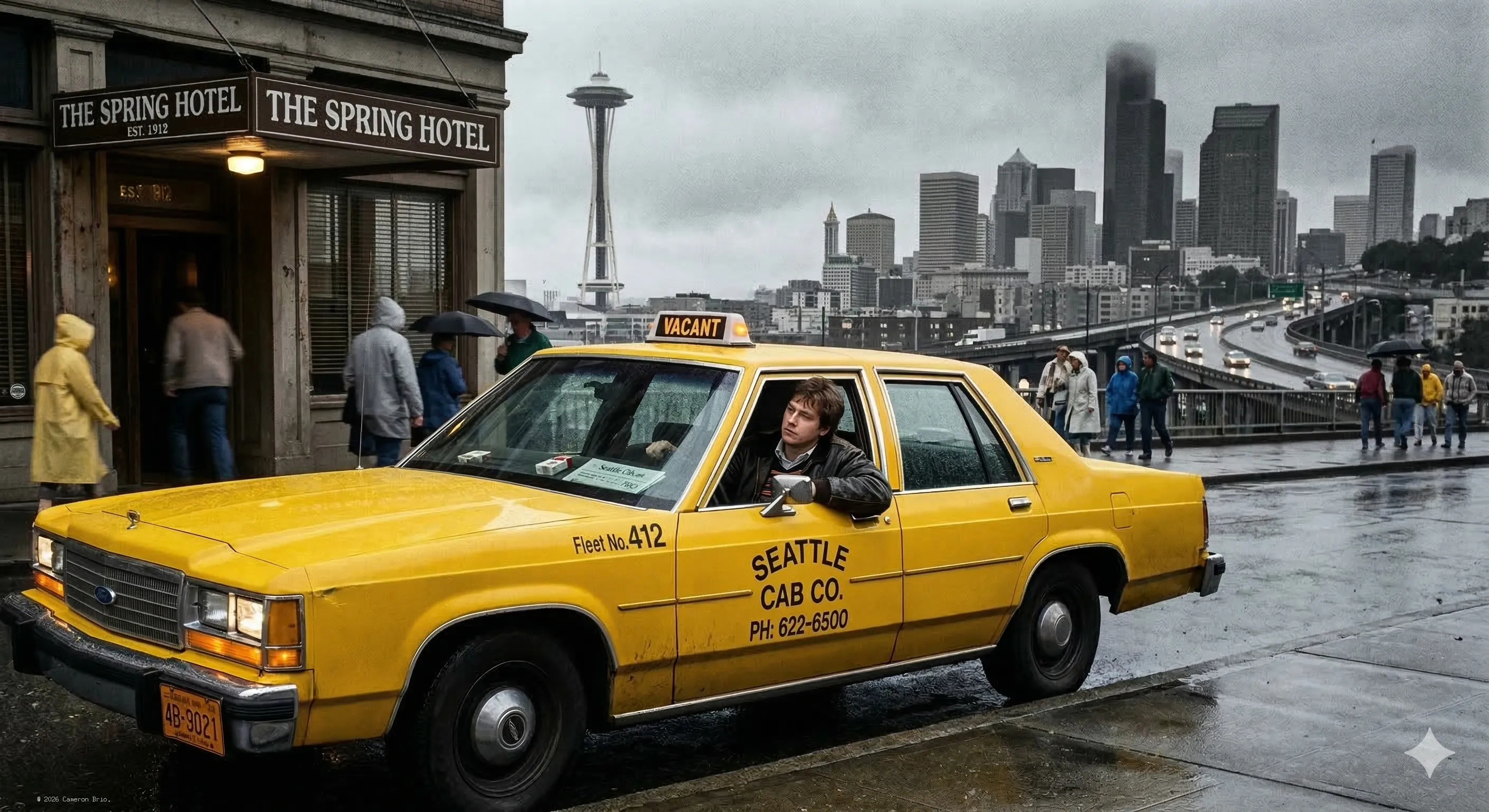
Quitting in my third year of law school was a double-edged sword.
Most of my fares offered a sympathetic nod when they heard the story, but back at the cab-lot, the lifers used my presence to validate their own shortcomings. I knew I was on the clock; my "college kid" look had an expiration date, and the city was already starting to etch lines around my eyes.
The Education of a Dead End
It was 1984. Seattle wasn't a metropolis yet, but it had cultivated all the vices of one. Most people saw a yellow car and thought of a utility. To us, the world was different. Cabs were mostly stationary objects. Unless it was the bar-rush in Pioneer Square or a major event like the Final Four, people didn't flag you down; they called and waited. Most drivers huddled at the hotel taxi stands, safe and stagnant.
But I was a "street" man. I drove everywhere. I picked up anybody: that was the only way to make money. I knew I couldn’t keep up with this for much longer. No matter how careful, dangers were still lurking at the night shift. There was yet another thing: cab-owners didn’t want you to put maximum mileage on the car. They much preferred if the driver sat at a taxi stand and took a few long trips; so did most of the drivers. But there were too many cabs on the road. I related to the movie Taxi Driver—to make money, you have to go everywhere and you can’t be choosy.
Driving a cab was supposed to be a temporary bridge. But I was learning that once you drive a cab, other doors don't just close—they weld shut. It’s not about a lack of skills; it’s about trust. When I interviewed for even the most mediocre entry-level jobs, I could see the suspicion behind the recruiter's desk. They never said it, but I could hear it: What’s wrong with him? My three years of law school, which should have been my greatest asset, had turned into a liability. It made me an anomaly. "Why would a man with three years of law school settle for this?" they’d ask with a crafty, sarcastic edge. To them, I wasn't an applicant; I was a mystery they didn't want to solve.
The Concrete Ecosystem
I wanted to define my own world, to stay above the grime of the cab-lot, but the plateau was fast approaching. It came to a head when I finally went to the manager to complain about the "partnerships"—the way the dispatchers would funnel the lucrative "shrewd calls" to their favorites over the radio.
"What are you even doing here?" The General Manager asked the question while playing with his red-striped suspenders. He was a replica of Clark Gable, right down to the mustache and the direct, realistic gaze. He’d come down to the lot on his day off to mediate.
"He’s coming down, right? Now, that is respect," the superintendent whispered, trying to butter me up.
I had a good case. I had evidence of the favoritism. But the GM didn't offer a rebuttal. He didn't need to. He just looked at me with a weary, patronizing pity.
"You’re not a mechanic," he said. "You haven’t bought a cab, and you’re not a silent partner. You’re young, you’re educated. You deserve more than this."
He was sweet-talking me into my own exit. He was telling me that the system wasn't going to change for me, because I didn't belong to the system. I took his words to heart, even if they were a dodge. I stopped fighting the lot politics.
I used to think about John Adams’s Invisible Hand—the theory that in a free society, men naturally gravitate toward the roles that need filling. If the world needs tailors, someone will find they have a passion for the needle. I’d wonder: What would Adams say about temp jobs? I realized the theory was true, even for me. I was free to choose, and yet I felt pushed into this seat. The realization was bitter: deep down, some part of me must have wanted this. I had fulfilled a role in the city's ecosystem that I never intended to claim.
The Mobile Altar
To survive this "validation" of Adams's theory, I had to apply a counterbalance. I had to find a way to stay human. I started drumming up my own business—my "personals." I had a roster of pole dancers, waitresses, and night-shift regulars who would wait extra time just for me. It wasn't magic; it was the way I carried myself. The first thing I’d do when they got in was dim the rearview mirror. I’d reset the tab and click it down, a ritual that signaled their privacy was safe with me.
I even bought a Mobira Cityman cell phone, a massive, expensive brick that I hoped would make me look like a professional businessman. But the math was failing. I was paying for a luxury to service five-dollar fares. I was trying to buy my way back to "normalcy" with the tools of a world I had already left behind. I was trying to be a businessman in a yellow car, but the street was still winning.
The Backstage of the Emerald City
Hardly any driver would venture deep into Rainier or Yesler. Customers there waited longer because they needed a driver willing to ignore the "Invisible Hand" of economics. Dispatch would announce a fare every few minutes, pleading for someone to take the call. It wasn't fair to the professionals, but it was the backstage of the Emerald City. The list of "permanent volunteers" for those zones was short. It was me and a few others—including a massive guy on probation who lived in the neighborhood, and even he had to make a stress call to dispatch one night.
Twelve hours on the road grinds you down into a specific brand of paranoia. It wasn't about a lack of bravery; it was the business of it. Those neighborhoods had an invisible culture: you never went from point A to point B. It was always A to B, then to C, then wait at D—and usually with no tip. The dangers of the boondocks balanced out the personal ones. The trips for Vanessa.
I didn't even know her last name. She was the only one I truly looked out for. Whether she was stuck at a casino after a boyfriend ditched her, or rushing to West Seattle to feed her grandmother at a nursing home, I’d be there. I’d see her waving through the big reception window of the Spring Hotel while I sat at the stand. Every time she called, she acted like she’d just seen me yesterday. For me, she was either the prelude to a vice or the recovery from one.
Neon and Chewing Gum
There was only one time the balance shifted. Vanessa asked me to join her at a hotel disco on the outskirts of the city. Her friends had flaked, and she needed a "prop"—a body to stand between her and the ego of an ex-boyfriend who was there with a new girl.
The atmosphere was a far cry from the Rainier Valley. It was all mirrored balls, sintetico beats, and the smell of expensive hairspray and cheap gin. I felt like an interloper, a creature of the night shift blinking in the neon light. We were slow dancing—the kind of forced intimacy that happens when you’re trying to look "taken" for an audience.
That’s when the absurdity of my life caught up to me. A piece of my gum—likely a habit to keep my breath from smelling like cab-lot coffee—got tangled in a stray lock of her hair. She gave me a look. Not of anger, but a sharp, funny "are you serious?" expression.
Under the rotating kaleidoscopic lights, we started to work on the knot. We moved in a way that, to the ex-boyfriend across the room, probably looked like a deep, whispered confidence. In reality, I was debating pulling out my pocket knife. I was hoping the strobing disco lights would disguise the blade, terrified I was about to give her an accidental haircut in the middle of the dance floor.
The song was ending. The tempo was about to break back into a frantic disco beat. I reached for the knife, but she caught my wrist. She didn't want the knife. She pulled me closer and kissed me. It wasn't a "prop" kiss anymore. It was a desperate, poetic theft of a moment. The disco lights blurred into long streaks of gold and purple. For those few seconds, I wasn't a law school dropout, and I wasn't a cog in Adam Smith’s machine. I was just there.
I gave the lock of her hair back to her, untangled by the sheer luck of the moment. That kiss took me to another world, but as a cabbie, you learn that every trip eventually ends. We could have laughed about it later, made it a "funny story" for friends, but we never spoke of that night again. The ritual of our silence was more important than the memory of the dance.
The Ghost of 17,000 Degrees
After a while, I’d had enough of the night shift. After hearing about a driver’s "close call" in the south end, the adrenaline didn't feel like a rush anymore; it felt like a debt I couldn't pay. I retreated to the day shift—a world of grinding traffic, short fares, and a competition that had turned fierce and desperate.
It wasn't just the career cabbies anymore. Everyone had caught on to the low barrier of entry. Even Boeing engineers, facing their own corporate uncertainties, were moonlighting. Seattle licenses weren't transferable, but they were cheap and issued by the city with a reckless abundance. All you needed was a modest registration fee and a car rigged to spec, and you were a businessman.
In a way, it was a mirror of law school. Most of us had entered the law without looking at the saturated market. The year I quit, 17,000 law students had graduated into a world that didn't necessarily need them. I tried to use that to wash my guilt. I told myself I’d quit for a good reason—that it wouldn't have panned out anyway. But the truth was a cold weight in my pocket: a law degree in hand, even in a saturated market, was infinitely better than a "third-year dropout" tag on a resume.
Everything good seemed to have an expiration date. Even Vanessa. Her grandmother had finally passed, and with the reason for her shifts gone, she left the state with her brother. She had moved on. The "Invisible Hand" had plucked her out of my world, leaving me behind to wait for a miracle.
A Yellow Sticker in the Sun
To pay for the magic, I covered extra shifts. The monthly bills were high, mostly because of Beatrice.
Beatrice worked at an advertising agency. She was tall, thin, with long blonde hair and a smile so thoughtful and harmonious it could be a reason for living. I didn't care if I was psyching myself into it; the phone gave me a strange, borrowed confidence. I would hide the bulky Mobira under the seat before walking into her office to pick up packages for delivery, pretending I was just a man who happened to be driving a car, not a man defined by it.
I chose my day. I put on my Nordstrom brown leather jacket—my "civilian" clothes—and walked in.
"Are you here for Beatrice?" the receptionist asked. "I didn't know she had a package for you today."
Before I could use my rehearsed line, Beatrice appeared. She walked slowly, reaching me with a magical, curtailed smile—one meant only for me, hidden from the receptionist. She handed me a heavy yellow folder.
"I guess you came for this," she said.
I didn't open it. I couldn't. I walked back to the cab, turned off the radio to kill the dispatcher’s chatter, and drove straight to Carkeek Park. I wound up the narrow road to my favorite spot and waited for the sun to turn a bruised, heavy red. I opened the folder. Inside was no paperwork—only a single yellow sticker with a phone number and a note: What took you so long?
I felt the wrath of the sun and the grace of it all at once. I was riding on the waves of a thousand strands of light. I picked up the Mobira, held it toward the fading heat of the horizon, and called her.
The Mandate of Goodwill
Then came the promise of the Goodwill Games. The city was buzzing. It felt like an invisible gift from nature. The mandate was official: every licensed driver had to attend a courtesy class to learn how to accommodate the athletes and guests flocking to Seattle. Ten days of continuous activity. Ten days of airport runs, hotel flags, and a city that wouldn't sleep.
I saw it as my "small fortune." My buy-out. My ticket back to a normal life. In the meantime, the world was changing at a dizzying speed. I could see it in the phone models—new designs hitting the market every month. My Mobira Cityman was costing me a fortune in airtime, a cost I couldn't justify to anyone else. To the world, a mobile phone was a convenience; to me, it was something poetic. Magical. I still used pay-phones for the mundane calls to save money, but the Mobira was for the rituals.
When I called Vanessa to say goodbye from Pier 56, the phone didn't just carry her voice. It carried the smell of the Puget Sound, the silence of the gulls, and the soft, calculated rhythm of her words. It wasn't a call; it was a concert of souls—a new strand of nature disguised in plastic and circuitry.
The fever of the Goodwill Games didn't just rise; it carved its own path through the city. It was a gravitational force, drawing people from every walk of life toward the heat of the action. Everyone was talking about the "transitional impact"—the phantom businesses and entertainment empires that would surely spawn from ten days of international attention. Even Bellevue, usually content in its suburban silence, was suddenly posturing as a 24-hour metropolitan district. I watched the headlines and shook my head. They didn’t need the Goodwill Games for that. All they needed was an extended liquor license, a few more bars serving "Slammers," and a Bellevue version of the Sorrento Hotel to anchor the nights.
The anticipation had caught me, too, but the "small fortune" I’d been dreaming of started to feel like a distraction. Finding Beatrice had made me realistic. She was a mirror reflecting a version of me that didn't belong in a yellow car. I was beginning to look for longer-term solutions, a way to build a life that didn't depend on the luck of a street flag.
The doubts started as a whisper. Someone—half-joking, half-deadly serious—compared the business prospect of the Games to a seasonal stint on a fishing boat in Alaska. The same grueling hours, the same frantic pace, but with a bigger payout in a fraction of the time. It wasn't just the cab business. Every retail storefront and street corner was swimming in the hype. If the Goodwill Games had been a corporation, its stock would have split three times over by June. The fever reached such a height that you could almost use the promise of those ten days as collateral at a bank.
We were all betting our futures on a ten-day stretch of road, waiting for the "Invisible Hand" to finally open up and drop the prize.
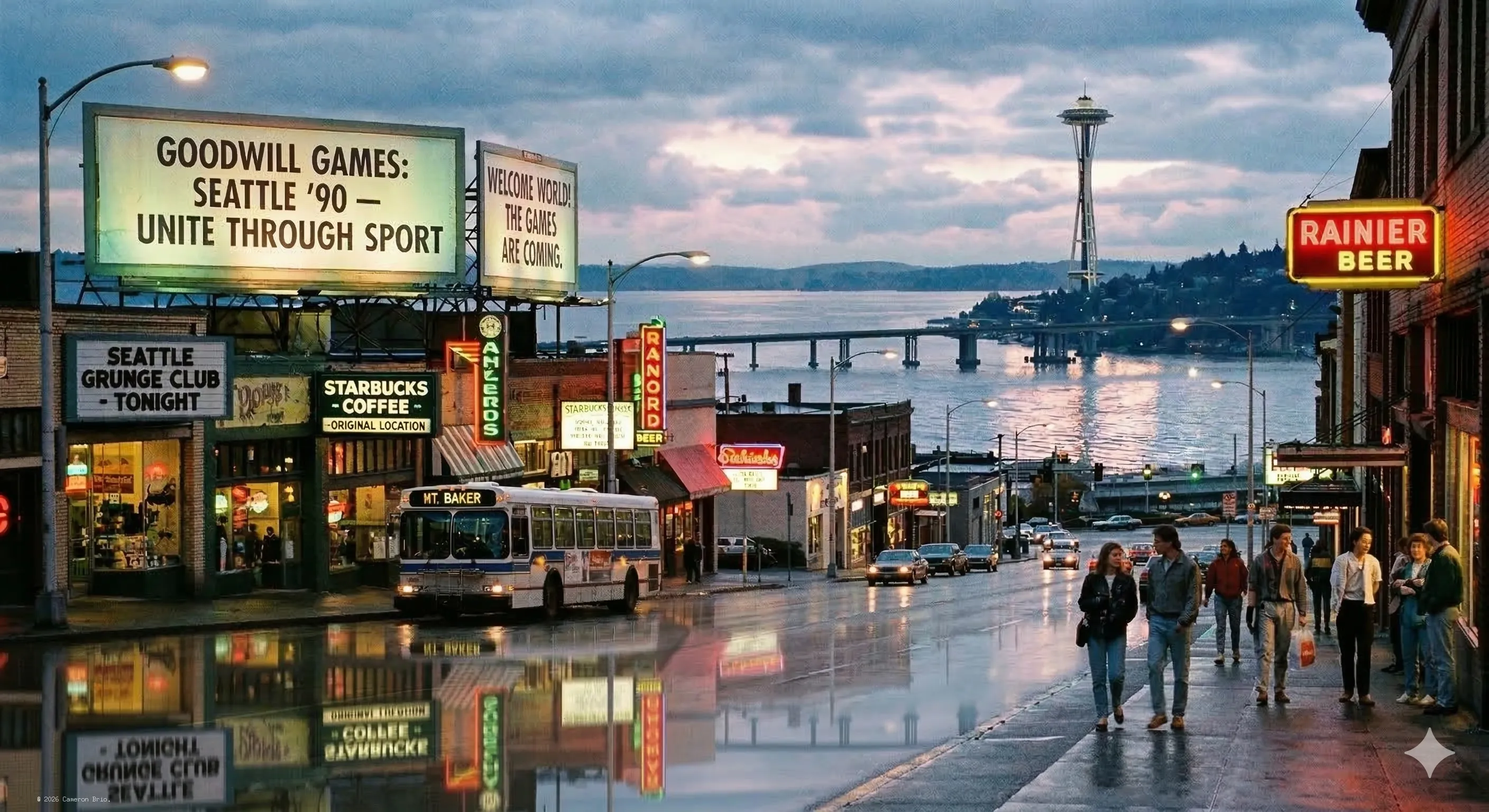
The city knew that even with the lure of free coffee and glazed donuts, the lot wouldn't show up for a lecture on manners. It had to be a mandate. I tried to stay cool, to keep my cynicism from curdling into insulation, but the room made it difficult. The lighting was a sickly fluorescent yellow, humming with a low-frequency headache. The floor was a mosaic of uneven linoleum tiles, and the chairs were designed with the same cruel geometry as a fast-food joint: built to be just comfortable enough to sit in, but painful enough to make you leave the moment you were done.
"They're probably going to suggest we get out and open the doors for the passengers," I joked to myself. I could almost see the Boeing engineers and the seasoned lifers in the room trying to calculate the extra seconds that would cost them on a metered fare.
A middle-aged woman kicked things off by reading a three-page essay. It was a dense thicket of bureaucratic prose, clearly written to justify the budget and the effort of the "Goodwill" initiative. As she droned on, I found myself slipping back into my own private "Jury Moment."
This was an insider joke I’d shared only with Beatrice. During my first year of law school, I’d worked as a "gopher" at the courthouse, running errands through the marble halls. While waiting for judges to scrawl their signatures on motions, I’d watch the juries. I’d study their faces, trying to imagine the friction in the jury room—the petty irritations, the way they reacted to a lawyer’s tie or a witness’s stutter. I became obsessed with a specific phrase I’d heard once: "Frankly, I find that offensive." It became my focal point for a certain kind of one-track mindedness. It was performative. It was a way for someone to announce their own virtue without actually processing the facts.
And then, it happened in the classroom. The speaker hadn't even finished her three-page essay—she hadn't even looked up from the podium—when a driver in the front row shot his hand into the air.
"I praise you for this," he said, his voice ringing with a suspicious level of enthusiasm. "This is exactly the kind of class we need."
I stared at the back of his head. The rest of the room was already ahead of me, their faces a mask of boredom or practiced agreement. I couldn't help but analyze it. It was a convolution of chaos—a moment where the fake praise met the fake lecture, and for a second, the two canceled each other out. It didn't soothe my doubts about the Goodwill Games. If anything, it confirmed them. We were all being trained to be actors in a play that hadn't been written yet.
The essay finally ended, followed by a pamphlet filled with condescending illustrations—cartoonish depictions of "ideal" drivers that felt like an insult to the intelligence of everyone in the room. I looked around; the swollen, sleep-deprived eyes of the cabbies looked like they were about to pop out and roll across the floor like rusty cans.
An Autopsy of Conscience
Just as the collective patience reached its breaking point, the lady caved. She cleared the stage for the guest speaker. A wave of sudden, heavy calm hit the room. No one had expected him. He was an old-timer, his body language a pantomime of long years on the pavement. We all recognized it instantly—even the "praise" guy in the front row went silent.
He forced a weary smile and gripped the edges of the podium as if it were the only thing keeping him upright against the gravity of his own memories. He was a retired beat cop, a genuine relic of a Seattle that didn't exist anymore. I was so intrigued I forgot the earlier insults; I realized I would have paid to hear this man speak.
The beat cop was a rare breed now. He opened with the common ground—the shared geography of the night shift. He talked about response times, the shattered glass under the big clock at 1st and Pike on New Year’s Eve, the white-knuckle terror of driving in the snow, and the adrenaline of surviving a waterfront riot. I liked to think I was the only one who truly saw it: he was looking for an exorcism. He wanted to melt that agonizing splinter in his mind, the one that had made him carry that bag of bricks all the way into his golden years.
The "teacher" was gone, and the classroom felt like it was in a free-fall. We were no longer talking about manners or the Goodwill Games. The subjects shifted into the raw reality of the road. The old cop was reciting from a different manual—one built on experience and new research into the things that actually mattered to us: insurance loopholes, licensing traps, the brutal math of recovering from an accident. Every few minutes, he’d throw in a memory, a jagged fragment of his past that kept us frozen in our uncomfortable seats.
Two hours passed like twenty minutes. Drivers who usually couldn't wait to hit the lot were now leaning forward, asking for his number, looking for a consultant, a protector, or maybe just a witness. But he wasn't there for the technicalities. He didn't want to be our consultant. The moment he whispered the word "fairness," I knew the confession was coming. He had come here to offload the heaviest brick in his bag—unless the lady with the three-page essay returned to kill the moment with a bureaucratic epilogue.
The retired cop wasn't just telling stories; he was performing an autopsy on his own conscience. You could tell by the way he’d stall—shifting gears the moment a memory became too vivid to polish for a public audience. He kept circling a "blunder," something simple yet devastating. He didn't reveal the crime, only the afterimage: the expression on a victim's face as they were dragged toward a cruiser.
I sat there, my mind a frenzy of John Adams’s Equity Theory and the "Invisible Hand." I realized then that we aren't vulnerable because we lose control of the world; we’re vulnerable because we have no blueprint for the emotional castles we build inside ourselves. We never know which brick will be the one to make the whole structure crumble.
I thought of an old Phil Donahue episode where a caller described a humiliating courtroom moment. Donahue asked if the man knew anyone there. When the man said no, Donahue asked, "Then why were you embarrassed?" At the time, I didn't get it. But watching this old cop, I realized that shame doesn't need an audience. It only needs a mirror.
The Checkmate in the Mist
The memory hit me with the force of a physical blow. It was raining—that heavy, relentless Greenwood rain that feels like the sky is trying to wash the city into the Sound. I was mid-shift, creeping through a side street with a passenger from downtown. I’d just passed a small roundabout when a loud, metallic jerk buckled the driver’s side rear. I hadn't seen a soul.
Immediately, the "cab-driver" math started: License points. Insurance thresholds. I was right on the border of losing everything. My false vanity—the idea that I didn't "need" this job—flared up, even as I felt my shoulders sag under the weight of the inevitable. I called dispatch and stepped out into the downpour.
The other driver was a younger version of me—ten years younger, at least. He was a cyclone of agitation, screaming and pointing, backing off and then lunging back into my personal space. His voice was a sharp blade in the rain.
The response was unnervingly fast. Rich neighborhood, I thought. Seattle is full of them—modest shells hiding mansions. Then, through the grey curtain of rain, I saw her. A policewoman was walking down the street, her steps heavy and deliberate. A cruiser pulled up from the opposite side. The male officer’s face was familiar, but the woman was a revelation.
Then, the shame hit: My appearance. Since Vanessa had left, I’d let myself go. I had a full, unkempt beard and long, tangled hair. In my green army jacket, I didn't look like a law student; I looked like Nick Nolte in Down and Out in Beverly Hills. I looked like a man the world was designed to ignore—or arrest.
The other driver and I were two sides of an uneven world. I stood there frozen, clutching my clipboard, watching the female officer. She moved with an invisible armor, her heavy duty belt looking weightless on her hips. I knew I had no chance. I was ready to say goodbye to my license.
We huddled in the back of the cruiser to escape the deluge. The younger man, Mr. Mizuno, sat beside me, his voice never wavering. He explained his speed, his "yield," and how I had materialized out of thin air like a ghost just to ruin his afternoon. I tried to ignore my appearance, but his posture was a claim of ownership over the street and the cops alike. The officers met his outbursts with a casual, localized patience—and that ease was exactly what terrified me.
The officers were silent. The woman stared ahead; the man scribbled on a clipboard. I wanted to tell them to skip the theater. Just give me the ticket. Let’s get this over with. I was drained. I didn't have the energy to fight insurance companies or challenge a summons. I just wanted to sink.
The policeman finally stopped writing. He pushed the clipboard through the divider window, but he didn't aim it at me.
"Mr. Mizuno, please sign here," he said, his voice flat. "You did not yield to your right."
The silence that followed was deafening. Mizuno looked at the officer with the eyes of a man betrayed by his own status. His jaw dropped; the tears were right behind his eyes. Checkmate. He signed the ticket, his world tilting on its axis as he lost the one thing he thought he possessed: the benefit of the doubt.
As I walked back to my cab, the rain eased into a mist. Something told me to look back. The policewoman was standing by the cruiser, waiting. She knew I’d turn around. She gave me a quick, sharp smile—a flash of human recognition—before sliding back into the car.
The old cop never finished his story. He didn't have to. I knew exactly where he was—standing in that dark, cold space where the law you’ve sworn to uphold and the justice you feel in your gut finally drift apart. I wanted to reach out to him. I wanted him to see what I had just seen in my own memory: the rain in Greenwood, the silent smile of the policewoman, the moment where the world was actually fair to a man who looked like a wreck. I wanted to tell him that someone else had already paid his dues. That he didn’t have to carry those bricks anymore.
Don’t try to rebuild the emotional castle you’ve broken, I thought, watching him grip the podium. I felt a strange, sudden power—a byproduct of all those hours behind the wheel, watching the city through a mirror. I wanted to tell him: I’ve been watching. I feel the connection. Give me your pain; I’ll carry it. I’ll dissolve it in the neon and the rain, and no one can devalue it.
But the moment passed. The "vultures" were already swarming him, their voices a cacophony of technicalities—insurance points, service records, licensing loopholes. They wanted the cop’s expertise; they had no use for his soul. For a second, he looked relieved. He was grateful he hadn’t had to spill everything, that he could retreat back into the safety of the "public version" of himself.
He glanced at the clock—two hours over schedule. He offered a quick thank you to the audience and disappeared behind the podium, fading into the fluorescent hum of the room.
I sat there in that uncomfortable chair, the "convolution of chaos" finally still. I realized then that I hadn't come to this mandatory class for the Goodwill Games or the "small fortune." I had come to learn that the Invisible Hand wasn't just about economics. It was the thing that placed me in that cruiser in the rain, and in this classroom today, just to witness a moment of truth.
I knew why I was here. And for the first time in years, I didn't feel like a dropout. I felt like the only person in the room who was exactly where he was supposed to be.