The concrete at North Seattle Community College didn’t lie to you. It was brutal, practical, and new. From the right angle, its curved, windowless sections almost mimicked the Hirshhorn Museum—if the Hirshhorn had been designed by a committee focused on low-cost maintenance. It was a maze of grey pathways where you could get lost just by turning your head too quickly.
Every quarter, I performed the same reconnaissance. I’d map the shortcuts from the street to the lecture hall, then to the instructor’s office. This wasn't about efficiency; it was about stealth.
I parked my cab three blocks away, tucked behind a row of overgrown laurels where no student's prying eyes would wander. I was back on the "education wagon," and like any addict, I was terrified of a relapse into the world of 12-hour shifts and cigarette-scented upholstery. I sometimes imagined starting a 12-step program for the semi-educated—the folks lingering on half-fulfilled dreams.
I felt like Salieri in Amadeus. God had given him just enough talent to recognize Mozart’s genius, but not enough to replicate it. He spent his life ridiculing the work he secretly worshipped. Here I was: a third-year UW Law dropout, hiding my Yellow Cab keys in my pocket while I sat through 100-level Social Science credits just to get my feet back under me. The tuition at UW was three times the price, but the ego-bruise at the community college was free.
By the time I hit my front door, the city’s grit stayed on the mat. My apartment was spotless—my only sanctuary. I’d flip on the TV and let the glowing warmth of Night Court wash over me.
Watching Harry Anderson perform card tricks behind the bench was my therapy. Having spent time as a legal apprentice, I knew what the scripts left out: the smell of the holding cells, the frantic, rhythmic chanting of public defenders, and the weary judges who would snap, “Shut up, Paul,” at a veteran lawyer who had argued one too many motions.
The show was a sanitized version of the life I’d walked away from, but in the early 80s Seattle gloom, it was the only version of the law I could still afford to love.
The Narrow Bridge
The community college catalog was a menu of second chances. I flipped past Anthropology and History until one title stopped my thumb: Enjoyment of Music 101. It promised a journey from the hollow echoes of Gregorian chants to the jagged, modern brilliance of Stravinsky. It promised a map of the world I had been carrying inside me, boxed up like old winter clothes.
I was a "closet" musician. My father had drilled the violin into my chin since I was a child, but I had migrated to the classical guitar in my teens. I kept it a secret. Once, at a party, I had tried to share that world—playing a delicate Parkening arrangement followed by a fiery Vitali Chaconne. I had bared my soul, only to look up and realize I was just a circus act to them. To the "Yuppies" and the "Boondocks" alike, music was just background noise. They couldn't feel the gears turning; they just heard the chime.
But my hunger was changing. I didn't just want to play; I wanted to build. I’d drive my cab through the University District, eyeing the neon sign of Dimitriou’s Jazz Alley. I’d watch Earl Klugh and feel a kinship—one instrument-switcher to another.
To kill time before a shift or a meeting with Mabella, I’d haunt the campus library. I’d bypass the card catalogs and wander the stacks, drifting from 18th-century maps to declassified CIA files. One afternoon, I stumbled upon Musical Thought by Carlos Chavez. It was a revelation. It spoke of symmetry, of nature, of the "contracts" between notes.
Then, I saw it: a full orchestral score.
Up until then, my world was written in two clefs—violin and guitar. I had never imagined a sheet of paper long enough to hold the breath of an entire woodwind section, the roar of the brass, and the heartbeat of the strings all at once.
I went home to my spotless apartment and began to sketch. I could hear the phrases—heavenly, complex arrangements that hummed in my skull. I’d find the melody on my guitar, then try to transpose it. I’d write a line for the viola, then struggle with the range of the cello.
That’s when I met the Monster: Orchestration.
I read how modern conductors grew grey hairs trying to fix Tuba parts written by composers who didn't understand the instrument's lungs. I realized that even Mozart, the "divine" genius, had a father who taught him the math behind the magic—the harmony, the ranges, the architectural skeleton of sound.
I was standing on one side of a canyon. On the other side was the music in my head. Between us was a bridge so narrow and so long it would take two lifetimes to cross. I had the talent, but I didn't have the "code." I was a cab driver with the blueprints for a cathedral and no way to talk to the stonemasons.
The Three-Pattern Limit
My instructor wasn't one of those "those who can’t, teach" types. He was a force of nature—a masterful pianist and conductor with deep roots in the Seattle scene. He’d stand before us in that sterile classroom and coax celestial sounds out of a cheap, battered upright piano that looked like it belonged in a saloon.
He didn't have "office hours." He didn't have time for small talk. But he dropped a truth in one lecture that rattled my ribcage: The human brain can only hold three musical patterns simultaneously. Even Mozart, he explained, had to layer his genius. He pointed to the scene in Amadeus where a dying Mozart dictates the Requiem to Salieri—stacking the brass, the strings, and the choir one line at a time because even a god-tier mind couldn't hear the full vertical stack at once. It made me think of the transition from multiplication tables to the first electronic watches appearing on the wrists of my passengers. Something was shifting in the world’s "hardware."
I started obsessing over the geometry of the stage. The traditional orchestral arrangement felt like a cage: horns in the back, basses on the side, violas centered. It was too rigid. The music humming in my head—this "gift" I was guarding like a secret—refused to sit still.
I heard a flute and a cello in a chromatic embrace, interrupted by a French horn that would snatch the melody away for three notes before handing the magic wand back. In a standard hall, those instruments were an ocean apart. The sound would be diffused, the "conversation" lost in the rafters. My professor wouldn't hear it; the libraries at UW had no precedent for it. I was imagining a sound that the physical world wasn't yet built to stage.
I’d go back to my guitar, playing the flute’s line, trying to "stamp" the feeling into my brain before the cab-world smudged it out. I was waiting for a bridge that didn't exist yet.
There were whispers in the University District—talk of something called MIDI, of computers that could record and layer sounds without a 40-piece orchestra. It was the dawn of a revolution, but for a guy parking a taxi three blocks away to hide his shame, that technology was as far away as the moon.
I could feel it, though. A change was coming. The nature of music was calling me, but I was still trapped in the era of sheet paper and rigid seating, waiting for the digital ghost to finally manifest.
The Rhythm of the Pavement
The music was re-wiring me. I wasn’t a jazzman yet, but I found myself improvising on the guitar with minor and diminished chords—sounds that felt like the grey Seattle mist. For the first time, I felt a deep, humming connection to the people in my cab. I began to recount their rhythms: the staccato of a nervous businessman, the legato of a tired nurse. I was no longer just a driver; I was a conductor of a million scattered words.
I fell in love with 5th Avenue. I never grew tired of the way it intersected the city, each cross-section a different movement in a symphony. I began to see the "Musical Thoughts" of Chavez everywhere—the symmetry of tree branches, the howl of the wind, even the rhythmic slap of the windshield wipers against a sudden, heavy rain.
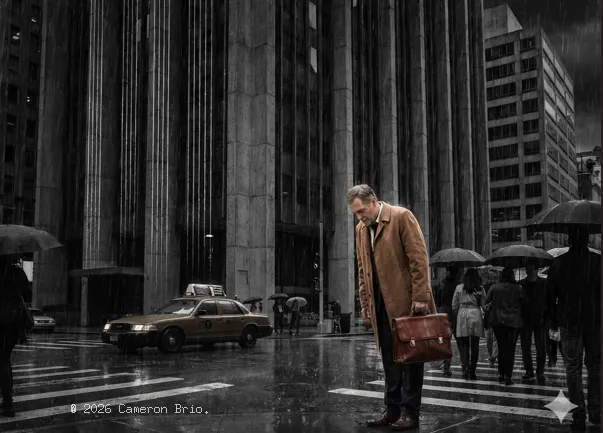
It was an East Coast rain—violent, sudden, and rare for Seattle. I pulled up to the intersection of 5th and Spring, watching the pedestrians huddle against the deluge.
Then, the blue car screamed past, zapping uphill with a total disregard for life. It hit a deep pool of standing water, sending a massive, silver arc of a splash over a man on the corner. He looked like an extra from a 1940s noir film—camel coat, a sharp "gangster" hat, and a brown briefcase. Too dressy for a clerk, but the briefcase gave him away.
I couldn't hear his words through the glass and the rain, but his gestures were loud. He shouted at the retreating blue car, pointing an accusing finger.
The car stopped.
A massive man stepped out. He didn’t run; he walked back down the hill with a slow, terrifying grace. He was oblivious to the crowd. When he reached the clerk, he began to "work" on him. It was surgical. A few heavy, calculated blows, and the man in the camel coat went down. The giant turned and walked back to his car as if he had just finished a routine chore.
Everything shifted into slow motion. There was no blood, but I saw something worse: the man’s world had been shattered. He didn't try to get up at first. He lay there with his face inches from the wet asphalt, his legs splayed in a messy disarray. I felt he found more comfort in the cold rain on his cheek than he would in facing the world again.
I wanted to help, but I was frozen. I watched the rain bounce off his wrinkled face. Finally, he pulled his legs together. He reached for his hat and his briefcase. He stood up and gave a small, tragic bow to the "audience" of silent observers. Then, he walked away with a new rhythm—a broken, limping beat that only I seemed to detect.
I felt connected to all of them in that moment: the victim, the cruel observers, and the man in the "dark armor" who had delivered the blows. I didn't remember the punches. I only remembered the image of a man who had lost one layer of the beautiful pattern I was trying to reach, only to be handed a dark, heavy wave of the symmetry of nature in its place.
The Intermission at Doug House
I couldn't go home. Not with the image of that man’s bow still burning in my retinas. I pulled into the lot of the Doug House and ordered the usual: two slices of apple pie, a scoop of vanilla, and my fourth coffee of the night.
Millie had the cup waiting on the counter before I even sat down. She was the only person in the city who knew my name without looking at a hack license. Sometimes I felt like I was in an episode of Cheers—except I wanted to be Sam, the smooth lead, and I always ended up as Norm, the one-liner character whose life began and ended at the edge of a barstool.
I never had long conversations with Millie. She had that "seen-it-all" aura that made words feel redundant. But I watched her. She had an elegance that defied the greasy-spoon setting. The way she held the pot, the way she surrendered her eyes to the rising steam for a split second—she was seeing things the rest of us missed. She stood tall, avoiding the weary, staggering gait of the other career waitresses. Every time I walked in, I’d glance at the neon sign with a knot in my stomach, terrified that one day she simply wouldn't be there.
"Should I ask?" she said, the coffee hitting the ceramic with a steady rhythm. I shook my head slightly. "That bad, huh?" she murmured, and moved on.
I returned the cab to the lot and went home, the silence of the apartment ringing in my ears. I wanted to watch a movie with Mabella, to be normal, but I couldn't tell her about 5th and Spring. The man’s bow to his silent audience had sealed a pact between us. He had kept his dignity; I would keep his secret.
Instead, I tried to explain the "invisible waves." I talked about the hidden order of nature, the symmetry Chavez wrote about, and how our lives were just melodies riding on a larger, unseen arrangement.
"Sounds like you want to get back to your writing," Mabella said. She didn't look up, but I could hear the gentle mockery in her voice as she pointed to the stack of manuscripts gathering dust under the coffee table.
A cold sweat broke across my forehead. The "gift" was no longer a comfort; it was a wave hitting me full-force. The music wasn't just in my head anymore—it was demanding to be born.
The Code of the Future
"But I write so simply," I told her, shifting in the uncomfortable chair of her small office. "Hemingway wrote simply," she shot back without missing a beat.
She was my English 101 instructor at North Seattle—a woman who saw through the "cab driver" exterior and into the messy logic of my prose. I had turned in a story about a father’s sacrifice—a classic cliché about a man confessing to a crime he didn’t commit to save his family. I thought it was trite. She thought it was a revelation.
Whenever I visited her office, ostensibly to discuss Death of a Salesman or the mechanics of Arthur Miller’s style, she would bring it back to my work. Miller once said that style could be taught in an hour; she was trying to teach me that what I had couldn't be taught at all.
"It’s an old story," I argued. "People have heard it a thousand times." "Not the way you tell it," she said. She picked up my manuscript and began to recite my own words back to me: 'Yes,' he replied, after removing the cigarette from his mouth... he could feel all the dimensions. She had tears in her eyes, her hand pressed to her chest. "You capture the smell, the weight of the air... you make the reader live in the room."
I liked the praise, but it terrified me. It felt like a fluke. Could I ever capture that lightning in a bottle again? Could I find another "original" thing in a world that felt so recycled?
She pushed me toward the future. She insisted I go to the computer lab and learn the "word processor." At the time, I was perfectly happy with the advanced electric typewriters—they were quiet, smart, and had that magical correction tape. They were all I needed.
But I felt obligated to try. The lab felt like my old Fortran classes, where we’d stack punched cards and wait hours for a result. Now, there were monitors. Students typed commands and saw them appear instantly on the screen like ghosts in a machine.
But I was lost. Setting a page margin felt like a seven-year apprenticeship in a 19th-century printing shop. I’d wrestle with the commands for twenty minutes before retreating to the smooth, honest keys of my electric typewriter.
My teacher was adamant: the word processor would revolutionize the mechanics of the soul. I just wanted to shake it off. I’d look at the other students—who seemed perfectly content to just be there—and I’d ask myself, Why me? Why was I the one cursed to see the patterns, to hear the music, and to be forced to learn the new, cold language of the future?
The Oracle of the BBQ Stand
"Oh, come on... I didn't mean anything by it," Mabella said. Her voice carried that sharp, sarcastic edge of someone who regretted only that she hadn’t said more.
I stood there for a few seconds, my shoulder feeling like it had been carved from lead. It was the distinct, cold weight of defeat—the feeling of realizing the chess match was over three moves before the checkmate.
"I'm driving the day-shift tomorrow," I said quietly. "I better get some sleep."
That was the last time I saw Mabella.
I traded the "Education Wagon" for a B.S. in Computer Science. I’d always planned to return to the UW, but the choice between massive debt and the freedom of the cab led me to a private university with night classes instead. It was longer, more expensive, and far grittier, but it was mine.
The world was fracturing. The AT&T breakup had turned the digital landscape into a frontier. Their brand of UNIX was locked behind corporate gates, but Berkeley was turning the 1970s dream of open systems into a reality. Suddenly, secretaries were being forced to learn nroff and troff—typesetting commands that felt an ocean away from the "word processors" my English teacher had championed.
I was on the wagon, trying to keep my balance, but I felt a lingering unease. MIDI had arrived, but it felt like a tool for the elite, for the big studios. More than that, it was a piano player's game. As a guitarist, I was a ghost in the machine; nobody even dreamed of a guitar "talking" to a computer yet.
The momentum was peaking, but I didn't understand the "Why" of it all until I saw a line in a third-rate magazine. I almost missed it—my friend Tess was pestering me for coins for the library vending machine—but a small article caught my eye.
The author’s picture looked like Norm from Cheers. He wasn’t a scientist; he was a consultant who organized conventions for a company that sold barbecue stands. I didn't dismiss him for it—I’d spent years picking up the silent, dangerous bodyguards of CEOs at the Olympic Hotel taxi stand. I knew that power often wore an unassuming mask.
The article claimed that processing power belonged at your desk, not at some distant "mother-ship." Then came the golden phrase that hit me like a physical blow: "That is the way."
It was a total imbalance of logic. It reminded me of a musician friend who once challenged our Calculus teacher to "extend the constant downward, out of its range." The teacher had stopped mid-sentence, shaking his head at the chalkboard, repeating, "That is impressive," over and over. He had lost his balance because someone had dared to look past the "given" rules.
In 1980s Seattle, everyone thought the computer fever would break—that it would normalize and slow down. But looking at that article, I felt the oracle speaking. There was no precedent for this growth. The "Barbecue Consultant" was standing on the bridge I had been looking for, and he was telling me that the mother-ship was dead. The power was coming home.
The Mozart of Microsoft Support
I was drifting. I felt less connected to the rhythm of the streets and more tethered to the glow of the terminal. While the rest of Seattle was at sports bars screaming for the Seahawks, I was haunting the computer lab. If I made it to a Mariners game, it was only for the seventh-inning stretch—a brief moment of oxygen before diving back into the silence of the stacks.
Then came the call. Late afternoon, 1995. I got the job: Windows 95 Support.
The moment I hung up, I lost my mind. I found myself frantically dancing around my apartment, making the same wild, exhilarating faces Tom Hulce made as Mozart in Amadeus. I wasn't a "programmer" yet, but it didn’t matter. I had breached the hull. I was in.
But I couldn't let go of the past entirely. I secretly kept my taxi license, picking up a car on the weekends just to keep my eyes on the pavement. It was a strange vantage point. I’d sit at the stand and watch my new corporate coworkers stumble out of Kells Irish Pub, holding hands and pretending they didn't know each other, their daytime masks melting away in the Post Alley shadows.
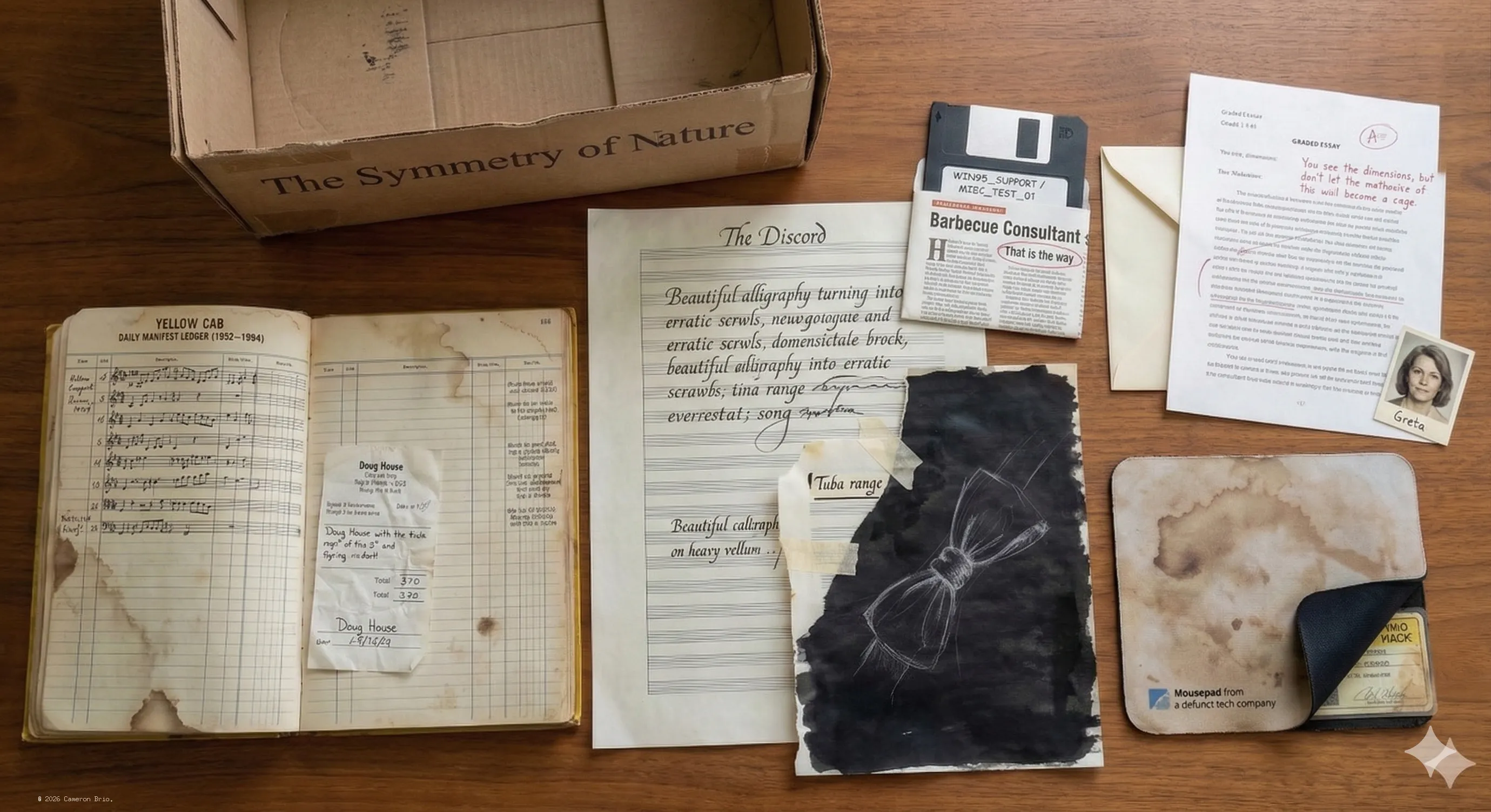
The news of Greta’s death hit me like a physical blow. I felt a sudden, heavy responsibility to keep her legacy alive. I could still see her eyes welling up with tears as she praised my "simple" writing. I wasn't hearing new symphonies in my head anymore; instead, I was haunted by a single, persistent sound: a lamenting flute. It was a melody that refused to be ignored. I just had to write it down.
I could feel the routine beginning to calcify around me. The tech life was comfortable, but I didn't want comfort—I wanted to keep searching. I knew the cab-life had to end soon, but I was terrified that without the taxi, I’d lose the mystery.
Yet, as I walked through the rain, I realized the mystery wasn't in the car or the streets. It was the bubble I was walking in. The music in my head was pounding against the glass, demanding to be translated. The "Narrow Bridge" was still there, but now I had the tools to start building. I just had to pick up the pen.
The Splinter and the Studio
"Who is that?" Leandra asked, her finger tracing the air toward the framed photograph of Greta. She had just finished admiring the sterile, quiet order of my apartment.
"That... is Greta," I said. The name felt heavy, a long, dreadful hesitation hanging between us.
Leandra withdrew with a natural grace. "Someone you knew?" she asked softly, not waiting for an answer. She settled onto the couch with a curvy, rhythmic motion, a silent reminder that she wasn't there to pry into my ghosts. I followed her, sitting close, feeling the weight of everything I had kept bottled up: the cab, the flute's lament, the cello’s growl. I was dying for someone to pull the splinter from my mind without scarring my soul.
Years had passed. I was a programmer now, but the job wasn't the sanctuary I’d imagined. I’d go home and write my own code, tempted to build a music notation engine from scratch just to prove I could. I didn't need to, though. The software had finally caught up; MIDI and notation were now one.
Searching for knowledge had become almost too easy. We had moved past the days of submitting keywords to a "mother-ship" and waiting for an oracle. But as the "MySpace" era dawned and information became accessible to everyone, I noticed a strange repulsion. The more people knew, the less they seemed to care.
I felt a creeping guilt. I had the purchasing power now; I was becoming the very "Yuppie" I used to watch from the front seat of my cab. Yet, I hadn't built the studio. I hadn't created the space for the one thing that was the focal point of my life. I was searching for a common denominator in a world that was moving too fast.
Every time I walked to the office kitchen to refill my coffee, I saw it: the city had followed me into the cubicles. The same faces, the same stories, but condensed into a new, potent form of vanity. I could feel it growing in me, too—a digital ego that threatened to drown out the "connected" feeling I had once found on the rainy streets of Seattle.
I had had enough. The flute was still screaming in the silence of my spotless apartment. It was time to stop searching and start building. I sat down at my desk and devised a plan.
The Redemption of the Sunday Suit
I caught my reflection in the glass of Greta’s portrait as I got ready for dinner. It had been years—the dotcom bubble had burst, and the era of Marion Barry’s legendary courthouse pivots felt like a lifetime ago. I remembered Barry most of all; his ability to get re-elected despite the video evidence felt like a political version of the "vices in plain sight" I used to witness from my cab.
I wiped the dust from the frame. For a second, I thought about taking it down—not to discard Greta, but to mark a new beginning.
Leandra was picking me up. It was a strange rhythm; I thought she’d be a ghost after the divorce, but she was in my life more than ever. I sometimes joked to myself that she only came around to thank me for the fat alimony checks that were currently draining my "purchasing power." I remembered an old cab-driver’s wisdom: Women are like buses; wait long enough and another will come. But for me, the rule was different:
Certain women only want you before the marriage and after the divorce.I didn't care. I wasn't interested in a sob story. I was just glad she was coming.
I put on a suit—something presentable. I had regained a sense of respect for the "business" of life. I looked back with a burning shame at the time our project manager took the whole team to the Seattle Opera House. We had shown up in tank tops, jeans, and shorts, dangling our tech-salaries in the faces of tradition. I wanted to redeem myself from that version of me. I wasn't dangling my wallet anymore; I was just trying to show up.
"How is the music going?" Leandra asked over dinner, swirling her wine with an overly dramatic flair.
"It’s going great," I said, watching the light catch the deep red of the Merlot. "I’ve stopped shopping for guitar-MIDI interfaces. I’m not messing around with the piano anymore, either."
I leaned in, a small smile playing on my lips. "I went back to the basics. It’s so basic you’ll probably laugh, but I’ll tell you more about that in a bit."
The Rachmaninoff Discord
I tried the MIDI "rectangles" one last time, just to be sure. I watched as people moved little boxes of sound around a screen, building music for clients without ever touching a key or a string. It was efficient, bloodless, and popular.
I couldn't do it. I didn't want a game; I wanted a talking typewriter for the soul.
I set up my apparatus on the apartment floor. It was a humble rig: a notation program with built-in samples, my classical guitar, and a mouse. I found a flute patch so hauntingly real it made my chest ache, even if the cello and French horn sounded a bit like ghosts of the real thing.
I worked from the floor up. I’d find the notes on the guitar, then click them into place on the screen, one by one. The software was my silent partner—it re-arranged my bars, transposed my clumsy shifts, and flashed a warning red when I tried to force a tuba into a range it didn't possess.
It was exhilarating. For the first time, the "Narrow Bridge" felt solid under my feet. I poured decades of the street, the cab, and Greta’s memory into the staves. I added a clarinet for warmth, bassoons for weight, and let a Tuba roar for emphasis. I spun the violas and cellos together in a chromatic dance and built a counterpoint with a harp. I ignored the tradition of "First and Second" violins—I wanted the raw, singular voice of the instrument. I ended with a bassline that felt like the heartbeat of Seattle itself.
I refused to listen to the full work as I wrote. I saved the final playback for a ritual.
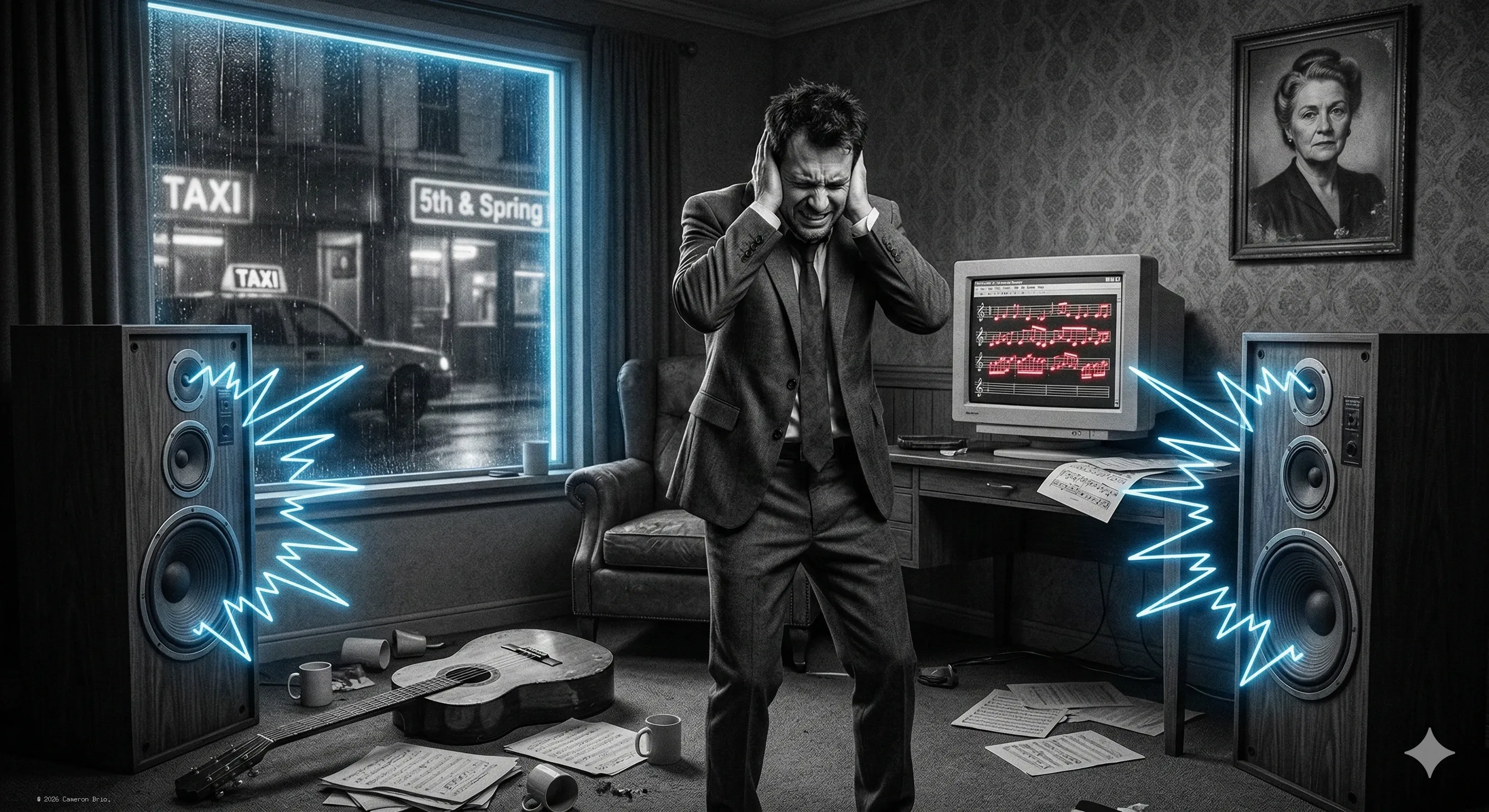
I hooked up the large speakers, poured a glass of wine, and toasted to the empty room as if I were standing before a hired orchestra at the Opera House. I took a deep breath and hit Play.
And there it was: The Discord.
It wasn’t just a mistake; it was a wall of sound so jagged and wrong it felt like a physical blow. I tried to drown the shock with another glass of wine, a quick bit of self-induced therapy, but it was no use. The sound was so catastrophic I had to cover my ears with my hands, standing there in the middle of my spotless apartment, desperate to hit the Stop button before the discord stained my mind forever.
I stood there in the ringing silence, trembling. I remembered reading about Rachmaninoff—how he had covered his ears in agony the first time he heard his own work played by a live orchestra. I wasn't a master, and I wasn't in a concert hall, but in that moment of total failure, I finally felt like a composer.