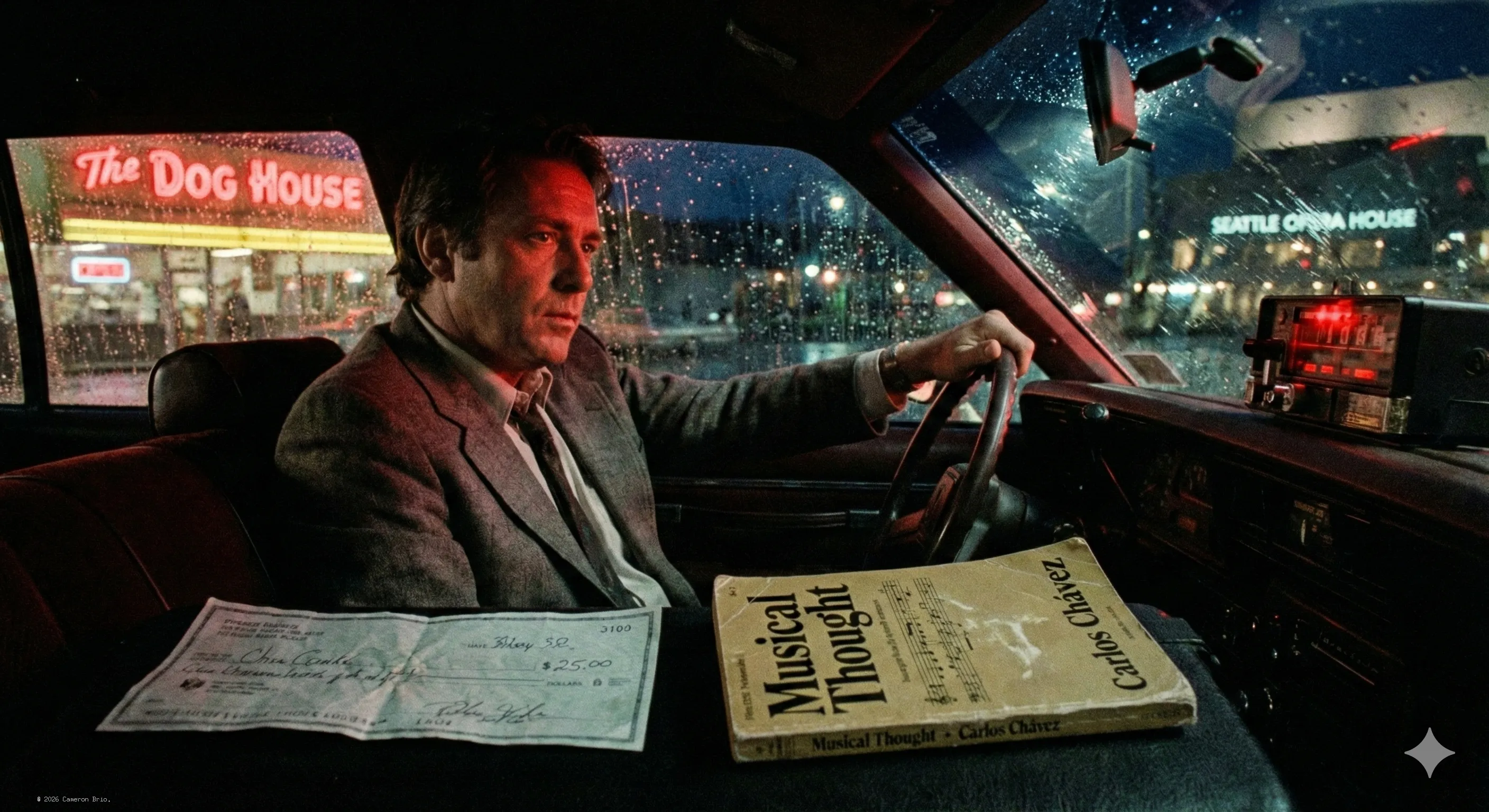
I had just finished my apple pie and my fourth cup of coffee. The Dog House didn’t feel like its usual vibe—the air was thicker, charged with a strange electricity. Before I could stir my divided attention to see why, I noticed the long bus parked outside. I laid a big tip for Millie and waved slightly; she was already walking toward the other side of the large dining room, a blurred streak of white uniform against the dark wood.
Tonight, I had a good feeling. Going to the Opera House was my only real connection to the outside world. Most people unknowingly make that division for me. Once you drive a cab, you’re in—until you get out. Sometimes, during the intermission, I would look around the bar while sipping on a glass of champagne, wondering who had dropped their savings on a roulette table in Vegas last weekend. I was dropping my rent money at the same table. I’d look at the suits and the silk dresses and wonder if any of them had ever actually read Musical Thought by Carlos Chávez.
I listened to the radio constantly while driving. The classical and jazz stations were my lifeline. They’d announced a guest performer: a young Greek violinist named Leonidas Kavakos. I’d heard his name whispered in the way people talk about a coming storm—something rare and inevitable. I didn’t hesitate to buy a couple of tickets for his performance of Mozart’s Violin Concerto No. 5.
I decided to ask Hanna to go with me. We weren't "dating," at least not in the way the city defines it, but she was a friend—the only one who didn't look at me and see a fleet number. I’d met her at the hospital while delivering medical packages. I loved those fares; they didn't talk back. Hanna worked in the staff wing, though I never asked her title—it didn't matter. She was tall, with long hair and thin lips that held a quiet intelligence. She was older than me, and the only person who would look me in the eye when I handed over the return slip.
When she smiled, it rang like poetry in my head. I’d started timing my arrivals just to see her elegant walk, though I couldn't always get the dispatch to line up. I felt brave enough to ask her now; after all, she was calling me by my first name. I caught her near the staff entrance as the sun was dipping below the Puget Sound. "Going somewhere?" she asked. No mention of the car. No "hey, cabbie." Just me and her in the fading light. "The Opera House," I said, leaning against the door. I felt the weight of my law school textbooks, still boxed up in my closet at home—a ghost of a life I’d almost finished. "Kavakos is playing Mozart. It’s supposed to be... transformative. I have an extra ticket." Hanna didn't hesitate. She just looked at me. "Friday? I'll find something to wear."
The Clash: Friday Night
Friday arrived with a cold, sharp wind. I had scrubbed the interior of the Chevy until it smelled of nothing but faint lemon wax, but as I pulled up to the Opera House, the "cab-world" felt like a heavy coat I couldn't take off. I was twenty-six, with the jawline of a litigator and the hands of a laborer. In my suit—the one I’d bought for mock trials three years ago—I looked like I belonged. But as I opened the door for Hanna, I saw the line of yellow cars idling at the curb. My brothers-in-arms. I saw the drivers slumped behind their wheels, eyes glazed, waiting for the very people I was about to walk among. We stepped into the lobby. The transition was jarring. One moment, the smell of exhaust and the damp Seattle pavement; the next, the heavy scent of expensive perfume and aged scotch. The "high-society" crowd moved in a synchronized dance of jewelry and soft laughter. They held their programs like shields. I felt the friction of my two lives rubbing together. To them, I was a handsome young man out with an elegant woman. They couldn't see the 400 miles I'd driven that week. They couldn't see the coffee stains on my soul.
"You're tense," Hanna whispered, her hand slipping into the crook of my arm. "Just adjusting to the altitude," I said.
We took our seats. The lights began to dim, turning the gold leaf of the ceiling into a hazy, celestial canopy. The chatter died down to a dull hum, and then, a silence fell over the room that felt like a held breath. Then, he walked out. Leonidas Kavakos didn't just enter the stage; he seemed to materialize from the shadows of the woodwinds. He was young, his presence strangely humble yet commanding, carrying his violin like a sacred relic. There was an edge to him—a sense that he, too, might be an outsider invited into this gilded room to show them something they couldn't find in their bank accounts. I leaned back, my hand finding Hanna’s in the dark. For a moment, the cab, the law degree I never finished, and the rent I couldn't pay didn't exist. There was only the Greek, the wood of the violin, and the first few notes of Mozart.
The Gaze of the Virtuoso
He walked onto the stage wearing a frock coat that seemed to swallow the light. After his bow, he reached up to fix his hair—a small, human gesture that didn’t diminish his stature. The applause was different tonight; it wasn't the polite, rhythmic clapping of the Seattle elite. It was heavy, expectant. They knew who he was. Kavakos seemed to drink it in, a slight tilt of the head suggesting he liked the weight of their attention. The acoustics of the Opera House were surgically sharp, carving out every rustle of silk in the audience. Then, the music began. I was already mesmerized, leaning forward in a seat that cost me a week’s worth of graveyard shifts. But then, the "Houdini act" started. Kavakos began scanning the first few rows, his bow arm moving with a fluid, terrifying precision. His eyes traveled across the fur coats and the pearls until they stopped. On me. He locked onto my eyes and didn't let go. It was a physical strike. All the while, the Mozart concerto poured out of his violin, flawless and ethereal, but his stare was grounded and relentless. I felt exposed. I wondered if he could see the "Taxi" light etched into my retinas, or if he saw a kindred spirit—someone else who lived entirely inside the music because the world outside was too quiet. He held the gaze through the entire movement, right up until the cadenza. Only then did he turn his face toward the wood of his violin, his eyes fluttering shut as he entered the solo.
“What a relief,” I thought, finally exhaling. I realized then that I hadn’t heard a single cough or a program rustle from the crowd. The entire room had been held in that same vacuum. I shifted in my seat, my muscles aching from the tension of being "glued" to his stare. I found myself praying he wouldn't lose focus, that the intensity wouldn't break him—or me. But as the cadenza ended and the orchestra surged back in, he found me again. It was as if he’d selected a victim. I froze, my heart hammering against my ribs, until I felt a sharp, sudden pressure on my hand. Hanna. She was squeezing my fingers, her grip tight and rhythmic. I looked at her out of the corner of my eye and realized she saw it, too. She was caught in the same crossfire.
The recognition of it drew us together; the shared weight of the performer’s gaze acted like a weld. She didn't pull away. Instead, she leaned into me, her shoulder pressing against mine, her presence a shield against the man on stage. By the time the next movement began, the air between us had changed. Kavakos was still weaving his magic, but the spell had done its work. I felt a surge of gratitude toward the man in the frock coat. I wanted to find him backstage, to shake his hand and thank him. Because of his stare, because of the Mozart, and because of the way the light hit the gold leaf above us, the labels were gone.
Hanna wasn't just a friend from the hospital any more. As she leaned her head toward my shoulder, the "cab-world" felt a million miles away. She was my girlfriend.
The Blue Light of the Living Room
The transition was slow, like a long fade-to-black in a film that takes years to finish. I wasn't a "cab driver" yet—at least, that’s what I told the man in the mirror every morning while I adjusted my tie. I was a law student on an extended leave of absence, a man of the elite who had simply stepped into the driver’s seat to fund a few vices and maintain the "freedom of the road." But the road is a hungry thing. It eats time. Now, the legal briefs were buried under a stack of utility bills, and the "freedom" I’d craved had settled into a two-bedroom apartment with Hanna. She was my anchor, the one person who still saw the "displaced prince" instead of the guy who knew the fastest route to Sea-Tac at 3:00 AM. For a while, it felt like I had cheated the system. I had the girl, the culture, and the "good life," all while avoiding the "Comedy of Errors" I saw my passengers falling into—the messy divorces, the failed businesses, the desperate lies. It was a Tuesday night, the kind of night where the Seattle rain feels like it’s trying to seep through the glass. I was slumped on the sofa, exhausted from a twelve-hour shift, watching the television. Eddie Murphy was on the screen, pacing the stage in a red leather suit, his energy a jagged lightning bolt compared to my lethargy. He was riffing on relationships, that high-pitched, infectious laugh punctuating his cynicism. "I was so tired of this," Eddie was saying, mocking the exhaustion of the American dating scene. "That I went to Africa... married her... and brought her here."
I chuckled. It was a funny bit—the idea of searching the globe for something "pure" only to have it corrupted by the neighborhood. Eddie mimicked the accent, the slow transformation of a woman who was "fine" until she started socializing with the ladies next door. “Eddie, we have to talk,” he droned in that perfect, mocking pitch.
I glanced toward the kitchen, where I could hear the domestic sounds of Hanna moving plates. I felt a smug sense of safety. That wasn’t us. We weren't the cliché. We were the couple from the Opera House. We were the exception to the rule of "What have you done for me lately?"
Then Eddie shifted gears. He started talking about the men. The liars. He described a man caught red-handed at another woman’s house.
No matter how much evidence the girlfriend piled up—the address, the time, the witness—the man just stared back with a blank, beautiful audacity and said, "That wasn't me."
"That was your car!" Eddie shouted, playing the girlfriend.
"That wasn't me," he replied, stone-faced.
I laughed out loud, but the sound felt hollow in my chest. The comedian was mining gold from the concept of betrayal—the sheer, nonsensical power of a lie told often enough to become a ghost.
I looked at the television, then at the door where my car keys hung on a hook. I was still young. I still had my "good looks." I still believed I could leap back into the elite world before the cab-world claimed me for good. But as Eddie Murphy’s laughter echoed off our walls, a cold thought flickered in my mind: the horn of betrayal doesn't always sound like a trumpet. Sometimes, it’s just the sound of a man saying "it wasn't me" until the truth stops mattering.
I wondered, just for a second, if I was lying to the world—or if the world was getting ready to lie to me.
The Lighthouse and the Gopher
I turned off the TV, but Eddie Murphy’s laugh lingered in the room like the smell of ozone after a storm. I looked at my hands. They were the hands of a man who could navigate a Chevy Caprice through a blizzard on Capitol Hill, but they were also the hands that once held the heavy bond paper of a Judge’s signature. Hanna walked in, drying her hands on a towel. She caught me looking at my guitar case in the corner—the Scarlatti she wanted me to play for her friend's wedding. "It’s just a Sonata in D" she said softly. "You have the gift. Why do you treat that guitar like it’s a chore?" I didn't answer. How could I tell her that every time I picked up the guitar, I felt the weight of the "Gopher" I used to be? I wasn't just a guy playing strings; I was a man who had seen the gears of the universe turn in a quiet courtroom in 1982. I never told her about that day. I was afraid she—or anyone—would see it as ordinary. But to me, it was divine. I was just an apprentice then, a "Gopher" fetching coffee and filing motions. The regular staff treated me like a ghost, but I didn't care. I loved the stillness of the courthouse. I loved the way the air felt heavy with the consequences of human error. That afternoon, the courtroom was nearly empty. No cameras, no weeping families. Just a "judge trial." There was the Judge, his secretary, and a prosecutor who looked like he’d stepped out of a Western—thick mustache, overconfident, acting like he owned the mahogany. Opposite him was the defense lawyer: a chubby man whose jacket seemed to be losing a war with his buttons. He had shrewd, tiny eyes that missed nothing. The prosecutor was rolling, steamrolling really, until the chubby lawyer leaned forward and whispered a soft objection. It wasn't a shout. It was a needle prick. The Judge froze.He took off his glasses—a slow, deliberate movement that felt like a curtain rising. He looked at the prosecutor and asked a single, devastating question:
"What law is that?"
The prosecutor shrugged, his confidence evaporating. And then, the magic happened. The Judge stood up and walked to a glass-fronted closet I’d always assumed was just for show. He pulled out a book so thick it looked like it could hold the history of the world. He slammed it onto the bench. Suddenly, the three of them—the Judge, the prosecutor, and the rumpled lawyer—were huddled over the fine print, searching for a single phrase that would settle the fate of the man in the dock. It didn't matter who won. What mattered was the Book. The Law was real. It was a physical thing you could touch, a balance that kept the world from spinning into chaos.
"Come here, son. You don’t have to wait for this," the Judge said, beckoning me over without even looking up from the page.
He signed my document with a flourish, but I barely saw the ink. I felt like I had been anointed. That was my seal. My eternal lighthouse. I knew then that my purpose wasn't just to live—it was to participate in that balance. To stand in that well with one hand in my pocket, confident because I had the Jury, and I had the Truth.Back in the apartment, the memory faded, leaving me with the reality of the 1980s Seattle mist pressing against the glass.
"I'll practice the Scarlatti tomorrow," I told Hanna.
She smiled, satisfied, and kissed my cheek. She saw a talented man who just needed a push. She didn't see the man who was terrified that his "Lighthouse" was dimming.
I went to the window and looked down at the street. Somewhere out there, my cab was parked, waiting for the next shift.
I was twenty-six. I had the good looks, the law school credits, and a woman who loved me. But I also had a secret: I was terrified that if I didn't make the leap back to that courtroom soon, I’d eventually stop being a man who drives a cab and truly become a cab driver. I could still feel the phantom weight of that law book in my hands. But as I watched a yellow taxi cruise past our building, I wondered if the "road of balance" I’d promised myself was actually just a long, winding detour into a life I never meant to lead.
The Evidence
Eddie Murphy was wrong about one thing. It wasn't the man standing there saying, "It wasn't me." It was the silence. It was the "Nothing" that Hanna threw at me like a lead weight.
I had been trying to be the "good man," the one who didn't let jealousy turn him into a cliché. I ignored the phone calls that ended too abruptly, the "breakups" her friends were supposedly having that required her presence at odd hours. I even ignored the advice of the old-timer at the cab lot, a man whose skin looked like a topographical map of every bad decision he’d ever made.
"You're first in line," he’d told me, his voice a gravelly rasp. "A woman like that doesn't come around often. Just stay in line, kid."
I felt a wave of shame then, realizing I was already living the "Comedy of Errors." I thought I was too smart for. I wasn't the elite law student anymore; I was just another guy in a grease-stained world, waiting for a woman who was already halfway out the door.
The confrontation didn't happen with a roar. It happened with the sound of a milk frother. I was in the kitchen, carefully crafting one of those expensive lattes that were starting to take over the city. I was focused on the foam, on the precision—a small, orderly task to keep the chaos at bay. When Hanna came home, she moved past me like a ghost, her coat still cold from the rain. I followed her toward the bathroom, a half-finished drink in my hand. The door was ajar.
There was a flash of light—the distinctive, clinical white-and-blue of a diaphragm box. She was pulling it from her coat pocket, her movements practiced and swift, tucking it back into the medicine cabinet where it supposedly lived. It was the new one. The one we hadn't used in weeks.
"You took your diaphragm to visit Abby?"
My voice sounded like it belonged to someone else—thin, reedy, the voice of a man who had just lost a case he hadn't even finished arguing.
"No, I didn't," she replied. No hesitation. No tremor.
"What was that then?" I was hovering on the edge of a sob, the "confidence" of my mock-trial days nowhere to be found. My hand wasn't in my pocket; it was shaking.
"Nothing," she said.
That "Nothing" was the most honest thing she’d ever said to me. It wasn't a denial; it was an invitation to the exit. She was showing me the door without moving a muscle. She had a "type," a man from a decade ago who still held the remote control to her heart. I was just the intermission. I was the guy who drove the cab and played the guitar while she waited for the main event to return to the stage.
I didn't leave. I couldn't. I stayed, and I listened. I became the "Gopher" of my own heartbreak, collecting the names and the dates that I used to dismiss as noise. I pieced together the ten-year history of a man who came and went as he pleased, leaving people like me to fill the gaps in between.
I wasn't angry anymore. The anger had been replaced by a cold, mechanical realization: I had failed the balance. I had let the "freedom of the road" lead me right into a dead end. "I'll still play the Scarlatti," I whispered to the empty kitchen later that night. It was a pathetic promise. A way to keep the mask on for just a little longer. If I played the Sonata in D, if I kept the music elegant and the coffee decorative, maybe I could pretend that the Lighthouse was still shining. Maybe I could convince myself that I wasn't just another passenger in someone else's life.The Sand Point Specter
We drove out to Sand Point, where the houses don’t just sit on the land; they command it. The air smelled of salt and manicured cedar. As I stepped into the bride’s family home, a cold shiver traced my spine. It wasn't just the draft from the sound—it was an atmospheric pressure. There was something powerful living in those walls, a history of expectations that made me feel small, even in my best suit.
Hanna floated through it all, seemingly immune to the weight of the place. I chalked my unease up to "musicality"—that raw nerve endings of a performer—but it felt more like a warning.
In a narrow hallway, I saw him: the father of the bride. He was hunched over a small desk that was bolted to the wall like an upright piano. He looked busy, or was trying to, but there was a hollowed-out quality to his movements. He looked like a man who had spent forty years playing a part he didn't write.
Then came the Mother of the Bride. She didn't waste time with pleasantries. She produced two pristine booklets of Christopher Parkening arrangements.
"Bach," she said, her voice like a gavel. "Instead of the Scarlatti. Jesu, Joy of Man’s Desiring."
I looked at the sheet music. I knew the piece—every classical guitarist does—but to master Parkening’s specific, glass-fragile phrasing in a matter of days? It was a tall order. She pressed the books into my hands as a "gift," but it felt more like a contract. She looked at me with an intensity that suggested she saw right through my law-student facade, right down to the taxi meter running in my head.
As we left, I glanced back at the father. He was still leaning on that tiny desk, looking out-of-this-world, a ghost in his own hallway. I still couldn't figure out why I was there. The Bach wasn't a reason; it was an excuse.
The Rehearsal: The Ghost in the Fingers
The rehearsal at the church was a disaster of the soul. The priest, a man who clearly valued punctuality over passion, gestured toward the altar. "The guitar piece. Entirely. Now," he commanded.
I wasn't in the mood. I hate playing on-demand, especially when my mind is a crime scene. I sat on the wooden bench, the guitar feeling like a lead weight. I tried to find the opening notes of the Bach, but my fingers had developed a mind of their own. They were clumsy, rebellious. Plink. A muted string. Buzz. A poorly fretted chord.
I was somewhere else. I wasn't in the sanctuary; I was back in that bathroom, watching the flash of a white-and-blue box being tucked away.
I was seeing the "Nothing" in Hanna's eyes.
I could see the priest’s mouth tighten into a thin line of disapproval. He looked at me as if I were a faulty piece of plumbing.
I wanted to stand up and shout, "I’ve got this! It’s just the diaphragm! It’s dangling in front of my eyes and I can’t see the strings!" But I said nothing. I just adjusted my posture, put one hand in my pocket for a fleeting second to find that old "mock trial" confidence, and started the Bach again. My "Lighthouse" was flickering, and I was playing for a audience of ghosts.
The $25 Verdict
The fear of the "Mother" had localized in my chest like a physical weight. She wasn't just the host anymore; she was the personification of every standard I had failed to meet. If the diaphragm was the evidence of my betrayal, this Bach piece was my chance at a plea bargain. I turned in my keys at the cab lot. I needed the meter in my head to stop running so I could hear the music. It didn't take days; it took hours. The "Jesu, Joy of Man’s Desiring" flowed through my fingers not as a chore, but as a lifeline. I felt the temporary, frantic ecstasy of an addict’s first "sober" day—a fragile "mojo" I convinced myself would last forever.
The wedding was a surrealist painting. Sam, Hanna’s friend, arrived in an alabaster Daimler DE36, looking like a ghost from the 1920s in his vintage driver’s uniform. I hid my guitar case in the trunk of Hanna’s car. I didn't want to be the "hired help."
"You don't have to do this, son," the father whispered as we entered the church.
His voice was a dry rattle, a warning from a man who had already surrendered. I didn't let it shake me. I shook his hand, smiled the smile of a man who still had a "type" of his own, and walked toward the altar. The performance was the one moment of pure clarity. The echo of the church swallowed the "hiccups" of the rehearsal. As I played the final chord, letting it bleed into a slow, deliberate arpeggio, the world shifted into a new dimension. I felt lighter. I wasn't a cab driver. I wasn't a failed lawyer. I was a vibration in the air. But the reception was where the dimensions collapsed.
The groom looked like he’d wandered off the set of a Western, his mullet and thick mustache a jarring echo of the "wholly prosecutor" from my courtroom memory. The bride, a silent nineteen-year-old with an expressionless face, seemed like a captive in her own celebration. It felt less like a wedding and more like a cult gathering where everyone was laughing just slightly out of rhythm.
Then, the haunting returned. Hanna had slipped away—not physically, but behind her eyes. She was blatantly eyeballing a man with a shock of red hair and a matching beard. Her "type." A shorter version of the mountain man she’d never truly left. She stood there in her white skirt, desperate, while I sat with my guitar, improvising through Villa-Lobos and Tarrega, my eyebrows giving away my agitation.
I was being haunted by a ghost—a dangling diaphragm—and in a moment of frustration, I reached out and pulled the microphone boom closer with a sharp, aggressive jerk. The bride’s brother saw the movement. He misinterpreted my agitation as a professional’s demand for better equipment or perhaps a silent complaint about the lack of compensation. He walked over, "helped" with the mic, and gave me a smile that felt like a summary judgment. In his eyes, and perhaps the Mother's, my performance was a commodity to be appraised, not a gift to be shared. I was done.
I walked over to Sam’s table, leaving the stage to the red-haired ghost Hanna was chasing.
"Great car, Sam," I said.
We talked about the Daimler, the John Patterson & Co. uniforms, and the mechanics of restoration.
As I watched Hanna, I realized the "dangling diaphragm" had vanished. Her "Nothing" wasn't a lie; it was a lament. I felt a strange, detached love for her in that moment—the kind of love you feel for a character in a movie after the credits start to roll. I realized then that my pride—the law student, the elite musician, the victim—was just a bag of bricks I had been dragging through the Seattle mist. All I had to do was let go. And I did. I took myself out of the equation and looked clearly: there was no betrayal, only two people searching for something they couldn't name. I was finally free. I could leave her now, not because she was "bad," but because the case was closed.
"It was great; we all enjoyed your playing," the brother said, appearing out of the shadows.
He pressed a folded slip of paper into my palm. I opened it under the table. A check for twenty-five dollars.
In his mind, he had evaluated my character and my art and settled the debt. An hour ago, I would have torn that check into pieces, insulted by the pittance, offended that he didn't "look up the rules" of what a man like me was worth. But as I looked at the paper, I realized I had the freedom of my soul in my palm.
The dimension I had been searching for in the Law and the Opera House had been inside me all along. It just wasn't revealed until I let go of the need to be seen.
In the world of the elite, my "divine" performance of Bach was worth the price of a few tanks of gas in the Chevy Caprice.
"Are you going to cash that?" Sam’s wife asked, her voice thin and knowing.
I looked at the check, then at Hanna, then at the memory of the Judge in his glass-fronted closet. I thought about the rent money I’d dropped on opera tickets and the four cups of coffee at the Dog House.
"You bet I'll cash it," I said, tucking the paper into my pocket. "I earned this one."
I didn't wait for a goodbye. I didn't look for Hanna.
The "Nothing" she had given me in the bathroom was now a gift of total silence. I walked out of the hall and into the Seattle night.
The air was sharp, smelling of the Sound and the looming rain. I found my car—not the Daimler, but my Chevy Caprice. The yellow paint looked dull under the streetlights, but the interior smelled like my own life: coffee, old upholstery, and the faint, lingering scent of a thousand strangers’ stories.
I sat behind the wheel and didn't start the engine. I took the $25 check out and laid it on the dashboard, right next to the meter. It was the first time I’d ever been paid for the music I loved, and it was exactly enough to buy a tank of gas and a few more hours of freedom.
I looked at my hands. They were steady now. No more "hiccups." No more "mock trial" posturing. I reached into my pocket, not to find a jury’s favor, but to find my keys.
I realized then that the "Lighthouse" wasn't a building or a career or a woman. It was the moment you stopped lying to the person in the rearview mirror. I wasn't a lawyer, and I wasn't a virtuoso. I was a man in 1984, driving a cab through a city that didn't know I existed.
I turned the ignition. The engine turned over with a familiar, gravelly roar. I flipped the "Taxi" light on, the red glow reflecting off the damp windshield like a small, private sun.
I pulled out of the Sand Point driveway, leaving the "Mother," the silent bride, and the dangling diaphragm behind in the mist. I headed toward the neon hum of downtown, looking for the next fare, the next story, the next "Comedy of Errors." The road was open. The balance was restored.