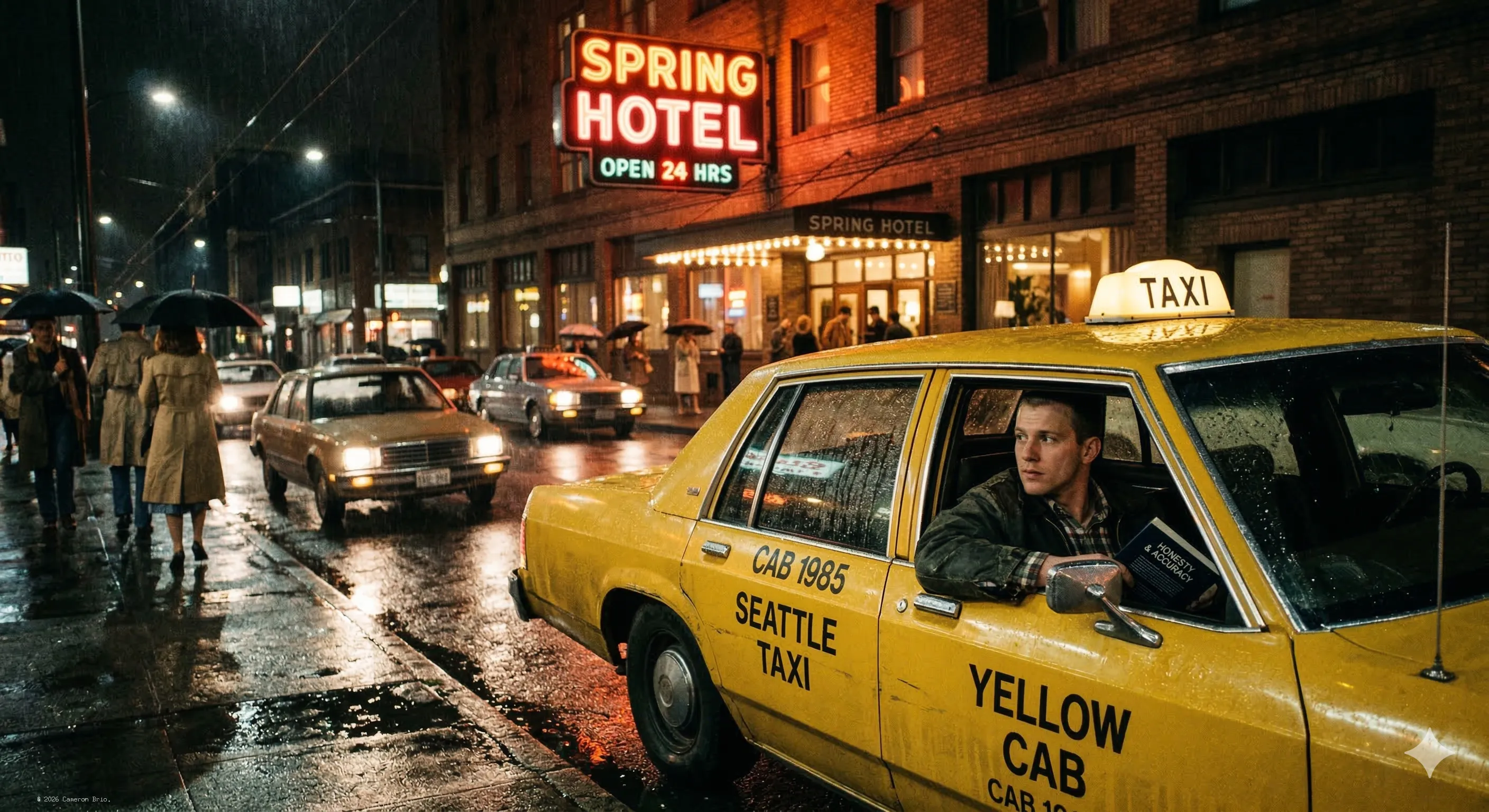
The Yellow Elephant of Spring Street
I always had a tough time with the "white lie." The way Nathaniel Hawthorne put it made the most sense to me:
"Accuracy is the twin brother of honesty; inaccuracy, of dishonesty."
It was 1985. Seattle was getting crowded. People had finally caught on to the "Emerald City" appeal and were migrating in from neighboring states, but none of that had done much for the cab business. My yellow taxi sat like an elephant on Spring Street, parked outside the Spring Hotel. I was only ever truly visible when trouble called for it. That big yellow chunk of machinery suddenly became the center of the world if there was an accident nearby and people thought I might have seen something.
"Let’s ask the cabbie," I’d hear them say.
It hardly ever panned out. Most of the time I was buried in a book or talking to Vanessa when she stepped out for her break. Even when I did witness a fender bender, I’d usually just nudge the cab to a different spot and tell them, "I haven't seen a thing since I've been sitting here."
Technically, that wasn't a lie—at that specific spot, I hadn't seen anything. But it sat heavy with me. I just didn't have the heart to tell people I couldn't afford a day off to testify in district court over their bent, expensive imported bumpers.
When people asked why I’d quit in my third year of law school, I gave it to them straight: "I don't know." There wasn't a specific problem; I even had the momentum. I knew no one would believe it. I could have said it was because I was a romantic, I suppose, but that wouldn't fly—especially coming from a young guy now driving a cab for a living.
Still, I wondered if too much accuracy could create its own kind of "white lie." What’s the difference, really, if a lie is manufactured but never spoken out loud? Maybe that’s how we psyche ourselves into believing what we want to believe, giving our avoidance a moral compass.
Nonetheless, the habit was working for me—so much so that it had started rubbing off on Beatrice. When her in-laws brought over a VCR copy of Reds to our party and asked if we’d seen it, I bowed out of the conversation by making a fuss over the drinks. My "bartending" consisted of opening twist-off beer bottles.
Beatrice just looked at them and said, "Interesting; they say it’s really a love story."
My cousin once told me: "If you want people to respect you, never talk about yourself."
The Pantomime of Truth
I could tell Beatrice’s in-laws were trying their best not to let the "cab-driving thing" get in the way of our relationship, but my silence about myself had created a sort of mist around me. Maybe that was why they seemed to enjoy my offbeat commentary on movie scenes; it was the only window they had into my head.
My favorite part of the film was when Eugene O'Neill tells Louise Bryant he would get on his knees, in his own way, if only she’d take him back. I always thought James Caan should have played that part; he’d been so good at playing betrayal in Rollerball a few years back. It was the kind of "Pretend Baseball Trading" logic that usually bored people, but Beatrice loved it.
"You and your James Caan thing," she’d say with a note of fond exasperation.
I was beginning to doze off while holding Beatrice’s hand, but a few minutes into the movie, I sat up for the Liberal Club scene.
"What do you say this war is about, Jack Reed?" the man with the massive mustache asked.
Jack Reed stood up, straightened his jacket, and looked around the room. With one hand tucked firmly in his pocket, he said a single word: "Profits." Then he sat back down.
As the laughter in the room began to die down, I spoke up.
"There it is. That’s the Hawthorne moment. Incomplete accuracy and honesty—the hand in the pocket while he said it."
I’d essentially hijacked Hawthorne’s quote and applied it to the screen, but I felt I had a good reason for it. Her brother-in-law actually paused the VCR. The screen froze on a grainy frame of Warren Beatty, and everyone turned to me in anticipation. Beatrice looked at me with a flicker of admiration.
"I didn't know pantomime carried so much psychology," someone said, teasingly but curious.
This—I realized—I was going to have to explain.
The Gopher’s Gallery
I had an apprentice job at the courthouse during my first year. I carried a fancy title, but in reality, I was just a "gopher" for the regular staff. Aside from a few official sessions consisting of enough paperwork to satisfy the school, I belonged to the clerks and the bailiffs.
I didn't mind. After a while, I realized I would have paid for the privilege of being there. Every chance I got—usually while waiting for a judge’s signature—I would study the room. I watched the jurors' faces, the prosecutors' strides, and the defense attorneys' practiced movements. I noted what they wore, what they carried, who assisted them, even the shine on their shoes.
Eventually, I noticed a pattern. It didn’t matter how expensive an attorney looked or how high a prosecutor’s rank climbed; certain rhythms were universal. It wasn't something I could easily elaborate on, but I could feel it.
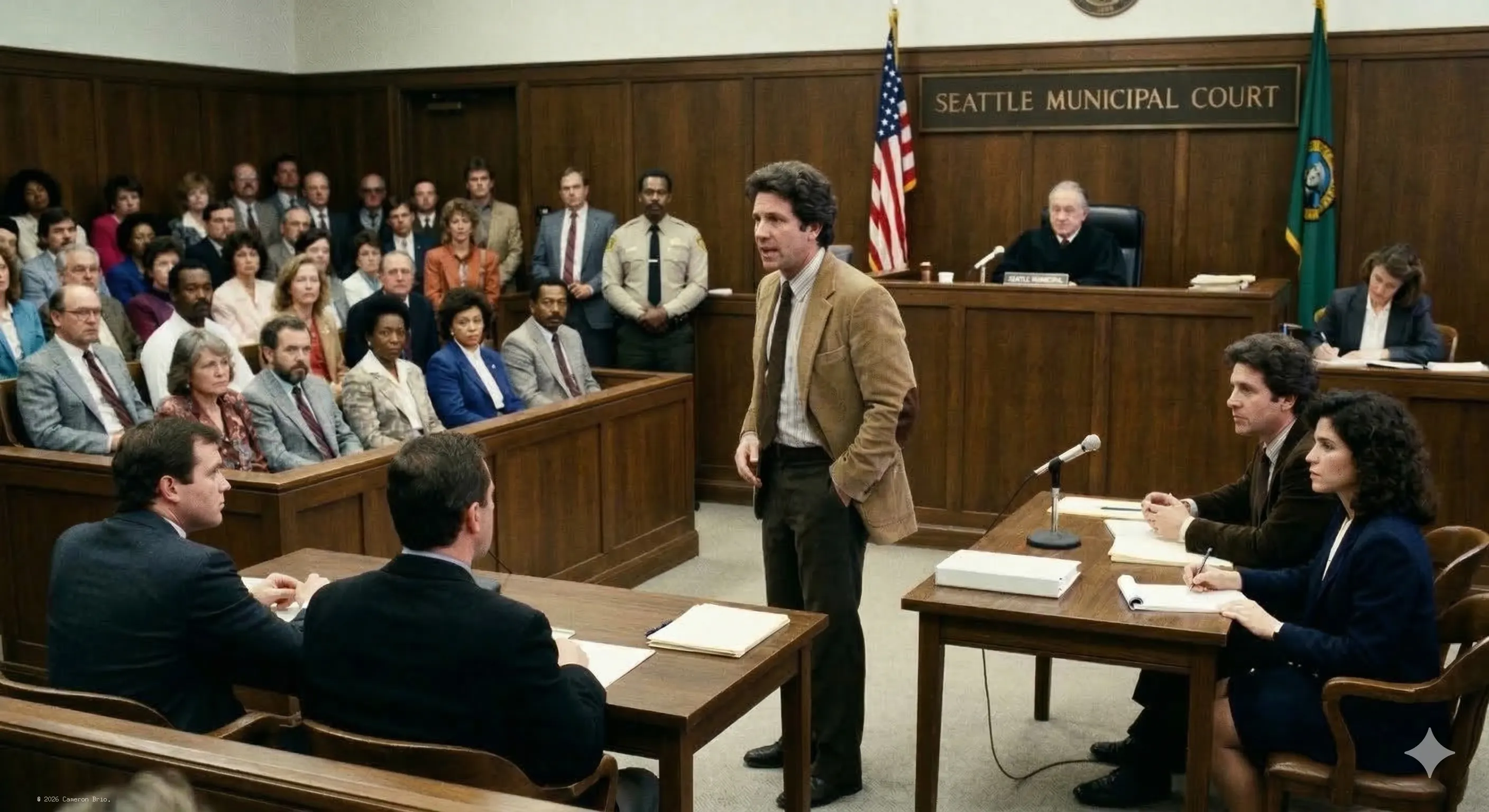
I also noticed the uniforms. Virtually every attorney on both sides wore a matching suit, except for one public defender. He always wore the same sport jacket with leather patches on the elbows. There was no regulation against wearing a sport jacket; it just took someone with the nerve to try it. He had an odd nickname, one only whispered by defendants and their families: "Guillotine."
The name didn’t fit his unassuming appearance or his cheerful, innocent face. But once, passing him in the hallway, I heard him say to a prosecutor with a wry smile tugging at his lips, "That’s the seventh one I’ve sent to jail today." It was an odd thing to say.
Then there was Paul Alden. He wasn't like the others. He was a tall relic of the arraignment sessions, sporting a white-trimmed beard and a permanent brown suit. People loved him. He could lay a whole case out for you in minutes; his assessments gave people a terrifyingly accurate idea of exactly how much money they were about to lose.
Whenever Mr. Alden got out of line and started trying to direct the "traffic" of the courtroom, Judge Hoffman would bark, "Shut up, Mr. Alden." If he got truly demanding, the Judge would drop the formality: "Shut up, Paul."
Hoffman always wore a rough, hidden smile when he delivered those lines—a flicker of admiration he didn't want anyone to notice. The gallery liked it, too. It made the room feel a little less like a machine and a little more like a home.
I noticed Mr. Alden had a specific, territorial move. Every time he knew he was about to go out-of-bounds or face a rejection, he would stand up and march toward the bench. He’d look up, hands clasped tightly in front of him, and deliver his motions to the judge. Without waiting for a reply, he’d make a wide, sweeping circle back to his desk. By the time he turned to face the bench again, his face was cheerful, glowing with a sense of accomplishment.
He would always try, and he would always bounce back—just like a character in a cartoon.
The Shadow of the Guillotine
It had been almost three months. I had only two weeks left before my apprenticeship would end.
I began to encounter "Guillotine" more frequently in the hallways. By now, there was a faint sense of mutual recognition; he would offer a sharp nod when he saw me, and I would nod back. I wanted to say something—a simple "Good morning, Mr..."—but I realized I didn't actually know his name. Beyond that whispered nickname, I hadn’t heard a single soul address him.
It was strange. Unlike Mr. Alden, whose name was practically part of the courtroom furniture, I never heard a judge call this man to the stand by name. When his turn came, the judge would simply make a clipped gesture with an open palm—a short burst of: "...and the defense?"
The anonymity felt surreal, but I wasn't about to go digging for answers.
Instead, I just paid a bit more attention, trying to piece together why they called him what they did. Sometimes, it felt as though he was the one following me. More than once, I found myself in a courtroom waiting for paperwork to be signed, only to realize it was one of his cases on the docket.
The trial courtrooms were a world away from the chaotic, revolving-door energy of the arraignment courts. However modest, they all shared the same anatomy: the jury box, the judge’s elevated bench, and two cheap tables sitting across from each other for the attorneys. And no matter how cramped the room, there were always a few rows for the audience.
If the court was in session, I would slip into the back and sit quietly. I wanted to devour every strand of the atmosphere; I sat there like a sponge, soaking up the tension and the dust.
Guillotine was cold and terrifyingly intelligent, despite his humble appearance. It was during one of those quiet afternoons in the back row that I finally saw him in action.
We’ve all seen the courtroom scenes embedded in movies. In some uncomfortable way, they seem to offer a reasonably accurate picture of reality. I always felt like the Hill Street Blues TV series was a bit too crowded—over-cast, maybe—but perhaps that was intentional. If you trimmed down the foot traffic in the arraignment sessions, it would look just like Seattle, give or take a few details like the humorous barbs between Alden and Judge Hoffman.
But there was one thing the movies always got wrong: the audience. In TV shows, there is always a sea of people in the gallery, no matter the setting—divorce, traffic, civil disputes, or the zany antics of Night Court. In a real courtroom, there was almost never an audience.
Guillotine had retreated to the back rows for a private consultation with his client. I didn't want to hear what they were saying, but it would have looked odd to simply get up and leave. There was only one empty row between us. I wasn't supposed to hear—yet I had the distinct feeling that Guillotine wanted me to hear.
I braced myself. To me, he was a sort of Rasputin for lawyers. I shifted into gear, gathering my senses while trying to mentally distance myself; it wasn't as if I could just cover my ears.
As it turned out, I didn't have to. The voices were garbled, but his rehearsed, crafted pantomime was loud and terrifying. He knew his mark, and he was directing his own movie.
I had seen this same pattern in Reds—actually, in almost any movie. I’d learned about it from a friend who was way ahead of me; he’d quit school during our pre-law courses and moved to L.A. to study directing. He used to tell me about the tiny things the crew spent hours getting right, sometimes even hiring consultants for a single gesture. One of those things was "pantomime." That was just the name I gave it, for lack of a better word; to me, it was the dance of the soul.
I had it all ready to point out to Beatrice, though I never got around to it. There’s a scene in Reds where Eugene O'Neill first walks into the room to ask Louise to take him back. He rests his elbow on a stack of boxes, creating this god-like, statuesque image of himself. He slightly kicks a box on the floor to indicate where a glass was packed. Every bit of it had a meaning. Otherwise, we could all just make movies with our own VCRs.
In this courtroom, "Rasputin" had that same rehearsed movement about him. He knew exactly where to sit and where to place his elbow as he delivered the news—news that, judging by his client’s frantic expression, meant the case was already lost.
A King of His Own Making
By now, I couldn't help myself. I had to see Rasputin in a "full movie," not just the flickering clips of his dominating presence in the hallways. I had been cultivating my experience by moving freely between the courthouse floors, but for a longer stay, I had to negotiate with the regular staff.
"All right," my supervisor said sarcastically, "but you’re not a writer, you know."
A case finally went to trial with Rasputin as the appointed counsel. It was as surreal as the quiet sessions in Superior Court, but for different reasons. It was far too crowded for a Municipal case. The defendant was unusually clean-cut and well-dressed, and the gallery was packed with friends and families from both sides of the aisle. It was an assault case—a simple fight between two men in front of a gift shop—but the atmosphere felt heavy, like a high-stakes political drama.
Again, nobody called Rasputin by his name. I wondered if he had a special contract for this. I could have easily checked the public list of defenders in the office, but I refused. I wanted to hear someone actually address him. The name didn't matter; the recognition did.
The trial dragged on for over a week—exhausting jury selections, delays, and a dizzying array of witnesses. It felt disproportionate. All this for a sidewalk scuffle?
Then came the closing arguments. Unlike the defense, the prosecution was a team. They had even called in a more experienced prosecutor from a higher court—a man with an average build and a thick, fuzzy mustache that covered half his face, the kind you’d see on a sheriff in an old Western.
Rasputin was up first. He didn't bother buttoning his jacket before stepping onto the floor, ignoring the cinematic tradition of the "orderly" lawyer. As he began to speak, he adopted a bizarre, almost comical persona. He looked like a man who had learned a cheesy new card trick and was performing it at a Denny’s counter at three in the morning, trying to impress a waitress on her last week of probation.
It was painful to watch—almost an insult to the room. The case is over, I thought. I only had three months of observation under my belt, but it was enough to know that having your client testify and demonstrate his boxing moves in front of the jury was usually a fatal mistake.
It got worse. After a brief intro, Rasputin shifted into analogies about bonds and comparative graphs. He wasn't even making behavioral references; he was talking about the fluctuations of money while staring intently at one specific corner of the jury box.
And then it happened. The Hawthorne moment.
He turned swiftly, as if he were about to ask for forgiveness in that grand Eugene O’Neill style. He shoved his right hand deep into his pocket, turned to that same corner of the jury, and whispered something very softly about the "truth."
The prosecutor followed quickly, before I could even digest what I’d seen. I looked at the defendant and his family; they didn't look worried. The defendant remained calculatingly calm.
The prosecutor delivered his expected lines with precision, finishing with a brilliant move. He turned and pointed to the audience behind the defendant. "This side wants to win," he said. Then he pointed to the complainant's side. "And this side wants to win. Let the truth win."
As the room cleared, I caught a fragment of Rasputin speaking to a woman with an overly made-up face. "Don't worry," he murmured. "The jury is in a good mindset."
It took only two hours for the jury to deliver a guilty verdict.
But I was still shaking. It wasn't the verdict that got to me; it was the realization of what I had just witnessed. Rasputin was strikingly intelligent—there was no doubt in my mind that he could have won the case if he’d wanted to. But as I watched him stand there, unmoved by the word "Guilty," I finally saw the light.
He was a king of his own making.
He had humbled himself, confused the room with his clumsy maneuvers, and diluted his closing argument until it was a muddy mess of analogies. But it wasn't a mistake. He had already declared himself the judge and the jury for his client long before the trial began. He had looked at the man he was defending, passed his own secret sentence, and then ensured the world followed suit.
I didn’t know when or how he had turned to this grotesque ritual, but he had sunk his powerful claws into the very soul of the courthouse. He was passing judgments before the "judge" or the "jury" ever stood a chance. He wasn't defending a client; he was playing God in a sport jacket with leather elbow patches.
Men like that terrified me. They were the ones who could re-write history.
I only told a thin version of the story at the party. I kept it light, offering just a few references to the hand in the pocket and that sense of wry, quiet dominance. I even shuffled my hijacked Hawthorne quote, blurring the lines of accuracy and honesty until I could package it into a neat, digestible warning:
"Never trust a man when he delivers a punchline with his hand in his pocket."
It worked. I won Beatrice’s admiration all over again, and her brother-in-law—who ran a recruiting agency—sat up straight, suddenly energized. He started telling us about a partner who had stiffed him on a deal years ago. He said he finally remembered the man standing in a boardroom, one hand buried deep in his pocket, telling him, "You have to look at this in longer terms," just moments before the other team arrived to sign the papers.
As much as I enjoyed the success of my own reference, I just wanted to let it go. I could feel a cold sweat beginning to prickle on my forehead. The performance was starting to feel like the very thing I had fled.
I didn't want to be the "expert" or the "philosopher." I just wanted to hold Beatrice’s hand and doze off while the movie played. It didn’t matter to me what Jack Reed did or said once he got to Russia.
For us, in that moment, it was just a love story. It felt good—just like a movie is supposed to feel.
Sanctuary at Northgate
Driving a cab had its perks. One was getting to know the city’s anatomy—the fancy dinner spots with fine atmospheres, the quiet coffee corners, or the scenic hideaways like my favorite overlook at Carkeek Park. But I never would have guessed that my favorite hangout would turn out to be an unassuming, old tavern up in Northgate.
It wasn't even my idea. One night, a dancer I knew was supposed to meet her ex-boyfriend at that tavern; it was close to his place, and things were tense. I was just about to pull out of her parking lot when she flagged me down. Her ex hadn't shown up yet, and she was nervous. She asked if I’d go inside and keep her company while she waited.
She was one of my "personals"—a regular who called me directly—so I didn't mind the extra attention. Besides, a break sounded good.
The place was one large, flat room with dim lighting and a surprising level of cleanliness. A few people were scattered at the bar, but the booths were empty; the real regulars hadn't drifted in yet. She went back to her seat and started sipping a beer. I didn't think it would be "cool" to sit right with her and look like a bodyguard, so I drifted over to the pool table in the middle of the room.
I played a solitary game, keeping a casual eye on her. A few minutes passed, and just as I was lining up a shot, a hot cup of coffee appeared on the rail of the pool table. I hadn't even seen the bartender approach. I grabbed the cup to thank him, but he was already halfway back to the bar, his back to me.
The coffee hit the spot.
I started going back there on my off-hours with Beatrice. The place was friendly—too welcoming for just a neighborhood tavern, really. Even though I felt like I didn't quite belong in a place like that, it was becoming my sanctuary. I loved playing pool with Beatrice and just shooting the breeze. The bartender always seemed to be looking out for us; every so often, he’d slide a beer onto the table and say, "On the house."
I had a strange feeling I was being buttered up for something. It didn't feel sinister, just... intentional.
The payoff came one night when the bartender called me specifically. He asked if I could do a favor for a guy in the back—an old attorney who had over-served himself and was in an embarrassing state. The bartender didn't want to call just any driver; he didn't want to risk the old man being recognized by some stranger who might talk.
When I arrived, I recognized the man immediately from my gopher days. He was one of those old-timers whose friends would still throw him a case or two because he simply refused to retire. He was a relic, but he was still a well-respected name in the courthouse.
The Witness in the Borrowed Tie
"You look nice..." a soft voice said above me.
I had been dozing off on a cold wooden bench outside the Seattle District courtroom. I sat up and recognized her immediately. It was Kaleen, one of the kinder regulars from my gopher days.
"Thanks," I said, smoothing out my lapels. "I borrowed the tie, but the shoes are brand new." I spoke as if she already knew this was the only suit I owned.
"What are you doing here?" she asked.
"I’m testifying in a civil case," I said.
She glanced at the clock, noting the late afternoon hour. "Still?"
"I was in there this morning," I explained, "but they’re going to call me back in any minute now."
She looked curious, so I continued. "A lady is suing a supplier. Their workers walked on her hardwood floors before the Swedish Varnish had fully dried. She’s suing for the damage, the stress, and the time the family had to spend at a motel while they redid the floors. Evidently, she was on the phone with a foreman right in front of the Spring Hotel. I'm here to testify about her state of mind, her demeanor, and exactly what she said—all of that."
Kaleen shook her head, a smile tugging at her lips. "So, you’ve been here all day?"
"Yeah," I said, and for the first time, I realized I didn't mind. "But it all worked out. Beatrice is taking me to the Opera House tonight. We’re going to see Itzhak Perlman. They say he’s getting forty grand for the performance."
She gave me a long, cheerful look—the kind that suggested she saw the "accuracy" of my life better than I did.
"Have a good time tonight," she said. "And say hello to Beatrice for me."