I. The Arboretum Shrine
It had been only two years since I’d quit law school and started driving a cab on the streets of a rapidly growing Seattle.
Even the weather was changing. It was 1985, and tourists were wondering where the rain had gone. I remembered how, just a few years back in 1980, a light drizzle would persist for a solid two weeks before you’d catch even a glimpse of sunshine. Now, there were record-breaking stretches of consecutive sunny days—and I liked it.
The whole city felt different when the sun was out. People looked more vibrant, almost mesmerized; even the trees felt changed. On most sunny days, if I had a fare heading toward Capitol Hill, I’d make sure to return via the winding roads of the Arboretum. I’d absorb the view of the Japanese Garden under a ceiling of leaves, the sunlight flickering through the canopy. It felt like a shrine. I emerged from that street feeling like a different man, wishing the drive would never end.
In a way, all this sunshine had forced me to look at everything through a poetic lens. That, mixed with the grit of the streets, had made me philosophical. My mind was racing faster and across a wider scope than my eyes could even track.
II. Mustard Yellow and Aramis
My cab had no divider; it was just a regular, well-maintained, mustard-yellow Chevy Impala equipped with a radio. “Finally, a clean cab.” the man said to the friend as they were getting in my cab. “Did someone leave those in your cab.”? the other man said pointing to a pack of Camel 100s on my dashboard. “Your cab smells too good for those cigarettes to be yours?” “They’re mine all right; I just don’t smoke in my cab.” I replied with a half hearted smile. He looked younger than the other one. He had a full business suit on. I felt a strong scent of Aramis on the back of my neck before I sensed its smell.
III. Agents of the Spring Hotel
It was impossible not to overhear the two businessmen talking in the back seat. Their conversation began with a Chapter 11 bankruptcy case and soon evolved into an adaptation of Sun Tzu’s The Art of War. They appeared to be in the insurance business—likely on the acquisitions side—and they were deep into it. During our short ride on that sunny day to Boeing Field, they covered Sun Tzu’s strategies on maintaining strong supply lines, harassing the enemy, and retreating when the opponent is at their strongest. They spoke of stalwart generals and the grim necessity of fighting to the last man when a situation is imminent and you are outnumbered. Perhaps it was my "college look" screaming semi-educated dropout, or perhaps it was just a look of youthful wisdom that gave me away, but I felt as though they wanted me to jump into their conversation—either as a challenge or for a bit of suggestive admiration. If anything, it was a showcase of their brilliance. What I heard was new to me; until that day, I’d never heard anyone describe a merger strategy like a world atlas. Yet, somehow, I felt I had sensed a version of it before, watching the filtered images of people from inside my cab. It was a version of thoughts and feelings trapped and floating between the skyscrapers of downtown Seattle, waiting for someone to turn them into storylines. “What do you think about Sun Tzu?” the younger said with a cold look into my rear-view mirror?
IV. The Art of Deception
I felt as if I’d been thrown into a fireball tumbling down a hillside. It felt like the universe had shoved me onto a stage to untangle a storm of thoughts—a splinter of an idea that had been lurking in my mind. I searched my memory, scrambling through every mental file of classroom discussions, until I finally landed on a conversation I'd had with a half-drunk political science major in a sports bar. I hadn’t actually read The Art of War, but I was armed with the deep, "think-tank" summary of a graduate student with an agenda. "I’m not even sure Sun Tzu actually existed," I said. "Oh, he existed," the older man interrupted before I could finish. He was dressed more casually than the younger one, but his voice carried the same heavy weight of arrogance.
I didn't want to give them an opening, so I leaned back slightly, caught their eyes in the rearview mirror, and doubled down. "Sounds to me like you’re just looking for zero accountability." The two of them exchanged a look and fell into a long, heavy silence. They leaned back in unison. The younger man adjusted his tie while the older one fixed his gaze on the pack of Camels on my dashboard. The air in the cab froze. They looked as though they suddenly regretted their Art of War showcase. Finally, the older man broke the silence. "How did you come to deduce that?"
I was suddenly glad this was a long haul. Vanessa, the receptionist at the Spring Hotel, had specifically asked me to take this fare. It wasn't just because I was parked at the taxi stand off Spring Street; it was because she knew I wouldn't ask why. I could always see her through the large window of the hotel’s main entrance. We weren't exactly friends, but we looked out for each other more than friends often do. Most businessmen and wealthy clients stayed at the Olympic Four Seasons. Only two types of "old money" types stayed at an unassuming place like the Spring Hotel: the old money itself, and the agents they controlled. I was ready to unleash my thoughts on the yuppie in the back seat—no sugar-coating, no compromises. I only hoped they couldn't see the reflection of the fear in my face glowing in the rearview mirror. To steady myself, I pretended I wasn't in a cab at all, but back at the UW, standing behind an old oak podium in a small classroom.
"Well, it’s simple," I began, opening my case. "The first sign is other people's money and resources." The older man froze. The younger one immediately reached for his tie, loosening it. I paused, giving them a chance to cut me off. Part of me hoped the conversation would end on their terms, but they now looked too eager for me to stop. I could feel they didn't want me to find a detour; they wanted the straight line. I knew my "think-tank" summary wouldn't be enough to carry me through this. I had to blend in my own thoughts—I just hoped I could bounce through the right points before delivering my final blow.
"Sun Tzu was hired to claim victory for an emperor who had his doubts," I continued. "To gain the emperor's confidence, he proved his method by training a group of concubines, turning them into disciplined warriors. But he ended up beheading one of them just to show he was capable of keeping emotion and mercy out of the equation. That is the very foundation of what an emperor needs to counterbalance his power. "The book should have been called The Art of Deception. Sun Tzu doesn't teach fighting; he teaches deceit. He uses massive amounts of money to build supply lines just to evade an enemy that appears strong. He teaches soldiers to stand at the enemy’s gates and make obscene gestures, hoping they’ll provoke a mistake. He cultivates a fear of betrayal so deep that the very generals who would have stayed loyal are pushed to turn against their leader. If he doesn't find spies in the army, he creates them." I glanced at the mirror. The air was thick.
"By the time that army returns, they are no longer the same men. Sun Tzu may deliver a victory, but the emperor is doomed because he is now surrounded by men who have developed a taste for deceit. It’s a roadmap to a hollow life. Sun Tzu is just an unscrupulous salesman who landed a high-stakes gig. If you follow his lead, you can stay in the shadows and succeed—for a while. But you’re only building a house of cards. "If you look around, you’ll see symmetry and duality in everything: trees, clouds, the ocean, even things under a microscope. When you cultivate deception, you create a wave of imbalance that is bound to die down and, one day, drown you." I wanted to stop, but the momentum of my own resentment wouldn't let me go. "Maybe the title should have been Audacity and Denial."
Suddenly, the man in the tie slapped the top of the front seat near my shoulder and burst into laughter. "I love this guy! 'Audacity and Denial!'" he shouted, looking at his companion. I kept a small, steady smile in the rearview mirror. His interruption didn't bother me; I’d had enough cab-seat conversations to know that most people can't track more than two lines of thought at once. Even in law school, they break topics into small pages and walk you through them.
You can't just unload a heavy shipment of ideas in front of people; they usually just grab the last phrase and run with it.
But this time, I felt they had absorbed it all. They looked pale. They seemed to realize that Sun Tzu only shows you a victory that destroys you in the end, changing you into something you can't recover from. It’s like setting out to find heaven, only to realize you don't know how to breathe the air once you get there. The older man dropped his chin to his chest for a moment, letting the younger man’s laughter reconcile the fears of whatever was waiting for them at the end of this trip. Then, the man in the tie hit me with another shot of mockery. "I love it... 'other people’s money,'" he said with a soft, sarcastic laugh. I couldn't let that slide. I had heard this subject come up in a dozen different ways, and I had versions of a response ranging from "polite" to "nasty." I decided he had asked for it, but I still gave him the somewhat polished version. "That's right," I said.
"You can’t have an orgasm with someone else's equipment."The cab went silent. I decided that whatever came next, I would stay quiet. Then I saw it: a quiet, warm look of admiration—or perhaps confirmation—from the older man in the mirror. For a brief moment, I felt like I was back in law school, winning my second mock trial. Only this time, there was something more at stake. There was history.
V. Millie’s Ritual
We were approaching the airport now, the runway stretching out to our right. Both men had fallen quiet—too quiet. The man in the tie tried to compose himself, putting on a face that suggested he’d simply had his bit of fun for the day. When I pulled to a stop, they both gave me a polite, silent nod and stepped out of the cab. I turned the car around and began the drive back toward downtown. It wasn't uncommon for "old money" types not to pay for their ride directly. Either an entourage member would settle up later, or the hotel would handle the bill with a generous markup. In any case, this ride was for Vanessa. Besides, at that moment, I felt like I should have paid them for the audience.
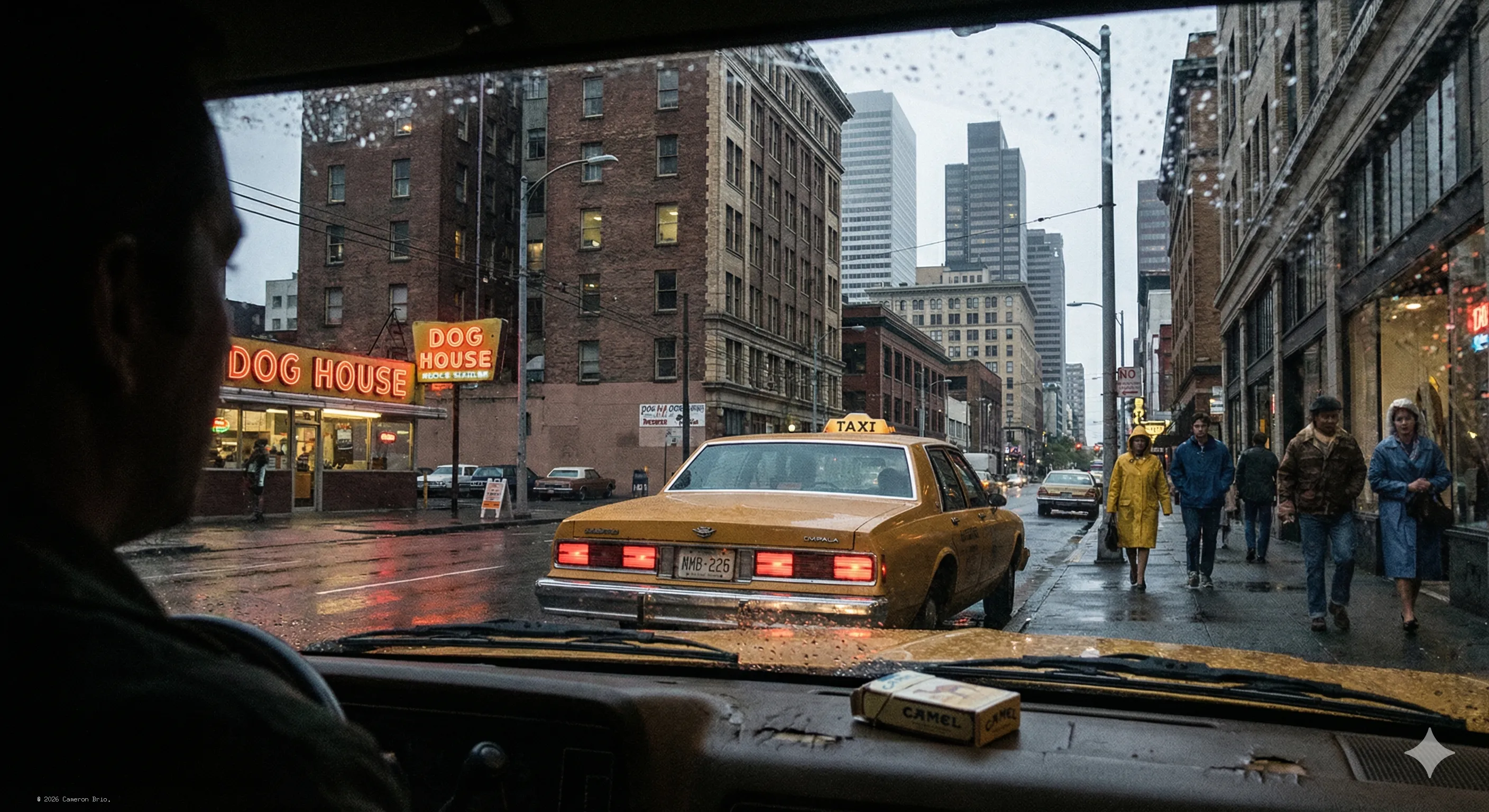
For a split second, I felt a rush of adrenaline, a sudden urge to keep driving north toward Tulalip. But I came to my senses and headed straight back downtown to the Dog House. Millie already had my ritual waiting for me: two slices of apple pie with a scoop of vanilla ice cream. "Are you coming back from the boondocks?" Millie asked. her voice was kind but demanding, a classic Seattle waitress tone. She poured my fourth cup of coffee slowly and deliberately. "No," I replied. "I only went as far as Boeing Field." She stopped pouring and gave me a half-hearted, knowing smile. "I’m proud of you, honey."
VI. The House Up North
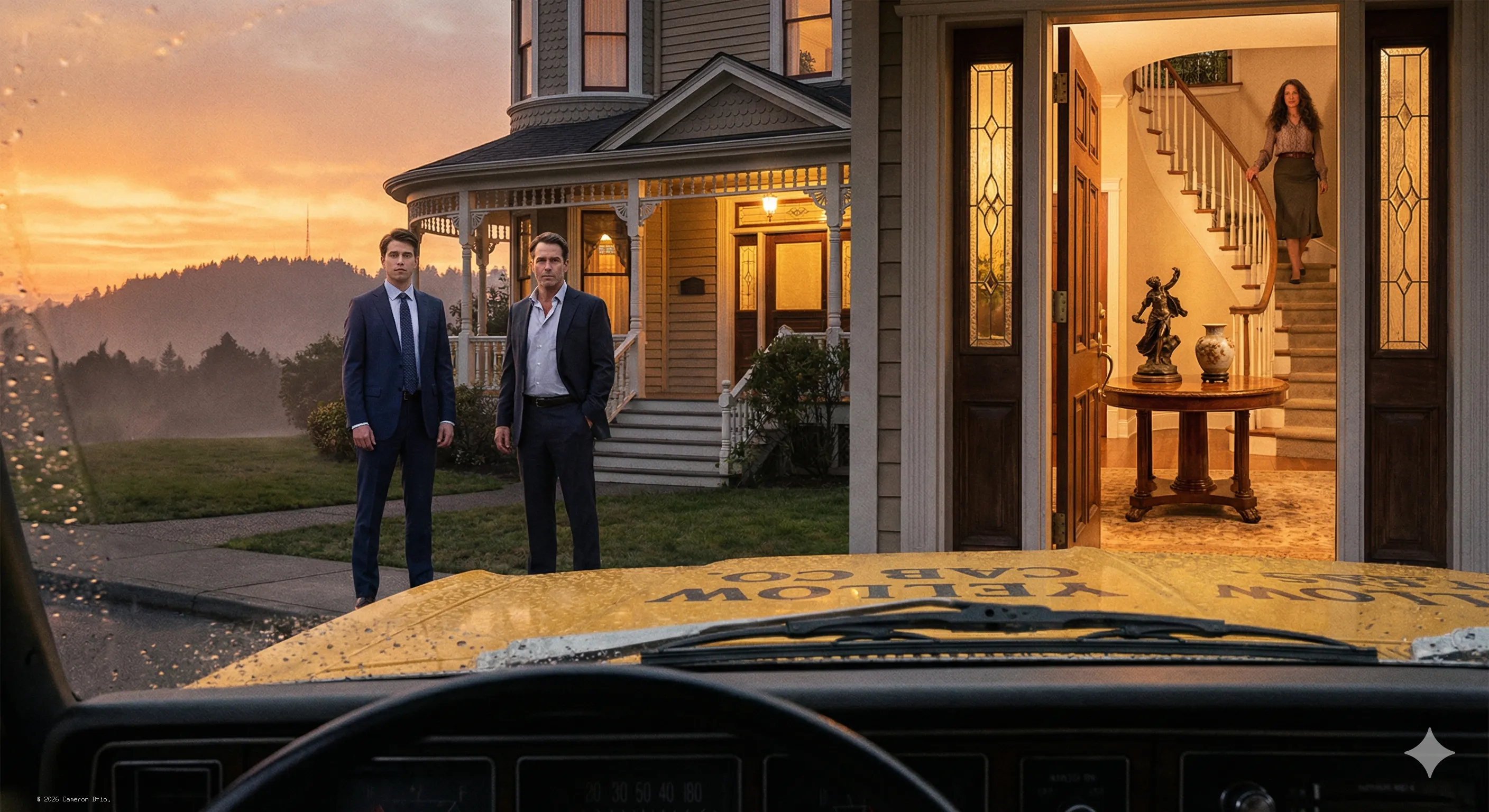
As I watched Venessa through the glass, I couldn't shake the Sun Tzu discussion from my head. Every so often, while she was on the phone, she would make a subtle gesture—a slight bounce of her hair against her fingers—just to let me know she acknowledged I was there. If she wasn’t the primary reason I drove a cab, she was certainly the reason I always chose to park at the 4th and Spring taxi stand. I didn't want to cast a shadow of doubt over my own thoughts, but I couldn't make the math add up. The logistics felt jagged: I’d had to drive way up north to a private residence to pick those two men up and take them to Boeing Field, yet they were officially staying at the hotel. That wasn’t entirely unheard of in this business, but the way they were waiting for me was. Something was off-balance. People of that caliber don’t get anxious about the arrival of a taxi; it’s not like they’re worried about being late. The plane doesn't leave until they get there. I tried to push past those small details, but the inconsistency began to gnaw at me.
I realize now it was my own vanity that kept me drilling into the subject. The entire setup felt like an invitation I wasn't supposed to accept. I tried to humor myself, thinking, “Oh well, it’s just another pitch from an Amway sales team at a grocery store,” but I knew better. It wasn't even close.
I had always kept my cousin’s childhood advice close to the vest. I must have been eleven when she first told me: “If you want people to respect you, stop talking about yourself.” At the time, that was a lot to digest. So were the Judo throws and the head-butts. She had been the only female Judo practitioner in her police unit back when the force was just starting to integrate full-contact expertise. She must have picked up her specific blend of philosophy and combat while stationed in Japan. I had taken her advice and pushed it even further: I wouldn’t even talk about others. I would only mind my own mind. She had a way of accepting things as they were. I can only analyze that now, in hindsight; back then, I was just grateful her lessons kept me from being bullied in high school. I’m still not sure what she saw in me—she never bothered teaching my older brothers. I felt I owed it to her legacy never to linger or dwell on a moment for too long. But looking at the street through the rain-streaked glass, I found myself wishing she were still alive. I needed to talk. Still, the feeling wouldn't leave me. I decided to go see George, one of the old-timers back at the cab lot.VII. The Oracle of the Cable Spool
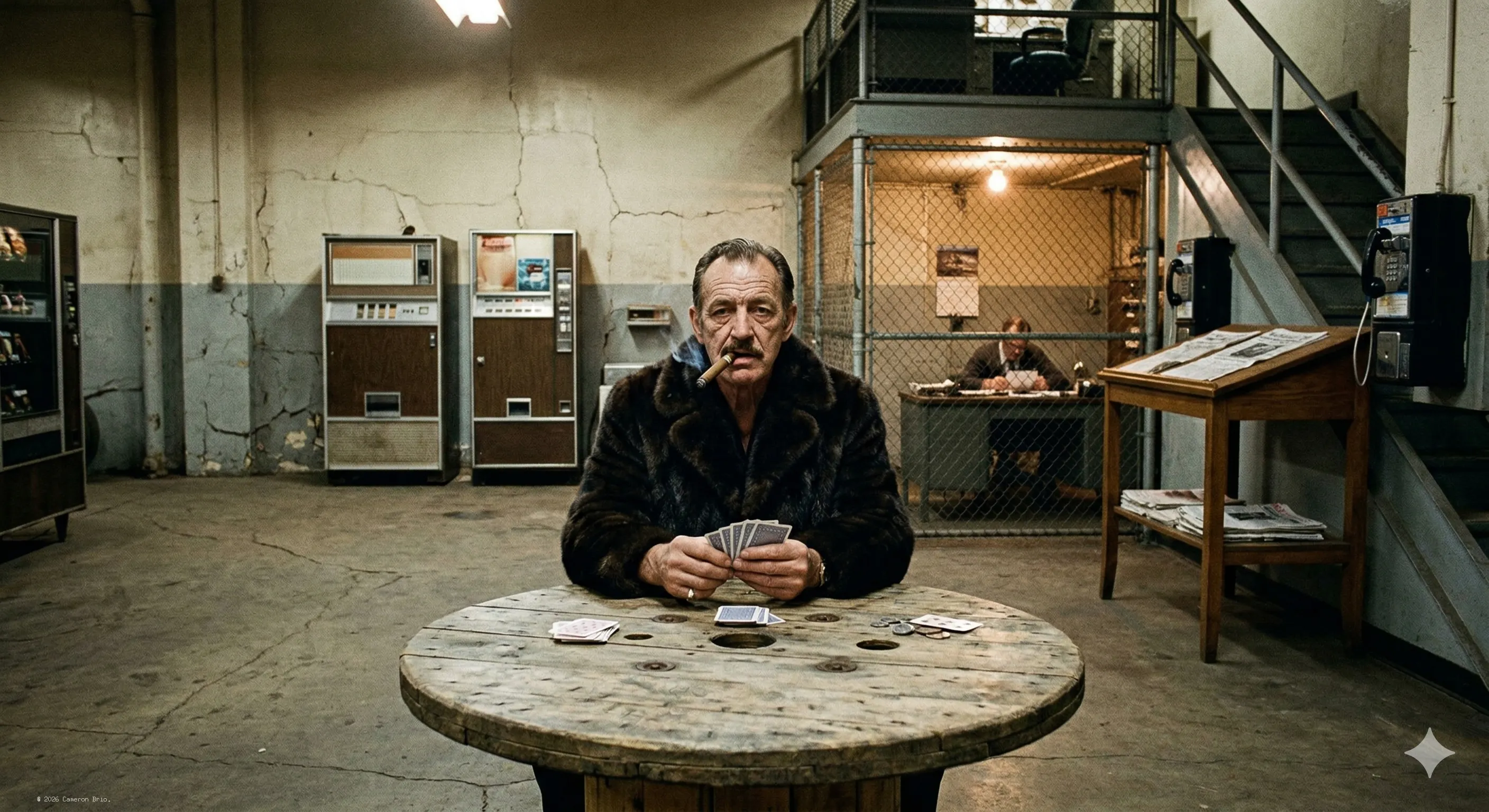
I had never talked to George directly. There were times I’d see him sitting at the round table—which was actually just a massive industrial cable spool—in the middle of the lobby. He’d be playing cards, a half-lit cigar perpetually tucked into the corner of his mouth. He had an unusual appearance for his age. He looked seventy in the face, but his body didn't look a day over forty. If you glanced at him, you’d swear he had a Clark Gable face grafted onto a John Wayne frame. In all the time I’d spent at the office, I’d never seen him standing up. He was always behind that spool, sitting perfectly straight in his signature custom-made sable jacket. Come to think of it, I’d never even seen him behind the wheel.
In sitcoms, they always show the cab lot as one big room where mechanics and drivers mingle under a single roof. This place wasn't like that. It was an office, strictly partitioned from the maintenance area. It was clean enough, with concrete floors and a few vending machines, though you could see the jagged cracks spiderwebbing across the walls. There was a "cage"—a cramped room where the superintendent shuffled paperwork for the next shift or fielded internal calls. Nearby stood a tall, slanted wooden table designed specifically for reading newspapers, much like the ones you’d find in a library. It sat near the payphone at the edge of the stairs that led up to the dispatch room. Technically, we were independent businessmen; there was no official reason to linger in the office. Half the drivers, myself included, simply picked up and returned our cars from the owner’s designated spots on the lot. But a select few would come inside to hang out, feed the vending machines, or play cards. If the movies ever got anything right, it was the old-timers and their cards. Watching them, I had the distinct feeling that as the world changed, these men would be the last of their kind.
I usually only smoked when I had a beer in my hand, or when I was up at a tribal casino feeding my own brand of curiosity. But tonight, I lit one. I had a challenge in front of me: how was I going to approach George? I was certain he knew me—likely better than I wanted him to. But then the old conflict flared up again. I didn't want to discuss myself, and I certainly didn't want to tell anyone what I was thinking.
VIII. The Four of Hearts
The light was failing, the sky bruising into a deep purple. I caught a glimpse through the window and saw George alone at the table. I almost turned back. There was no one else in the room, and he was playing against an imaginary opponent—a two-handed game of Rummy with a ghost. It felt surreal, especially when I realized it was April 1st. April Fool’s Day. I was ready to walk away, but then I remembered that while the rest of the city’s cab fleet was swarming the Kingdome for the Final Four, I was the only one sticking to the quiet corners. Most drivers were chasing the quick cash of the tournament crowd, but I preferred the steady, strange rhythm of 4th and Spring.
"How do you like that?" George asked casually. He didn't even look up; it was as if he’d known I was standing there before I even reached the door.
"See? It’s like magic. A four of hearts goes in, and it comes out exactly when it's invited." He tapped the table twice and let out a deep, rolling laugh. "This’ll give Charlie a dose of his own medicine. Took me a month to figure out how he was doing it." He finally pulled the cigar from his mouth and looked at me. He was smiling, but I couldn't tell if it was a genuine grin or a predator’s smirk.
"Don't worry, kid. You don't have to say a word." He leaned back. "Let me guess: whatever's eating you, it has nothing to do with this lot."
In a way, he was right. Nobody at the cab lot cared about anything that didn't directly impact their pocketbook—unless it was a sports debate. Those would flare up like brushfires. There was even a guy at the Seattle Times who’d answer the phone for free just to settle arguments over stats and scores. I’d actually called him once, just for the hell of it, to ask about the '65 World Series. “1965, you say? Give me a second... here it is. Dodgers over the Twins, four games to three.” That man’s voice and the card games were the only things that gave this lot any signs of life.
"Let me make it easy for you," George said. "It’s the doubt. You need to get rid of it. Come to terms with what you know, and you’ll be alright."
"It’s just that—" I started, trying to craft a sentence that wouldn't reveal too much. George cut me off. It wasn't an interruption so much as a rescue.
"You don't have to explain," he said, and then, with a flick of his wrist, a four of hearts appeared from his sleeve. "Everyone knows about your proximity to the 'Old Money.' It’s not what you think, though. Most people just have an idea of it—and for them, that’s enough of a reason to either stay out of your way or try to get close to you."
I stared at the card. "What do you mean?"
"Well, let’s look at the books. How many airport trips have you had lately from the Cancer Research Center?" Before I could answer, he kept rolling. "Do you ever wonder why Venessa only calls you, and why no one here complains about it? Before you showed up, nobody touched the 4th and Spring stand. No worthy trips ever came out of there—just Canadian tourists heading to the waterfront. There’s zero foot traffic going uphill on Spring Street." George paused. I pulled up a chair and lit a Camel 100, a silent signal that I was listening."Everyone sees you sitting there right in front of that big hotel window," George continued. "Have you ever seen a shift manager, a concierge, or any kind of boss give Venessa a hard time?
He shuffled the deck with practiced precision. "You see, everyone works for 'Old Money,' even if they don’t realize it. The funny thing is, the 'Old Money' doesn't even have to spend that much to get what they want—not like these yuppies throwing cash around to prove they exist. People shouldn't call them 'Old Money.' They should call them 'Old Power.'"
I was starting to grasp his meaning, but the dots weren't quite connecting yet. I was hungry for more, but I felt a seed of doubt beginning to take root—not about the city, but about Venessa. George went back to the cards, practicing the cheat move over and over, his hands a blur in the dim light of the lobby.
IX. The Unwitting Auditor
"It’s not what you think, George. I’m not that important," I said, though my voice lacked conviction.
"Oh, you’re important, kid. Whether you want to be or not," George countered. "Let me ask you this: how many doctors come and go from the Cancer Research Center? And how many of them run their mouths in the back of your cab? You know more than you think you do. It’s a long ride from the Medical Center to Sea-Tac."
He leaned forward, the spool table between us feeling like a witness stand.
"Think about it. You’ve got maybe fifteen top-tier doctors, plus research assistants, nurses, support staff, and trial patients. What do you think the overhead is on a setup like that—and who do you think insures them? The doctors' salaries alone are north of four million. You think all of that is covered by charity bake sales? Think again." George topped it all off with a smirk.
"You’re in the insurance business and you don’t even know it. Just don't ask me to spell it out for you."
His words hit like a shot of adrenaline. Suddenly, an array of voices began to play in my mind—a discordant symphony of every conversation I’d ever hosted. I heard those doctors again, their voices varying in tone and pitch like a fractured opera. I didn't want to spell it out, either—not even to myself. It was always the little things they let slip: a casual reference to a failed trial, a legal vulnerability, or a breakthrough that hadn't hit the papers yet. Information that could win a litigation case or move stocks by ten points before the opening bell. It was a shrewd play: appeal to a man's vanity or his desire to seem intelligent, and eventually, he’s bound to offer up examples or pass on sensitive data just to prove his own point. I’d heard of "fake interviews" designed to bleed a competitor’s secrets by making a desperate candidate sing for their supper. But I’d never considered this—the subtle, passive harvesting of information from the back of a mustard-yellow Chevy.
"You'll be alright, kid. Just come to terms with the doubt," George said, and for the first time, I saw a flicker of genuine admiration in his eyes. "I know you’ll never bow to anyone unless you have a deep, personal respect for them."
"How do you figure that?" I asked, lighting another cigarette to steady my hands. "Simple," George said. "When we had that ruckus over Muhammad Ali’s 'phantom punch' against Liston, you were the only one who didn't pick a side. Everyone else was busy pointing out the holes—the glove not touching, Rocky Marciano’s commentary. But you wouldn't stoop to that level. You just accepted it for what it was. To you, it didn't matter if the punch was a ghost. You couldn't bring yourself to belittle years of sweat from either man."
He went back to the deck. "Look—it’s working now. Even I can't tell when this card slips back into my sleeve. I can't wait to see Charlie’s face when I show him his own trick." He tapped the spool again and let out another deep, rolling laugh.
Realizing that George wasn't actually planning to cheat Charlie—that he was just mastering the "deception" to prove he understood the game—brought a small smile to my face. I gave him a respectful nod and turned to leave. As I reached the door, George hollered after me.
"By the way, kid... don't bother deciding between Burgundy or Red. They’re all red in the end."He jammed the cigar back into his mouth, his laughter still echoing against the concrete walls.
X. The Abyss and the Anchor
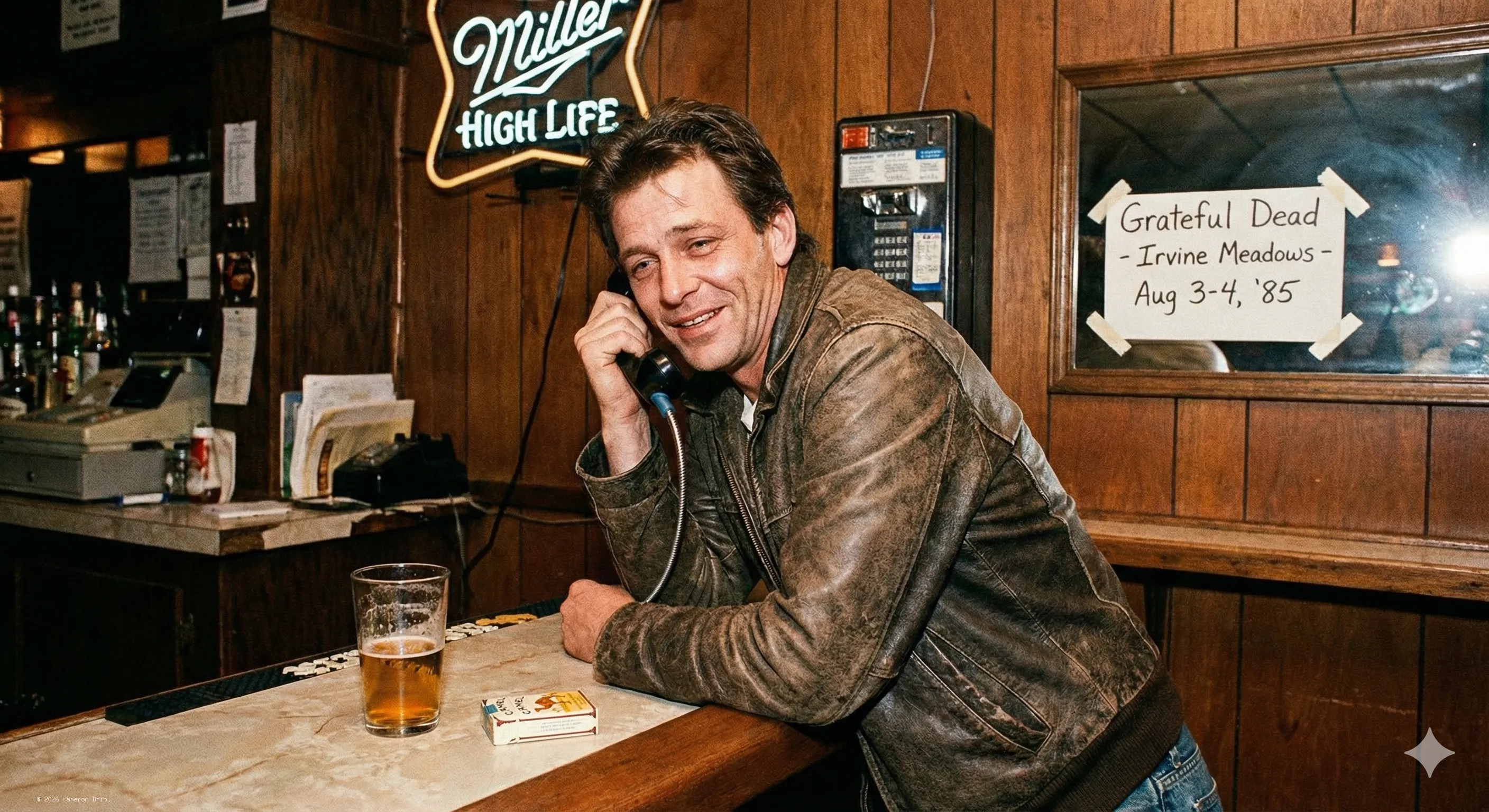
I felt uneasy, a low-level static humming in my nerves. I couldn’t process everything George had laid out. If anything, I was being forced to face my own denial. But even the weight of the city’s secrets seemed less important than my doubts about Venessa. I had spent so much time idolizing her—casting her as a Beatrice-like figure of purity—that I was suddenly terrified. I didn't know if I was worrying for my own sake, or if I was afraid to tell the real Beatrice that the woman I’d portrayed as a saint was actually a silent gear in a very dark machine. I couldn’t drive anymore, and I couldn't just walk it off. I needed a drink. For a second, I thought about catching a ride with one of the guys over to Triples on Lake Union, but I knew better. Triples wasn't the kind of place you went to sit alone with a heavy mind. Instead, I headed north to my favorite tavern in Northgate, a place where I was actually welcomed.
The first Miller draft hit the spot. I sat in that big, dim room with the old pool table in the center, and the smell of the rusty carpet felt incredibly pure. It felt real. Staring into the amber of the glass, I realized it wasn't Venessa I had been idolizing; it was the idea of her. Regardless of my doubts, she would still be that same woman on the other side of the glass, acknowledging me with those subtle gestures. I had accepted her as she was a long time ago. No newly discovered truth could break that seal now. If confronting her was supposed to give me a sense of control, I decided I didn’t want it.
My cousin was right: real control is found in acceptance—not in rebelling against a cause that is merely a reflection of the abyss looking back at you. The choice is always ours: whether or not to pollute our own minds.
Doubt is an invisible poison. We can choose to swallow it and let it take over our souls, or we can simply let it fall and fade away.Deep down, I knew the answer lay in coming to terms with my own vanity—the root of every bit of poison lurking in my mind.
"Hey, it's me... I think I’ve had one too many beers tonight. Can you come get me?" I was leaning against the bar’s counter, talking into the payphone.
"Rough night?" Beatrice asked. Even over the line, I could feel the warmth of her smile.
"Yeah," I said, a bashful smile of my own breaking through. "You could say that."
"Hang in there, it’ll be just a little while," she said. "I have to pick up Denise’s cat first—she’s leaving for Hawaii tomorrow."
"Don’t you want to know where I am?" I asked.
"No," Beatrice laughed. "I already know where you are. I can smell that carpet from here. Besides, this should cheer you up: my dad got us a couple of tickets for the Grateful Dead. They’re playing Irvine in a couple of weeks. We can stay at his place in Anaheim."
"No way," I said, the darkness of the evening finally beginning to lift.
"We’ll talk about it when I get there," Beatrice said.