Seattle in the 1980s had a specific kind of gray, but my childhood memory of our Somerset backyard is surprisingly bright. It smells of damp grass and the sweet, acidic scent of the fruit my cousin used to layer over her face while she tanned.
She was twenty years my senior, a towering, athletic presence who had followed the family lineage straight into the police force. When she stayed with us, she was a force of nature. She’d commandeer the TV and the best snacks from my older brothers with the casual authority of someone who knew exactly where the pressure points were. I felt safe when she was around—not just because she was a cop, but because she looked at me and saw an adult. She spoke to me with a devastating, unvarnished honesty, as if she were arming me for a war she knew was coming.
"After your fruit thing, right?" I’d ask, hovering over her as she lay in the shade. "All right," she’d groan, waving a hand dismissively from under a layer of cucumber slices. "I keep my promises."
The Invisible Window
The lessons usually started with Judo, but she was building something much larger than a set of throws. She built an "invisible window" for me. Through it, I could look at the Bruce Lee fever gripping the decade—the Karate, the Kung Fu, the Wing Chun—and see what was actually practical.
"It’s not his moves," she’d say, watching a screen with me. "It’s the way he does it. He fights beautifully."
She blended street-smarts with high philosophy. She wasn’t a beat cop, which perhaps gave her the luxury of perspective. She’d tell me George Orwell’s story of the elephant—the man who shot a calm, innocent animal because he was terrified of looking like a fool in front of a crowd.
"It doesn’t matter if it’s a dojo or a stage," she warned. "The crowd will push you into a script you never signed up for. They’ll cheer until you do something you can’t take back."
The "Sun Tzu Crew"
Her tactical advice was condensed into a single, dense ball: Don’t feel, don’t think, and most importantly, don’t try to win.
"Remember," she’d say, "you’ll always be outnumbered, and you’ll never have enough room to maneuver."
It took me years to realize she was describing the world, not just a back-alley scrap. I saw it later in history books—the Roman legions paralyzed in the German jungles because they didn't have the space for their rigid formations. I saw it in the "swarm move" of schoolyard bullies; they never showed up as a one-man show.
I began to see the "Sun Tzu Crew" everywhere—in advertising, in social circles, even at family dinners. People instinctively gang up, coordinate, and deceive to weaken a target before the fight even begins. I wasn't one of them. I was the one leaning against the wall, watching the "ribbon of glass" cut through the polished disguises of polite society.
The Apogee
The most "secret" move she ever taught me felt like a let-down at first. "The headbutt," she said. "The headbutt?" I was incredulous. "That’s the secret? What if the guy is way taller than me?" She didn’t blink. "Then climb him first."
That was the apogee of her curriculum: Adaptation. Years later, I was in a music shop with a friend who was looking at a classical guitar. He asked the salesman for the price. I remember mumbling under my breath: "It’s five hundred dollars if it stays on that wall, but it’s worth ten thousand if it’s in my hands."
It wasn’t about the guitar, and it wasn’t about the headbutt. It was about the execution. It was about the "Beautiful Fight" she had been preparing me for since I was ten years old.
I just didn't realize the most painful part of the lesson was yet to come.
The Green Lake Shift
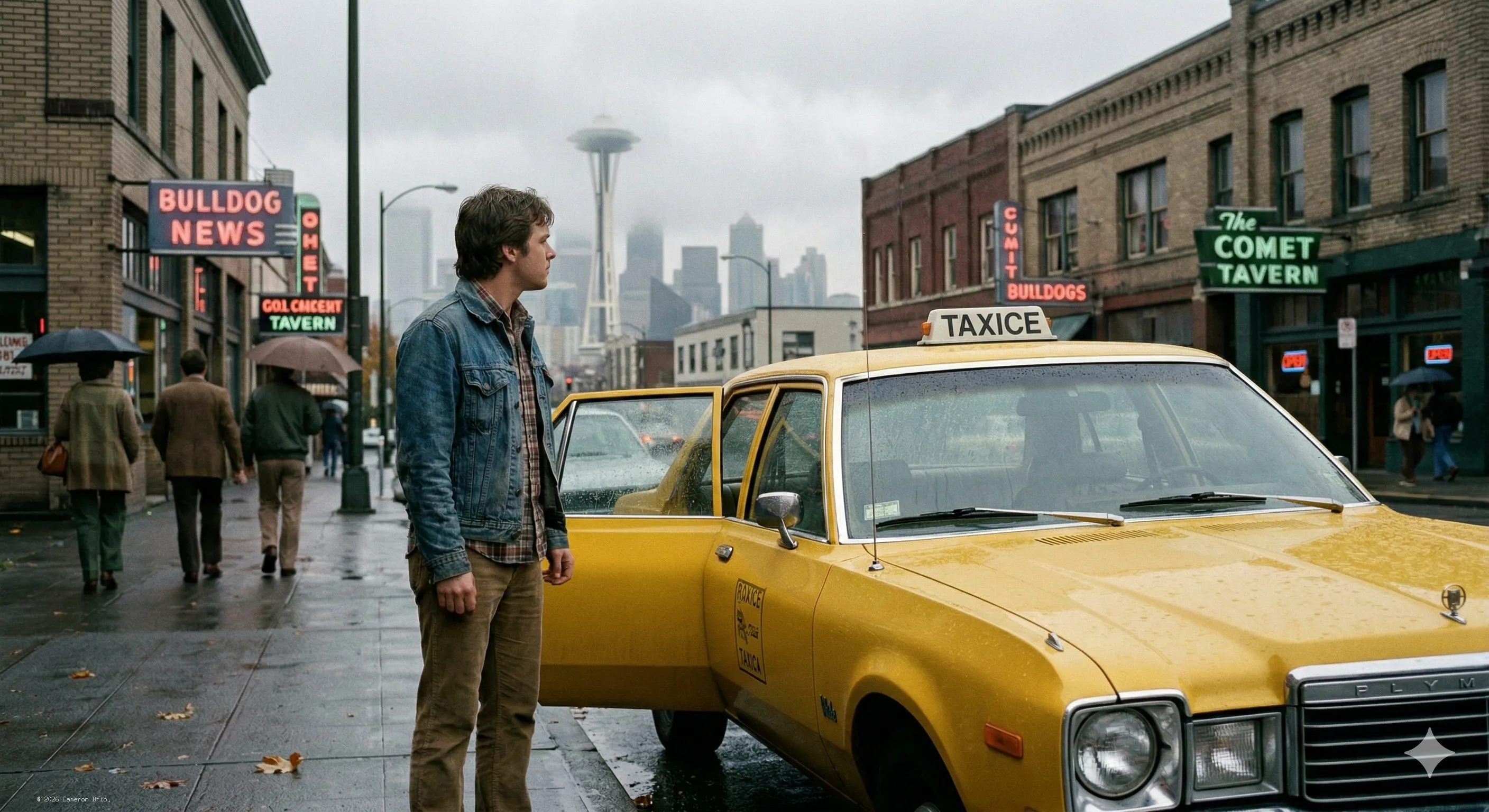
By the mid-80s, my world had begun to fold in on itself. I had dropped out of my third year of law at UW, trading a future in the courtroom for the graveyard shift in a taxi. I spent my nights driving into the "Boondocks"—the tribal casinos—watching the neon blur of Seattle through a cracked wind shield.
I still had my "college looks," a fading mask of potential that allowed me to blend into normal life. But inside, I was a character in a sitcom that wasn't funny. I felt like Elaine from Taxi—the gallery receptionist who thinks the cab is a temporary pit stop—but deep down, I knew I was becoming Alex Rieger. The lifer. The man who stops waiting for miracles.
I was searching for something—the El Duende, that dark, soulful spirit of art—but no amount of training could bring my cousin back. I jumped from Shoto Kan to Kan Zen Ryu to Wu Shu, a frantic, indiscriminate hunger for a truth I couldn't name.
Then came the rumor of the man at Green Lake. "He’s a student of Dan Inosanto," a friend told me. "He’s unassuming. Small place. But you should see his hands in close-combat. He maneuvers inches from the opponent."
The light came on. I have to see this guy.
I parked my cab two blocks away, the yellow paint looking garish against the damp pavement. My friend was waiting at the entrance of a cramped, repurposed space. The "dojo" was just a room with a strip of worn-out red tape on the floor separating the audience from the students.
I scanned the crowd. One man caught my eye—a guy with a desperate, hollow look. He didn’t need self-defense; he was looking for a reason to exist. I’ve seen it before: martial arts schools are often just a block away from AA halls. Both are places where people go to feel whole again, or at least to find a productive way to distract themselves from the slide down the rabbit hole.
The instructor stepped out. He was tall, with brown hair and a thick detective’s mustache. He looked like he’d spent time in a courthouse. He didn’t wear a uniform. He didn't even call it Wing Chun any more; he just called it "self-defense."
As he spoke to the crowd, I sensed the plateau. He was performing enthusiasm to pay the rent, but his eyes told a different story. He looked like a man who wanted to shed the very power he had spent a lifetime acquiring. He looked as if he would trade all that devastating skill for just one day of a truly "ordinary" life—one without the burden of knowing how fragile a human body really is.
The audience didn't see it. They just wanted to buy a piece of him for a modest fee.
"What would you do next?" he asked, responding to a challenging question from the crowd.
The audience began to perform. They talked about lateral movements, leg sweeps, high-low combinations. They were playing the script.
The instructor cut through it. "What if your opponent is six-foot-four? Well-built. Wearing a two-inch thick coat and heavy boots. He’s standing right in front of you. What do you do then?"
Silence fell. The shallow answers evaporated.
"You use your mind," a voice said.
It was the quiet guy—the one who looked lost.
The instructor pointed at him, a flicker of genuine admiration breaking through his professional mask. "That’s right. Without the mind, the technique is meaningless."
He looked at the man as if he’d finally found someone worth teaching. Then, as quickly as the connection had formed, he bowed out and retreated into his office, leaving us on the other side of the red tape.
I stood there in the silence, thinking of my cousin. Climb him first, she had said.
The "Sun Tzu Crew" was here, too. But for the first time in years, I wasn't just watching the glass cut; I was looking for the exit.
The Pine Street Intersection
I had always been good at finding the detour. In Enter the Dragon, Bruce Lee calls it "the art of fighting without fighting"—luring a bully into a row boat and letting him adrift. I had my own version of that, but the streets of Seattle in the 80s didn't always offer a row boat.
As a college drop-out behind the wheel of a yellow cab, I was a walking—or driving—bullseye. I looked like a "fine target": soft, educated, and trapped in a glass-and-steel box.
The trouble started with a scream. "What is your problem?" I still don't know what I did. Maybe I didn't yield fast enough; maybe I was occupying the lane he felt he owned. It didn’t matter. In his mind, the script had already been written, and I was the villain.
We hit the red light at 5th and Pine. It was a gorgeous Seattle summer midday—the kind of rare, golden afternoon where the Emerald City actually sparkles. I wanted to be anywhere else, lost in the sunlight, but the guy wouldn't have it.
He bolted from his car, a blur of misplaced rage charging toward my window.
Everything went into slow motion—the "condensed ball" my cousin spoke about. He threw a clumsy hand into the cab—a "punch," I suppose—as I frantically cranked the window up. When he couldn't hit me, he tried to snatch my ski sunglasses off my face. Failing that, he retreated to the rear of the cab and delivered a hollow, metallic kick to my bumper.
"Come out and fight like a man!" he roared.
I sat there, my heart thudding against my ribs, watching the light. I felt the surge of my training, the instinct to "climb him," to use the mind, to execute the headbutt. But I chose not to "fight like a man." I chose to survive the shift.
The light changed—green or red, I didn't care—and I pinned the accelerator.
I spotted a cruiser across the street and hammered on the horn, a rhythmic, desperate SOS. I pulled into a parking lot near Westlake Mall, and the police officer, a tall, young kid who looked like he’d just stepped out of the academy, drifted over.
He didn't need an explanation. He just stood there, a silent, blue sentinel that signaled to the guy behind me that the "stage" was now closed.
We shared a look, the officer and I. We both knew the ritual. We knew that the paperwork, the court dates, and the lost hours of wages weren't worth the satisfaction of a report. As long as there was no blood, it was just another "distraction" in a city that was losing its shine.
As the officer turned to head back to his cruiser, he paused, leaning slightly toward my window. "You know," he said, his voice flat and honest, "your job is more dangerous than mine."
I watched him walk away. My cousin’s words echoed in the quiet of the cab: You’ll always be outnumbered, and you don’t have much room to maneuver. I realized then that the "Sun Tzu Crew" wasn't just in the dojos or the boardrooms. They were at the red lights, waiting for you to roll down the window.
The North Gate Trap
I kept my training a secret from most of my friends. I had seen the "rabbit hole," and I was fighting like hell not to fall into it. Once you cross that line, you start seeing everyone else as "civilians." You start seeing exits instead of architecture. You start seeing targets instead of people.
I was desperate for a normal life—a wish that most people took for granted. I had a plan: join the Army, serve my time, and come back with an honorable discharge. I’d tell the law school dean some line about "finding myself," and get back to the 3rd year I’d abandoned. My friend James was already ahead of me. He told me stories of soldiers in bar fights—men who didn't care about the boxing ring, men who just kept getting up, unafraid and unthinking, until the MPs arrived.
I knew I was halfway to that mindset. I understood that terrifying power of being beaten down and still rising. But deep down, I didn’t want it. Not any more.
The problem was my friends. They used me as a centerpiece, a way to show off to the "civilians." I was a willing participant, though I couldn't admit the truth to myself: I was their clown. When I was invited to a pool party at an apartment complex in North Gate—a rarity in Seattle—I craved a real invitation. I wanted to be invited because I was me, not because of what I could do. But then the line came, the one I’d been dreading:
"Hey, don't forget to bring those new nunchucks."
They weren’t even practical. They were long, beautifully polished wood I’d ordered from a mail-order catalog. They were a wall decoration, a prop for a movie that wasn't being filmed. But I took them anyway. I packed the prop, and I headed to the stage.
The moment I stepped into the backyard, a cold sense of uneasiness washed over me. The "Sun Tzu Crew" was already there.
I saw Dax and Faye.
Faye was the match, and Dax was the gasoline. Every time they were around—at a movie line, a restaurant, a bar—the routine was the same. Faye would be provocative, Dax would play the offended protector, and I was the one who had to step in and perform a version of "fighting without fighting" to keep the peace.
But I couldn't leave. Because Mabella was there.
Mabella was the most beautiful girl I’d ever met. She worked at the Bon Marché, a friend of a friend, and I’d been playing the guitar for months just to stay in her orbit. I wasn't going to pass up the chance to be near her, even if it meant stepping onto a stage I knew was rigged.
What could go wrong today? I told myself, looking at the blue water of the pool and the shimmering Seattle sun. Everyone knows everyone. I won't step into the trap.
I didn't realize that by bringing the nunchucks, I had already handed them the script.
The Luminous Shift
I kept my face neutral, playing the role. I saw Faye in her denim skirt, perched on the arm of Dax’s chair like a flag planted on a hill. I expected Dax to offer some word of thanks—a repayment for the night I’d stepped in to save him outside the Varsity Theatre—but he just gave me a shallow nod and a smile.
I didn't have time to dwell on it. A gentle pull on my arm turned me around, followed by the soft weight of a half-hug.
It was Mabella. She had been waiting for me.
In a flash, the world transformed. The North Gate apartment complex, the pool, the nagging anxiety of the "Sun Tzu Crew"—it all dissolved. I was finally living the dream I’d been chasing through the rainy graveyard shifts in the cab. The sun rays were tangled in Mabella’s brunette hair, creating a flicker of light that held me mesmerized. I couldn't smell the chlorine or the charcoal grills any more; I could only smell her.
She wasn't just a girl; she was the star I was traveling on. I felt weightless, shifted into a parallel universe where the mask was gone and, for once, the Phantom got the girl.
"So, you like Deep Purple?" she asked, a playful, deep smile dancing on her lips. "Let me guess... your favorite is 'Smoke on the Water'?"
"I’ve done a variation of it on the guitar," I replied, my voice steady despite the pounding in my chest. "It even has a tremolo section."
Mabella leaned closer, her presence a warm orbit. "Oh," she whispered, "that sounds luminous."
Luminous. The word hung in the air like the very light in her hair.
At that moment, I felt a power I had never found in a dojo or a law book. I realized that my cousin was right—the subject didn't matter; it was the way she said it. The meaning was in the delivery, the connection, the shared breath. I was crying inside, a silent sob of relief and eternal happiness. I was standing on the corner of a life I finally wanted to keep.
I didn't want this to end. I wanted to freeze the frame, to live in the "luminous" tremolo of that conversation forever.
But the "Sun Tzu Crew" was still there, and the nunchucks were still leaning against the wall—a polished, wooden prop waiting for the next act.
The Ghost Party
I finally descended from heaven and touched back down at the party. I think everyone could read it on my face—that dazed, luminous glow of a man who had finally found his exit. The odds of this working out were seventy-thirty at best, but I didn't care. I only needed a few people to be happy for me.
"Can I get you another beer?"
It was Hillary. She wore a conspiratorial smile, glancing at Mabella with the quiet pride of a matchmaker who had just hit the jackpot. She didn’t wait for an answer; she returned moments later with a Miller and a margarita. I realized then that they had planned this—the introduction, the timing, the "luminous" moment. The realization only made me happier.
I caught sight of my nunchaku. They were dangling from a pool chair, no longer a "prized possession" but something discarded, like a car lent to a friend who had wrecked it. I quickly shook off the feeling. They were just two pieces of polished wood. They didn't matter any more. Nothing mattered but the girl.
I noticed Dax and Faye—the North Gate "Bonnie and Clyde"—were gone. I joked to myself that maybe someone had finally asked Faye to change into something less provocative. For a few minutes, the air felt clear. I felt a rare, genuine ease.
And then the script caught up with us.
Dax exploded through the large sliding glass door facing the pool. He rushed toward me with such velocity that my training began to hum in my veins, my weight shifting instinctively. But I wasn't the target.
He didn't say a word. He snatched the nunchaku from the chair and dashed back out even faster than he’d come in.
He didn't have to spell it out. I didn't even want to look around the pool, but I could feel the atmosphere curdling. Mabella’s hand clamped onto mine, holding tight, as if she could anchor me to the "parallel universe" we’d just built.
The pool party had instantly become a "ghost party." The music—a track from The Cure, Hillary’s favorite—kept playing, but the life had been sucked out of the yard. I scanned the faces of the people I didn't know; they were watching me, waiting for the "clown" to perform.
I felt my cousin’s voice then. A cold, clear command in the back of my mind: Don't go.
I forced my muscles to unlock. I relaxed my posture, refusing the role they wanted me to play. I saw the relief wash over Mabella’s face, a soft exhaled breath. For a second, I thought I had won the "Beautiful Fight" by doing nothing at all.
Then we heard it.
The sharp, crystalline explosion of glass breaking in the upper parking lot.
I looked at Mabella. I didn't want to let go of her hand. I didn't want to leave the light. But the "Sun Tzu Crew" had moved the stage to the pavement, and the silence of the ghosts was too heavy to ignore.
I stood up.
The Elephant in the Garden
By the time I reached the upper parking lot, the "parallel universe" of the pool was gone. The stage was set. Dax stood there, the nunchaku resting on his shoulder like a cheap movie prop, mumbling to himself as he paced. From a second-story window, a man was screaming—a jagged stream of English and Tagalog that felt like an operatic menace.
This is the last time, I told myself.
Everything slowed. I felt the same cold rush I’d felt in the Boondocks, that strange clarity before a storm. I formed a plan: pass Dax, get Mabella, and leave. I thought of Jack Nicholson in Five Easy Pieces—just walking away from the car, the girl, and the life, hitching a ride into a new self.
But I hesitated. And in that second of hesitation, the "Comedy of Errors" began.
An iron—a heavy, household steam iron—pounded into the pavement inches from my foot. The sound was like a dim explosion. My mind stalled. I had no frame of reference for a domestic appliance being used as a mortar shell. Looking at the sharp, heavy edge of the iron, I realized this wasn't a "manly" fight. This was a hunt.
I made the final mistake: I stepped inside the building. It was a subconscious urge to punish myself, to see the script through to the end.
Two steps in, the hallway erupted. A roar of voices, a crowd of men—the "Sun Tzu Crew" in its purest form. They didn't come at me one by one like in the movies; they hit me like a tide.
I felt pressure more than blows. I couldn't maneuver. I was pinned between the wall and a mountain of bodies. The punches weren't powerful, but they were a barrage, a thousand tiny cuts. I couldn't raise my arms. I couldn't retreat. I was pushing forward with my face, my training keeping me upright when a "civilian" would have collapsed. I wanted to drop, to find room to move, but I was frozen in the crush.
This was the "swarm move" my cousin had warned me about. They surrounded me like hyenas.
I felt the "ribbon of glass" falling before it even happened. In a panic-frenzy, I tried to find an opening. I pivoted, my body instinctively reaching for a Yoko Geri—a side kick that could break ribs and lines. But the pressure was too much.
They dragged me down toward a thick bottom window. I threw myself through it just to escape the crush. I didn't feel the pain, only the weight. But as I went through, a jagged shard of thick glass remained in the frame. It stayed, and it waited.
It cut my right arm with surgical precision.
I tumbled into the parking lot, back into the light. My arm hung loosely, a mangled mess of fabric and gushing red. I stood up—still standing!—and leaned against a parked car. My eyes were swollen shut, the world a dim, bloody smudge. I secured my dangling arm with my left hand, a conscious shell of the man who had been "luminous" ten minutes before.
One of them followed me out. "You want to help your friend?" he mocked.
My body coiled for one last Yoko Geri. I wanted to redeem myself. I didn't feel rage; I wanted to surgically break him, to prove the training meant something.
But I froze. My body was used to "beautiful" kicks, and there was no beauty left here.
I didn't deliver the blow. Instead, I began to drift. I spotted Mabella and Hillary at the edge of the lot, frozen like statues in a museum. They were shaking, watching the "clown" bleed out on the pavement. Dax was nowhere to be found.
I walked to the center of the lot, away from them, away from the ghosts. My knees touched the ground as if I were about to deliver a divine message, but I had nothing to say. I felt like the elephant from Orwell’s story—the innocent beast that finally lies down for the last time because the crowd demanded a show.
Time split. I was drifting into the gray when a car pulled in. It wasn't Mabella or my friends who moved. They were still paralyzed by the script.
It was a stranger. A short, stocky man with a thick mustache and long black hair. A man coming home from work.
He stopped his car. He didn't ask for a story. He just pulled gauze from a first-aid kit, wrapped my arm, and helped me into the front seat. As the North Gate Medical Center blurred into view, I tried to speak. I wanted to apologize for the blood on his upholstery. I wanted to tell my cousin I was sorry for letting her down.
But my lips wouldn't move. The elephant had finally laid down.
The Weight of the Ribbon
The North Gate Medical Center didn’t have the "luminous" light of the pool. It had the sterile, flickering fluorescence of a reality that could no longer be ignored.
As the doctors worked on my arm—stitching the "decoration" back together—the adrenaline finally ebbed, leaving behind a cold, hollow clarity. I looked at my hands. They were the hands of a cab driver, a law school dropout, and a failed martial artist. But they were also the hands that a stranger had held to keep me from drifting away.
For days, I replayed the hallway. I felt the shame of the "clown" and the guilt of the "elephant." I thought I had let my cousin down because I didn't "climb the giant" or deliver the perfect Yoko Geri. I thought the "Sun Tzu Crew" had won because they had broken the glass and my body.
But as the scars began to knit, I realized the twist.
My cousin’s teaching—“don’t feel, don’t think, and most importantly, don’t try to win”—wasn't just about the mechanics of a fight. It was a manual for the life that comes after the fight.
I had survived because I hadn't tried to "win" a battle that was already lost. If I had stayed in that hallway trying to be a hero, I would have died there. My "panic frenzy" wasn't a failure of technique; it was the ultimate act of adaptation. I had used the pressure of the "hyenas" to propel myself through the glass—the only exit available.
I learned something my cousin couldn't teach me in the shade of the Somerset backyard: There is no shame in the break. The "Beautiful Fight" isn't about the perfect move. It’s about the fact that even when the glass ribbon cuts you, even when you are outnumbered and outmaneuvered, you are still responsible for the man you become when the blood stops gushing.
A few weeks later, I saw my reflection in the yellow cab’s rearview mirror. The swelling had gone down, but my nose sat slightly differently now—a permanent reminder of the North Gate stage.
I didn't look like a lawyer or a "college boy" any more. I looked like someone who had seen the "Art of Fighting without Fighting" fail and had found something more durable underneath: Resilience.
I thought of the stranger with the thick mustache. He wasn't a martial artist. He wasn't a philosopher. He was just a man who saw a dying elephant and decided to help it stand up. That was the "luminous" truth I had been searching for. It wasn't in the nunchaku or the Bruce Lee films. It was in the gauze, the first-aid kit, and the silent ride to the hospital.
I reached for the gear shift with my scarred arm. It was stiff, and it hurt, but it moved.
I realized I didn't need the Army to give me an "honorable discharge" from my own life. I didn't need to be a "Phantom" or a "Clown." I just needed to drive.
The twists and turns had been painful—unbearably so—but they had stripped away the "script." I was no longer waiting for a miracle. I was the miracle. I was the one who got back up.
As I pulled out into the Seattle rain, I didn't feel outnumbered. For the first time, I had all the room I needed to maneuver.
The Duality of the Glass
After the hospital, the world felt different—sharper, colder, but somehow better. The shift manifested in the small things. I developed an obsessive urge to keep my apartment spotless, as if by scrubbing the baseboards I could scour away the memory of the hallway.
"Your bathroom is so clean," Mabella said once, her voice echoing in the tile. It was the highest praise I could imagine. It meant the grime of the North Gate parking lot hadn't followed me home.
It had been months. I didn't feel the heat of revenge, but I felt the pull of the unfinished script. I found myself at the apartment’s management office, facing a curvy, middle-aged woman behind a vintage wooden desk. She sat with an elegant, knowing stillness. Before I even spoke, I could tell she knew exactly who I was, despite my face having knitted back together.
"Here it is," she said. She didn't wait for me to ask. She simply wrote down the names of the two "hyenas" who had leased the unit. She offered a long, sympathetic smile—a silent acknowledgement that the rules of the office didn't apply to a man who had gone through the glass.
"But they've already moved out," she added. "No forwarding address, I suppose," I said.
I didn't need the address. I didn't want a courtroom or a lawyer. I knew how the "Sun Tzu Crew" worked. In a mob, the guilt is diluted, split among the pack until everyone gets probation and no one gets the blame. Taking them to court would just be another stage where I didn't sign the script.
I couldn't shake the duality. I wanted to move on, but the world wouldn't let me. I couldn't watch a fight on TV anymore; the choreographed punches looked too real, triggering the memory of the pressure on my skull and the weight of my dangling nose. I was chronically reminded of how fragile we are.I was waiting for a "Boondocks rush"—a moment to balance the scales. I told myself I’d never seek it out, but I felt like the city was watching me, waiting to offer a trade.
It happened on my way back to the cab lot after a grueling night shift. The light was red near Westlake.
The Badger and the Honeycomb
A dark, classic BMW sat idling at the intersection. As I rolled closer, the scene turned grotesque. A rough, scruffy man in a green army jacket was halfway through the car’s sunroof. He was burrowing inside like a badger into a honeycomb.
Inside the car, a woman was struggling. She was a study in desperate harmony—one hand on the wheel, one on the stick-shift, her arms crossed defensively over her chest. It was a pleasant, empty night. There were no witnesses. No "Sun Tzu Crew." Just me, the badger, and the girl.
My heart hammered. This was it. The window of opportunity. An ethical cause with a Good Samaritan twist. I had the room to maneuver. I could be the hero this time. I could get the "thank you" I never got at North Gate. I could redeem the elephant.
I pulled the cab alongside the BMW. I shifted into neutral, my foot heavy on the brake. I slammed the accelerator, letting the engine let out a guttural, predatory roar that echoed off the empty buildings.
"Hey man—cool it!" I shouted. My voice was a command, vibrating with the authority of the police cousin I’d lost.
The man froze. He hadn't expected another soul to be in the city. He jolted, scrambling out of the sunroof like a panicked animal. He didn't look at me. He didn't fight. He just drifted onto the sidewalk, mumbling into his beard as he faded into the shadows of the skyscrapers.
The light turned green. The woman didn't wave. She didn't look back. She just bolted, her tires chirping as she vanished into the Seattle mist.
For a split second, I was excited. I had a "cab story" to tell. I had won the "Beautiful Fight" without throwing a single punch.
But as I sat at the green light, the excitement evaporated. It was replaced by a dark, oily feeling in my gut. The encounter hadn't been luminous; it had been horrible. It was just more glass, more pressure, more reminders of the badger-men waiting at red lights.
I didn't want a "thank you" date. I didn't want to be an angel. I just wanted the night to end. I put the cab in gear and drove, leaving the intersection behind, wishing I could be as clean as my bathroom floor.
The Third Base of Chandrapore
The duality was no longer a theory; it was my skin. I was still behind the fence, watching a border I refused to cross. I still had my "good looks," the lingering glow of a law student who hadn't quite been broken by the pavement. I was still telling myself—and anyone who would listen—that I was going back to school. I was "enjoying the streets," I said. But the streets were starting to look like the only place that told the truth.
The gap between me and my college friends was widening into a canyon. I was drifting, and they could feel the current. They didn't trust my world of graveyard shifts and badger-men, yet they still invited me out—always to "public" places.
I realized then that they were setting a new kind of stage for the clown. They wanted the "deep" guy, the "martial artist" guy, the "detective" guy. I was trying to scrape the makeup off my face, but they kept handing me the script.
We sat in a dimly lit bar after seeing A Passage to India. Hillary was there, stirring her Kahlua and coffee with a thin straw, the clink of ice against glass the only rhythm in our conversation. They were complaining about the length of the film, the pacing, the confusion. They couldn't wrap their heads around the characters—Dr. Aziz and Adela Quested.
"They had already gone to third base," I said, my voice sounding older than the rest of theirs. "But they had to put on the act. They had to fool a courtroom full of people and the mob screaming outside."
"How did you deduce all that?" Hillary asked, her eyes searching mine for the punchline.
"It’s in the letter Aziz sends her at the end," I replied. "If Adela hadn’t withdrawn the charge, the men like Aziz would think they had a real chance with a woman like her. And that? That would have sent the magistrate, Ronny, into a tailspin. It would have collapsed their entire disenchanted view of colonialism. The lie was the only thing holding the system together."
A silence fell over the table.
"Wah... that’s too deep," someone muttered. "Why did they make the movie so long?" another added, checking their watch.
I looked at them—my friends, the "civilians"—and I saw the same people who stood frozen at the North Gate pool. They didn't want the truth about the courtroom or the mob; they wanted a shorter movie and a lighter drink.
I was talking about the collapse of an empire, and they were talking about the runtime. I realized then that I wasn't just a law school dropout. I was Dr. Aziz in the cave, and there was no Adela Quested coming to withdraw the charges against my life.
I took a sip of my drink and looked toward the door. The street was out there, dark and honest, waiting for me to get back behind the wheel.
The Invisible Mirror
In the cab world, things were worse. My presence was a philosophical threat to the lifers—the men who had accepted that the road ended at the edge of the lot. They looked at me and saw a detour they hadn't taken, and they resented me for it.
Yet, I was a magnet for "personal calls." The dispatchers would crackle over the radio, asking specifically for my unit. Waitresses, pole dancers, and the weary night-shifters of the city would wait twenty minutes longer just to see my Chevy Impala pull up. They didn't want a shortcut; they wanted the safety of a clean car and a driver who didn't pry.
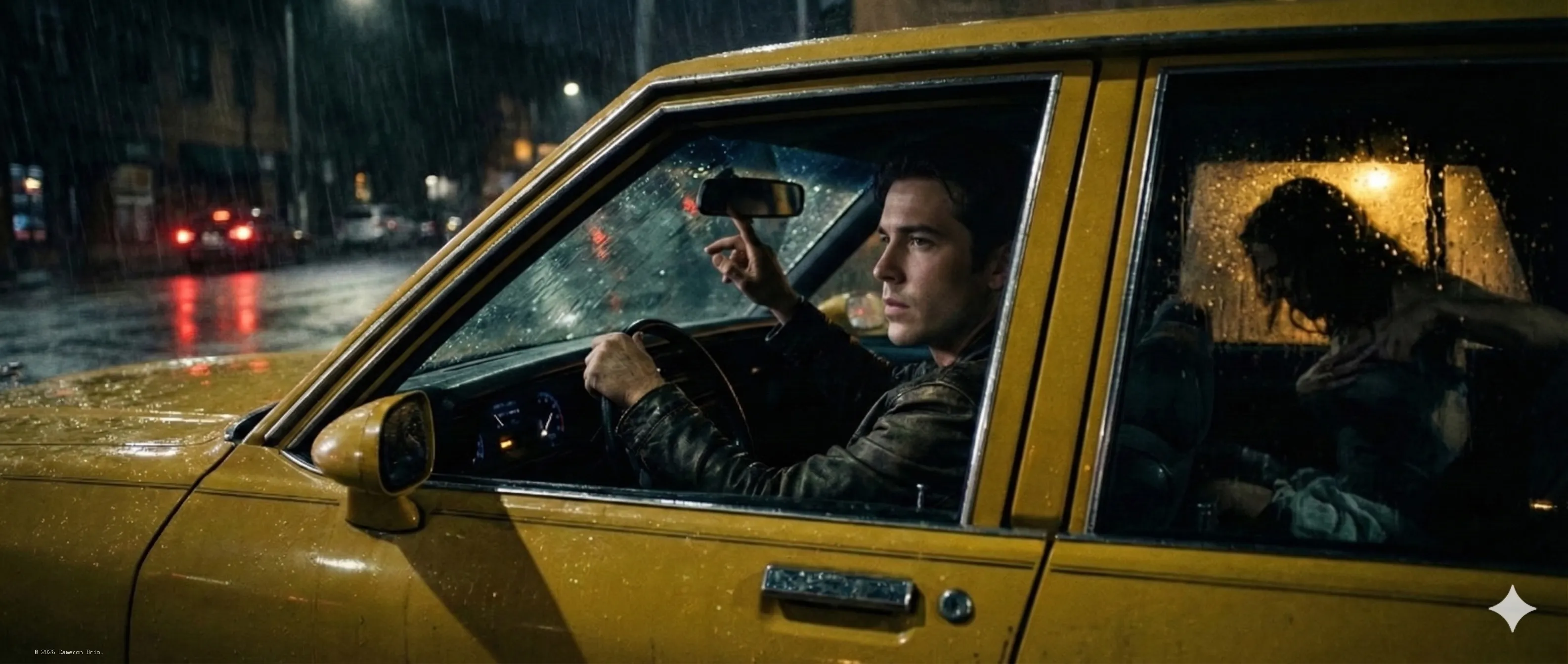
I became a master of the invisible boundary. When Vanessa, an alluring blonde receptionist, would scramble into the backseat late for a party, she’d change her clothes right there behind my neck. "You don't have to look away," she’d say, half-joking as she moved in the dark. I wouldn't look. Instead, I’d reach up and dim the rearview mirror light—a silent signal that her privacy was a vacuum I wouldn't fill. They loved that. They loved being seen by someone who chose not to look.
The lot was a sponge, soaking up the "razzmatazz" of the strip clubs and the high-society whispers of the Washington Athletic Club. George Burns was right: the people who knew how to run the country were all driving taxis or cutting hair. We were invisible observers, privy to stock tips and illicit business deals, possessing a massive, useless knowledge of the city’s sins.
I hated myself for knowing both sides. I hated that I could pass for a politician with a splash of Clive Christian cologne, yet I spent my afternoons in a fleet of idling Impalas and Buick Skylarks.
I tried to avoid the 4:00 PM rush at the lot. I’d show up late to miss the swarm of angry men anxious for the first fat fare of the evening. The lot usually had an unwritten order—a code of conduct for men struggling with their own dualities. But that code was starting to fray.
The shift began with Mack. Mack was a friend, a driver who had finally cracked. He went up to the dispatch room, screaming about the radio tactics—the shrewd way the dispatchers handed the best fares to their favorites.
The response wasn't a scuffle; it was an execution.
The dispatcher, representing his own brand of the "Sun Tzu Crew," waited until the lot was quiet. No witnesses. No room to maneuver. He beat Mack with a calculated ferocity that went beyond the usual lot beefs.
Mack didn't press criminal charges. He knew the game. The dispatcher’s girlfriend already had him in and out of jail every few months; another assault charge would be just another Tuesday. Instead, Mack organized a folder of photos—clinical, gruesome evidence of his injuries—and sued the cab company. He claimed they were responsible for his safety.
Looking at those pictures, I felt the old pressure on my skull returning. The "traditional veil" of the lot had been pierced. The safety I thought I’d found in my clean cab and my dimmed mirrors was an illusion. The badger-men weren't just at the red lights anymore; they were in the dispatch room, holding the microphone.
I was becoming apprehensive. The duality wasn't just in me—it was in the very pavement under my tires.
The Requiem and the Ticket
Malcolm X’s biography sat on my coffee table, a hipster badge Mabella had brought over but never finished. I was flipping through it while Cat on a Hot Tin Roof played for the third time on the TV. I stopped at a line that chilled me: Right before his final speech, Malcolm turned to an assistant and said, "Maybe I shouldn't go out there tonight."
I knew that feeling. It was a physical weight in the gut, a tangible Déjà Vu that warned me whenever a badger-man was about to cross my path. But like Malcolm, I usually did the opposite.
I didn't even want to drive that day. I was only out there because my friend, a washed-up pro boxer with dentures on his left side, needed me to cover his "nut." He was a man who had taken one too many hyena-style barrages because a coach wouldn't throw the towel. To keep my bridges polished and shiny, I told him yes.
I had a plan: pick up the car early, do a quick rush-hour run, take Mabella to her study session in Bellevue, and end the night with a cuddle on my spotless couch. It was a script for a "normal" life. But the cab lot had a script of its own.
The lot was a disaster. My boxer friend hadn't parked the cab outside; it was stuck in the safety-check line. As I turned the corner, the agitation began. A stocky, wounded wolf of a man was behind me, fuming.
I tried to play the "Eagle Act." When an eagle is harassed by crows, it doesn't use its claws; it simply flies so high the crows can't follow. I pulled out of the line, parked in a tight spot, and casually started talking to my friend Mack about tickets for the Muhammad Ali exhibition match. I was being "wise." I was being superior.
The crow didn't care about my height. He charged.
He jumped me, and for a second, I was back in the hallway. My knees shook. The terror was a cold vacuum in my chest. But this wasn't a swarm; it was a one-man crew.
My training took the wheel. On auto-pilot, I executed a snappy, inward Ashi Braai—a sweep that turned his own weight against him. He went down in a tumble. He scrambled up like a frog, agile and desperate, and charged again. This time, he pinned me against Mack’s truck.
We were frozen. He was a wrestler, four times my strength, trying to grind me into the metal. I opened my stance, bracing against the truck, the adrenaline turning technical. And then, the moment shifted.
In the middle of the struggle, he looked up. In his eyes, I saw a thousand apologies. He didn't want to be there. I didn't want to be there. But the crowd—the dispatchers in the window, the other drivers—were watching. We were two clowns in a "Requiem for a Heavyweight," paid to put on a performance of rage we didn't feel.
He held his head up, offering me the target. He was ready to take the fall just to end the show.
I snapped the headbutt. It was a surgical, recoiling torque—an elaborate jab of bone on bone. It made a tearing sound for the witnesses, but I pulled the power back at the last millisecond. He acted like it hurt. We both let go at the same time.
The "Beautiful Fight" wasn't the sweep or the strike. It was the fact that we choreographed a truce in the middle of a war.
The police arrived—a K9 unit and a smiling middle-aged cop who didn't even talk to us. He talked to the superintendent while I composed myself. I had learned how to lead a lost soul without being cruel. I felt like a leader, even if the "theatre" was just a greasy cab lot.
I drove to Bellevue, picked up Mabella, and later found myself back at my favorite spot: 4th and Spring. I was slouching in the seat, watching the world through the side-view mirror, waiting for Vanessa. I was in a trance, drifting between the rammatazz and the law school dream.
"Do you like Muhammad Ali?"
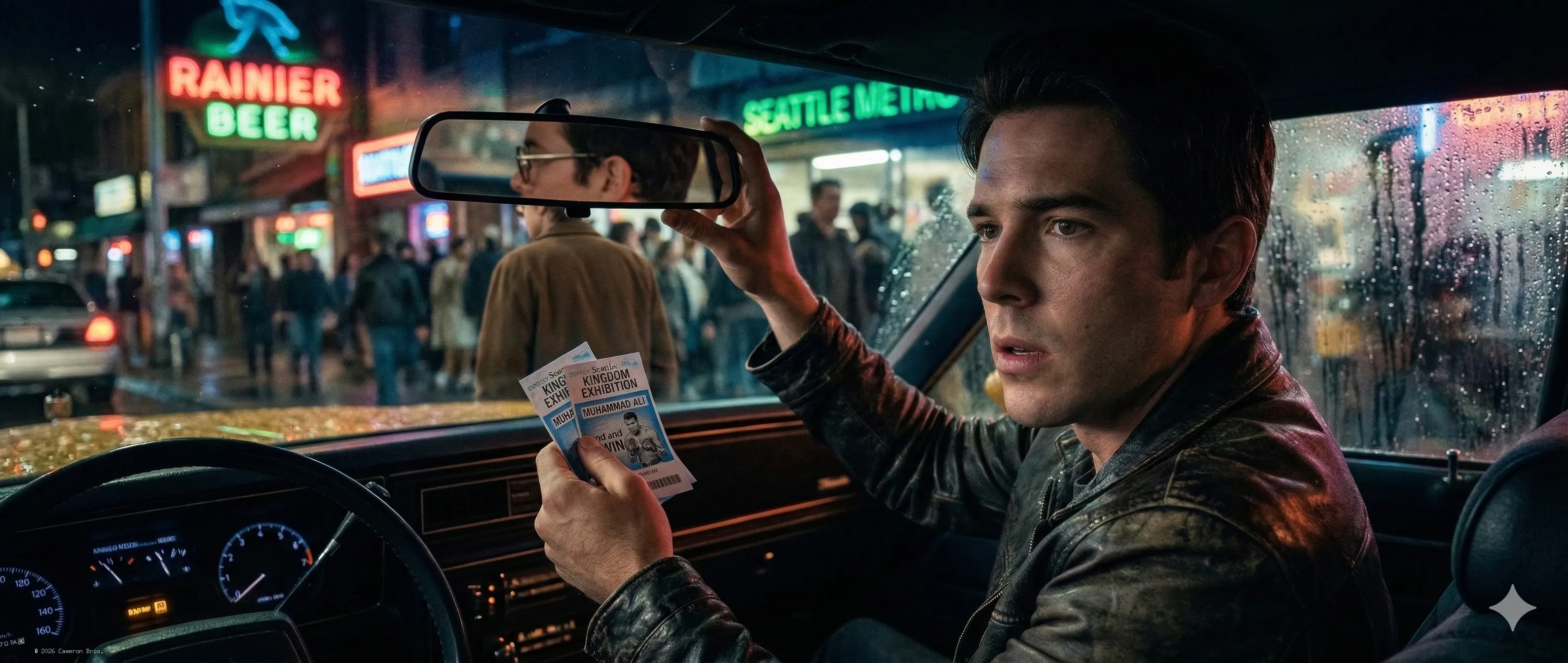
I blinked. A short, unassuming man with thin-framed glasses was standing by my window. Before I could answer, he reached in and handed me two thick strips of blue and white paper.
"Here are two tickets," he said softly. "Enjoy."
He touched my hand—a gentle, human contact that felt like the stranger’s gauze from the North Gate parking lot. Then he disappeared into the 4th Avenue crowd.
I looked at the tickets. They were real. I wasn't just a clown or an elephant anymore. I was a man sitting in a clean cab, holding a miracle in his hand.