Cameron Brio

The Weightless Wall

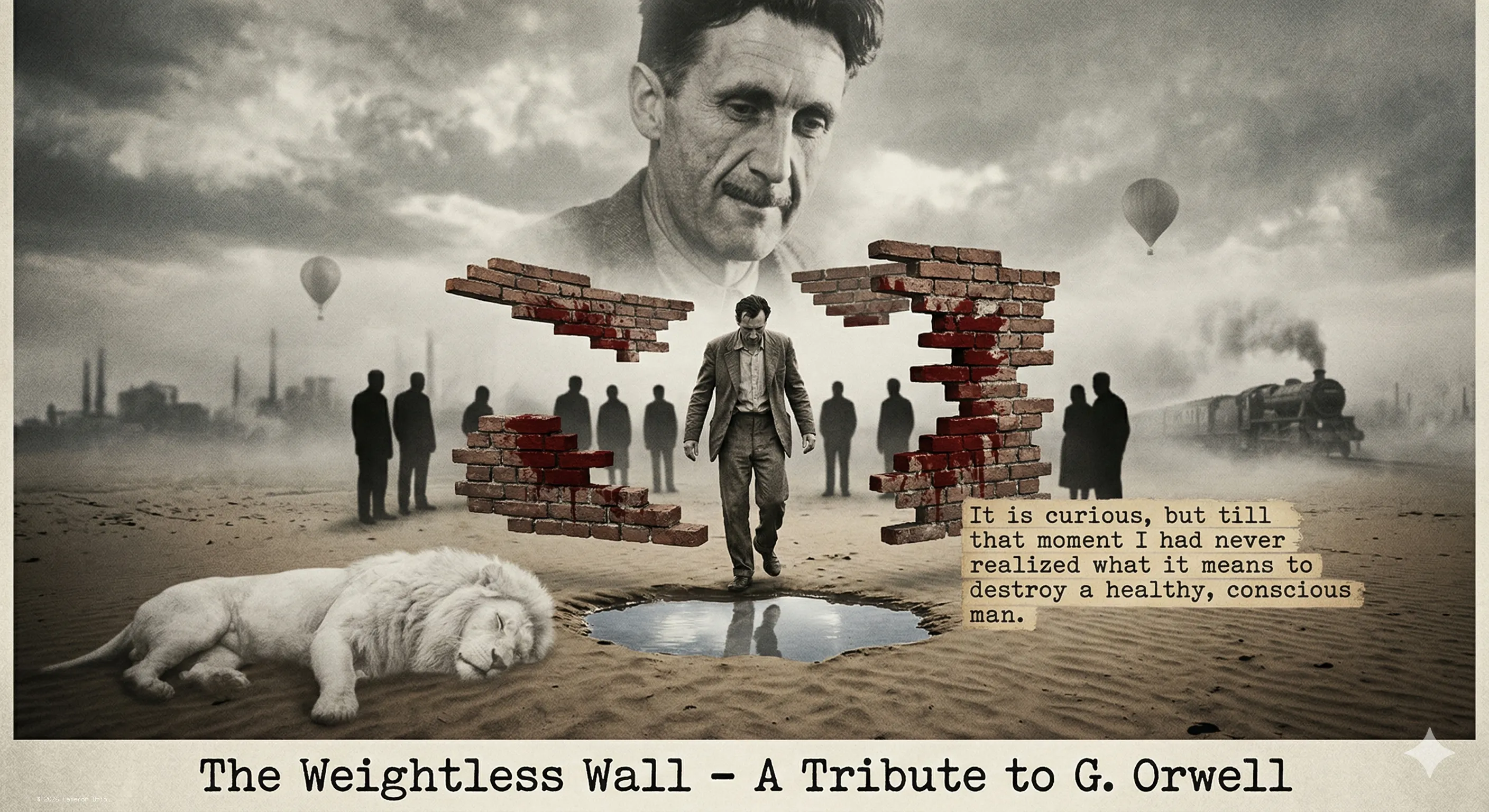
The Weightless Wall is a surrealist reimagining of the psychological landscape found in George Orwell’s seminal essay, A Hanging. While Orwell used stark, realist prose to document the "unspeakable wrongness" of an execution in colonial Burma, this poem translates those themes into a dreamscape of symbols. The "train" represents the relentless, mechanical march of the state toward a predetermined end—a journey that is "windowless" and populated by "men without faces" who have traded their humanity for duty. The central motif of the "weightless wall" captures the fragility of the boundary between life and death; it is a barrier written in blood, yet it exists only in the "splinter" of the observer’s mind. This poem seeks to honor Orwell’s observation of the "mystery of life" by focusing on the hollowed-out world left behind when that life is extinguished.

"It is curious, but till that moment I had never realized what it means to destroy a healthy, conscious man. When I saw the prisoner step aside to avoid the puddle, I saw the mystery, the unspeakable wrongness, of cutting a life short when it is in full tide."
— GEORGE ORWELL, A HANGING (1931)
The Weightless Wall
A prism of light lost of its luster
floating aimlessly in a train
windowless and full of men without faces
moving fast with all its roar
left behind in the cracks
of walls hidden in a splinter in my mind
A blurry gesture by a man with
a pocket watch and his head on his chest
froze the time beneath my dangling feet
bound to a one sided truth written with blood
running down the bricks on a weightless wall
behind a circle of faceless men
A man in the balloon is casting
my fears on a world marooned in doubt
The white shadow of a beast half sleep
with its claws deep in the sand is watching
a lifeless man who let the train go by
By Cameron Brio - March 2026